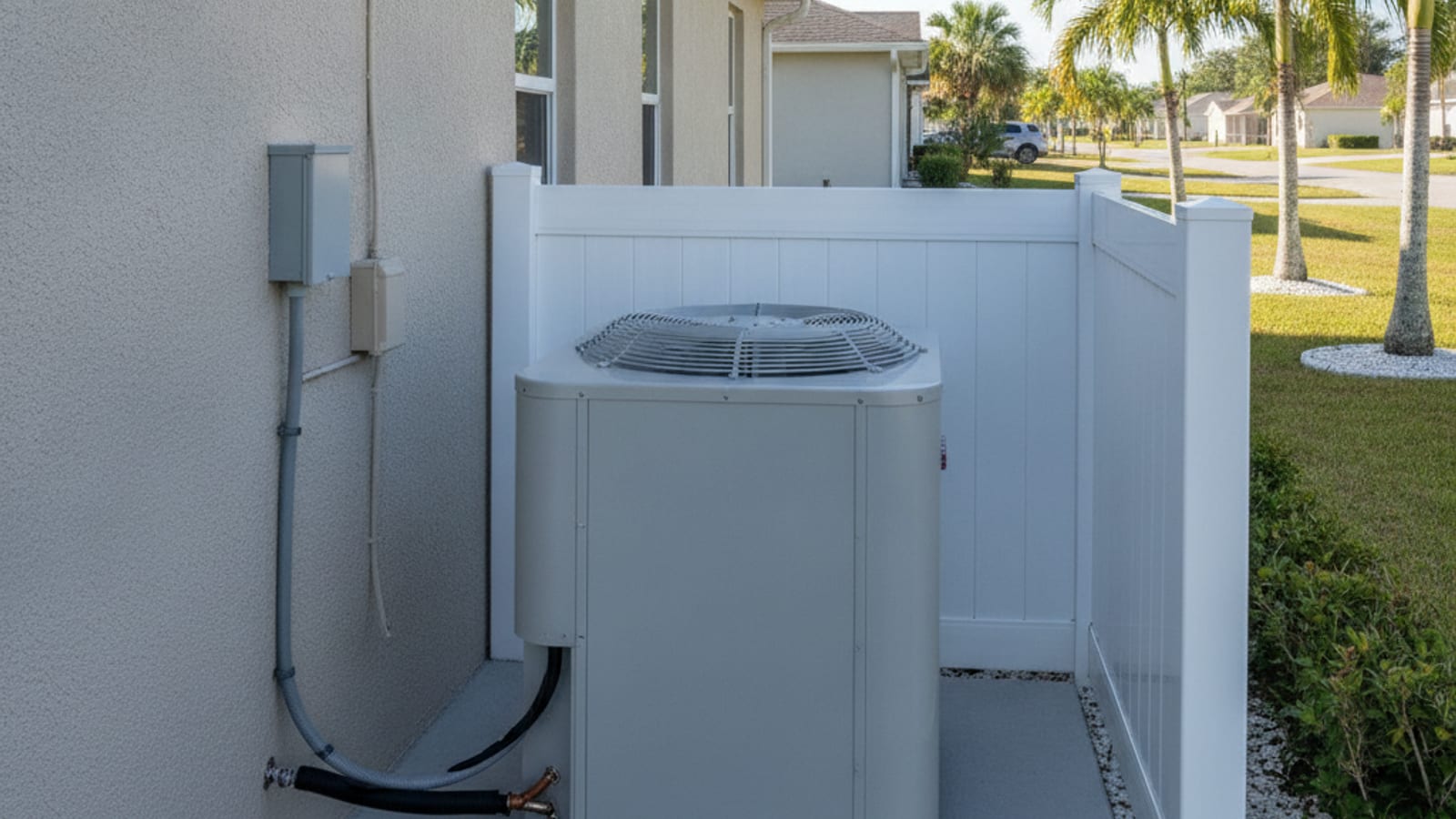
Half of the Englewood area lives under a recorded declaration of covenants. Rotonda West, the Cape Haze peninsula, most of the newer stretches of Englewood East and almost everything built in South Venice in the last thirty years sit inside a homeowners’ association with an architectural review committee and a published set of standards.
So when the condenser dies in August, there is a second question underneath the first one. Not just who can get out here, but whether anybody has to approve the replacement before it goes in.
Florida answers part of that question by statute, and the answer is more specific than either side of the usual argument. Section 720.3035 of the Florida Statutes takes one category of air conditioning decision away from the association completely. It leaves a great deal with them. The whole fight is over which side of that line your particular unit falls on, and the line is drawn in plain language.
The provision that actually names air conditioning
Section 720.3035 is titled “Architectural control covenants; parcel owner improvements; rights and privileges.” Paragraph (1)(b) is a list of things an association and its architectural committee may not adopt or enforce. Subparagraph 2 of that list is the one written for this exact situation. An association may not enforce or adopt a covenant, rule, or guideline that:
“Requires the review and approval of plans and specifications for a central air-conditioning, refrigeration, heating, or ventilating system by the association or any architectural, construction improvement, or other such similar committee of an association, if such system is not visible from the parcel’s frontage, an adjacent parcel, an adjacent common area, or a community golf course and is substantially similar to a system that is approved or recommended by the association or a committee thereof”
Read it slowly, because the protection is real and it is conditional. There are two conditions, and both have to be true at once.
The first is visibility, and it is measured from four specific places: the frontage of your own parcel, an adjacent parcel, an adjacent common area, and a community golf course. Not from the street at the far end of the block. Not from a drone. Not from the fairway six holes away.
The second is that the system has to be “substantially similar to a system that is approved or recommended by the association or a committee thereof.” That phrase does the quiet work. An in-kind changeout, the same style of equipment in the same place, is the easy case. An unfamiliar piece of equipment in a new location is not.
Put the two together and the practical result in this market is narrower than people hope. A split-system condenser tucked behind a screened side yard, replaced with a comparable condenser on the same pad, has a strong claim to subparagraph 2. The same unit sitting in open view beside the driveway does not, because it fails the first condition before you ever reach the second.
Everything else still runs through the declaration
Where subparagraph 2 does not reach, the association’s authority comes back, and paragraph (1)(a) is where it comes from. The authority of an association or its architectural committee to review and approve plans for “the location, size, type, or appearance of any structure or other improvement on a parcel” is:
“permitted only to the extent that the authority is specifically stated or reasonably inferred as to such location, size, type, or appearance in the declaration of covenants or other published guidelines and standards authorized by the declaration of covenants”
That sentence is a limit, not a grant. The power has to be traceable to the recorded declaration or to published guidelines the declaration authorizes. A standard somebody mentioned at a meeting, or a preference a committee member holds, is not in either place.
The same paragraph adds a second requirement. An association or committee “must reasonably and equitably apply and enforce on all parcel owners the architectural and construction improvement standards authorized by the declaration of covenants”. Equitable application across all owners is the test, which is why the condenser three doors down matters to your case.
Subsection (2) handles a situation that comes up constantly in equipment placement. Where the declaration or the published guidelines give options for material, size, design or location, then “neither the association nor any architectural, construction improvement, or other such similar committee of the association shall restrict the right of a parcel owner to select from the options provided”. If the guidelines list three acceptable places for mechanical equipment, the committee does not get to insist on its favorite one.
Subsection (5) closes the obvious workaround. Neither the association nor its committee may enforce any policy or restriction inconsistent with the rights set out in the declaration or the published guidelines, “whether uniformly applied or not,” and may not rely on such a policy in defense of an action taken against an owner. Enforcing an unwritten rule evenly does not make it enforceable.
Where the pad sits, and whose setback governs
Condenser placement in a deed-restricted neighborhood usually turns into a setback argument. Subsection (3) settles two parts of it.
First, unless the declaration or published guidelines say otherwise, “each parcel shall be deemed to have only one front for purposes of determining the required front setback even if the parcel is bounded by a roadway or other easement on more than one side.” Corner lots in Rotonda West are the reason that sentence exists.
Second, and more useful, where the declaration and published guidelines set no specific setback limitation, “the applicable county or municipal setback limitations shall apply,” and neither the association nor its committee “shall enforce or attempt to enforce any setback limitation that is inconsistent with the applicable county or municipal standard or standards.” A committee that invents a mechanical equipment setback the declaration never adopted is enforcing a number the statute points away from.
None of that changes the county’s own requirements. Sarasota County and Charlotte County each have their own rules about where equipment can sit and how high it has to be, and those are separate from anything the HOA does. We cover the elevation side of that in our guide to AC flood elevation rules in Englewood, and the permitting side in our guide to whether an AC replacement needs a permit.
There is one more sentence worth knowing before you start the paperwork. Under paragraph (1)(c), an association or committee “may not require a building permit to be issued by a governmental authority to a parcel owner as a prerequisite for review by the association or committee concerning the construction of structures or improvements on the parcel.” You do not have to pull the mechanical permit first just to get on the committee’s agenda. The two processes can run side by side, which matters when the house is 88 degrees inside.
A denial has to say what it is denying
This is the part most homeowners never find out about, and it changes how a denial gets handled.
Paragraph (4)(a) starts by saying that each parcel owner is entitled to the rights and privileges in the declaration and the published guidelines regarding architectural use and permitted improvements, and that those “may not be unreasonably infringed upon or impaired” by the association or its committee. Then it attaches a specific obligation to a no. If the association or committee denies a request or application for the construction of a structure or other improvement, it:
“must provide written notice to the parcel owner stating with specificity the rule or covenant on which the association or committee relied when denying the request or application and the specific aspect or part of the proposed improvement that does not conform to such rule or covenant”
Two things, in writing. The rule relied on, and the specific part of your proposal that does not conform to it. A denial that says only that the proposal does not meet community standards is not either of those. A written denial that cannot name the covenant is telling you something useful about whether the covenant exists.
Paragraph (4)(b) puts weight behind it. If the association or committee “should unreasonably, knowingly, and willfully infringe upon or impair” the rights and privileges in the declaration or published guidelines, the adversely affected owner is entitled to recover damages caused by the infringement, “including any costs and reasonable attorney fees incurred in preserving or restoring the rights and privileges of the parcel owner” That is a high bar, with three adverbs in it. It is not a tool for an ordinary disagreement. It is why a committee’s counsel takes a specific, documented request seriously.
Standby generators are a different category entirely
If the replacement conversation at your house also involves a generator, subsection (6) is the provision to read, and it is newer than most people’s copy of the rules.
Paragraph (6)(a) states that to protect the health, safety and welfare of the people of the state and to ensure uniformity in hurricane protection installed by owners, the subsection “applies to all homeowners’ associations in the state, regardless of when the community was created.” It requires the board or its architectural committee to adopt hurricane protection specifications for each structure on a parcel, which may include color and style, and all specifications adopted by the board “must comply with the applicable building code.”
Then paragraph (6)(b) does the real work. Notwithstanding any other provision in the governing documents, the board or committee:
“may not deny an application for the installation, enhancement, or replacement of hurricane protection by a parcel owner which conforms to the specifications adopted by the board or committee”
The board may still require an owner to adhere to an existing unified building scheme regarding external appearance. What it may not do is deny a conforming application outright.
Paragraph (6)(c) defines the term, and the list is where this touches HVAC. Hurricane protection “includes, but is not limited to,” roof systems recognized by the Florida Building Code which meet ASCE 7-22 standards, permanent fixed storm shutters, roll-down track storm shutters, impact-resistant windows and doors, polycarbonate panels, reinforced garage doors, erosion controls, “exterior fixed generators,” fuel storage tanks, and other hurricane protection products used to preserve and protect the structures on a parcel.
An exterior fixed generator is named in the statute. That puts a permanently installed standby generator, the kind sized to carry an air conditioner through an outage, in a category where a conforming application cannot simply be denied. If your board has not adopted specifications yet, paragraph (6)(a) says it must. Our guide to sizing a generator to run your AC covers the equipment side of that decision.
A portable generator rolled out of the garage after a storm is not an exterior fixed generator, and nothing above applies to it.
The fine, if it gets that far
Fines are a different statute, s. 720.305, and the limits in it are worth knowing before anybody panics about a violation letter over a condenser.
Subsection (2) allows an association to levy reasonable fines for violations of the declaration, bylaws or reasonable rules. A fine “may not exceed $100 per violation” against a member, tenant, guest or invitee “unless otherwise provided in the governing documents.” A fine may be levied for each day of a continuing violation with a single notice and opportunity for hearing, except that it “may not exceed $1,000 in the aggregate unless otherwise provided in the governing documents.” And a fine of less than $1,000 “may not become a lien against a parcel.”
The process matters more than the number. Under paragraph (2)(b), a fine or suspension levied by the board may not be imposed unless the board first provides “at least 14 days’ written notice of the parcel owner’s right to a hearing” and that hearing must be held within 90 days after the notice is issued, before a committee of at least three members appointed by the board who are not officers, directors or employees of the association, or close relatives of one. The notice has to include a description of the alleged violation, the specific action required to cure it if applicable, and the hearing date and location. Under paragraph (2)(c), if that committee does not approve the proposed fine by majority vote, the fine may not be imposed.
Paragraph (2)(e) is the sentence to act on: “If a violation has been cured before the hearing or in the manner specified in the written notice required in paragraph (b) or paragraph (d), a fine or suspension may not be imposed.”
Curing before the hearing ends it. That is usually a faster path than being right.
Getting the documents, since everything above points back to them
Nearly every answer in this article ends at the same place: what the recorded declaration and the published guidelines actually say. Section 720.303(5) is how you get them.
Under paragraph (5)(a), the official records must be made available to a parcel owner for inspection or photocopying “within 10 business days after receipt by the board or its designee of a written request from the parcel owner”, within 45 miles of the community or within the county where the association is located. The association must also allow an owner or an authorized representative to use a portable device, including a smartphone, tablet or portable scanner, to make an electronic copy of the records in lieu of the association providing copies, and it “may not charge a fee to a member or his or her authorized representative for the use of a portable device.”
Paragraph (5)(b) adds that failing to provide access within 10 business days of a written request sent by certified mail, return receipt requested, “creates a rebuttable presumption that the association willfully failed to comply with this subsection” Paragraph (5)(c) sets minimum damages for a willful failure at “$50 per calendar day up to 10 days,” counted from the eleventh business day after receipt.
Paragraph (5)(g) rounds it out. The association may adopt reasonable written rules on the frequency, time, location, notice and manner of inspections, but may not require an owner “to demonstrate any proper purpose for the inspection, state any reason for the inspection, or limit a parcel owner’s right to inspect records to less than one 8-hour business day per month.”
Send the request in writing. Ask for the declaration of covenants, any recorded amendments, and the published architectural guidelines and standards the declaration authorizes. Those three documents decide your case.
The statute people cite that does not apply here
There is a widely repeated belief that Florida law stops an association from blocking energy equipment on a house. The statute behind that belief is s. 163.04, and it is worth reading before relying on it.
Subsection (2) provides that a deed restriction, covenant, declaration or similar binding agreement “may not prohibit or have the effect of prohibiting solar collectors, clotheslines, or other energy devices based on renewable resources from being installed on buildings erected on the lots or parcels covered by” it. Subsection (3) gives the prevailing party in litigation under the section costs and reasonable attorney fees.
The devices named in the statute are solar collectors and clotheslines, inside the category of energy devices based on renewable resources. Nothing in the text names a central air conditioner, a heat pump or a condensing unit, and we have not obtained any source applying s. 163.04 to conventional air conditioning equipment. Walking into an architectural committee meeting with s. 163.04 in hand, over a condenser, is likely to go badly.
Subparagraph 720.3035(1)(b)2 is the provision that names air conditioning. It is the one to read.
Condos are governed by a different chapter
If you own a unit rather than a parcel, almost none of the above is your statute. Homeowners’ associations run on chapter 720. Condominiums run on chapter 718, the association’s control over the building envelope and common elements is structured differently, and the questions about who owns the air handler and who owns the line set have different answers. That is its own article, and we wrote it: condo AC replacement rules in Englewood.
What to do, in order
Start with the documents, not the argument. Make the written records request under s. 720.303(5) and get the declaration and the published architectural guidelines in hand before you say anything to the committee.
Then answer the two conditions in subparagraph (1)(b)2 honestly. Is the equipment visible from your frontage, an adjacent parcel, an adjacent common area or a community golf course? Is the replacement substantially similar to a system the association approves or recommends? If both answers favor you, the committee’s approval requirement does not reach the job. If either one does not, you are filing an application, and filing a good one is faster than arguing.
A good application is boring and specific. The make and model of the equipment, the exact location on the parcel with a dimensioned sketch, the height of the pad, the finish and color of anything visible, and the screening if the guidelines call for screening. Specificity is also what forces a denial to be specific back, under paragraph (4)(a).
If a denial arrives without the rule it relied on and the part of your proposal that does not conform, ask for it in writing, citing that paragraph. If a violation notice arrives, read paragraph 720.305(2)(e) first and ask what cures it.
And if the equipment placement question turns into an equipment question, that part is ours.
Frequently asked questions
Can my HOA stop me from replacing my air conditioner in Florida?
Not where subparagraph 720.3035(1)(b)2 applies. An association may not enforce a rule requiring review and approval of plans for a central air-conditioning, refrigeration, heating or ventilating system if that system “is not visible from the parcel’s frontage, an adjacent parcel, an adjacent common area, or a community golf course and is substantially similar to a system that is approved or recommended by the association or a committee thereof.” Both conditions have to be true. Outside them, the declaration and the published guidelines govern.
Does an HOA have to approve my condenser if it is visible from the street?
The statutory exemption in subparagraph (1)(b)2 turns off once the system is visible from your parcel’s frontage, an adjacent parcel, an adjacent common area or a community golf course. At that point the association’s authority under paragraph (1)(a) applies, limited to what is specifically stated or reasonably inferred in the declaration or the published guidelines it authorizes, and applied reasonably and equitably across all owners.
My HOA denied my application. Do they have to tell me why?
Yes, in writing and with specifics. Paragraph 720.3035(4)(a) requires written notice “stating with specificity the rule or covenant on which the association or committee relied when denying the request or application and the specific aspect or part of the proposed improvement that does not conform to such rule or covenant.”
Can the HOA require me to get a permit before they will review my application?
No. Paragraph 720.3035(1)(c) provides that an association or committee “may not require a building permit to be issued by a governmental authority to a parcel owner as a prerequisite for review by the association or committee concerning the construction of structures or improvements on the parcel.”
Can my HOA deny a standby generator?
Not one that conforms to the specifications the board adopted. Paragraph 720.3035(6)(c) lists “exterior fixed generators” within hurricane protection, and paragraph (6)(b) says the board or committee “may not deny an application for the installation, enhancement, or replacement of hurricane protection by a parcel owner which conforms to the specifications adopted by the board or committee.” Paragraph (6)(a) requires the board to adopt those specifications and applies to all Florida homeowners’ associations regardless of when the community was created.
How much can a Florida HOA fine me over an AC violation?
Section 720.305(2) provides that a fine “may not exceed $100 per violation” and, for a continuing violation fined by the day under a single notice and hearing, “may not exceed $1,000 in the aggregate”, in each case “unless otherwise provided in the governing documents.” A fine of less than $1,000 “may not become a lien against a parcel.”
Do I get a hearing before the HOA fines me?
Paragraph 720.305(2)(b) requires at least 14 days’ written notice of your right to a hearing before a fine or suspension may be imposed, with the hearing held within 90 days of the notice before a committee of at least three board-appointed members who are not officers, directors or employees of the association or their close relatives. Under paragraph (2)(c), if that committee does not approve the fine by majority vote, it may not be imposed.
How do I get a copy of my HOA’s architectural guidelines?
Make a written request under s. 720.303(5). Paragraph (5)(a) requires the official records to be available for inspection or copying “within 10 business days after receipt by the board or its designee of a written request from the parcel owner”, and the association must let you photograph or scan them with your own device at no charge. Paragraph (5)(g) says the association may not require you to state a reason for the inspection.
Does Florida’s solar law protect my air conditioner from the HOA?
The text does not say so. Section 163.04(2) bars deed restrictions from prohibiting “solar collectors, clotheslines, or other energy devices based on renewable resources”, and names no air conditioning or heat pump equipment. We have obtained no source applying it to conventional AC equipment. Subparagraph 720.3035(1)(b)2 is the provision that addresses central air conditioning.
I live in a condo, not a deed-restricted house. Is this the same?
No. Chapter 720 governs homeowners’ associations and parcels. Condominiums are governed by chapter 718, and the ownership line between the unit and the common elements changes the answer. Read our guide to condo AC replacement rules instead.
When the equipment decision is the real decision
Englewood Air Pro is a referral service, not the licensed contractor doing the work. We connect homeowners with licensed local HVAC pros, and every pro we connect you with carries their own license and insurance.
Most architectural committee problems in this market are not really arguments about law. They are arguments about a drawing that was too vague. The contractors we send are used to working in Rotonda West and Cape Haze, and a clean proposal with the model, the location, the pad height and the screening on it gets through review far more often than a one-line quote does.
If you are replacing a system in Englewood, Rotonda West, Cape Haze or South Venice, call (941) 292-6250 and we will get a pro out who can put the placement in writing before you file anything. Our guide to what an AC replacement costs in Englewood is worth having open while you compare proposals, and our guide to what Florida law requires in your AC replacement contract covers the paperwork on the contractor’s side.
Statutory citations are to the Florida Statutes as published by the Florida Legislature at leg.state.fl.us. Nothing here is legal advice. Your recorded declaration of covenants and your association’s published guidelines govern your specific situation, and an attorney is the right person to read them with you.