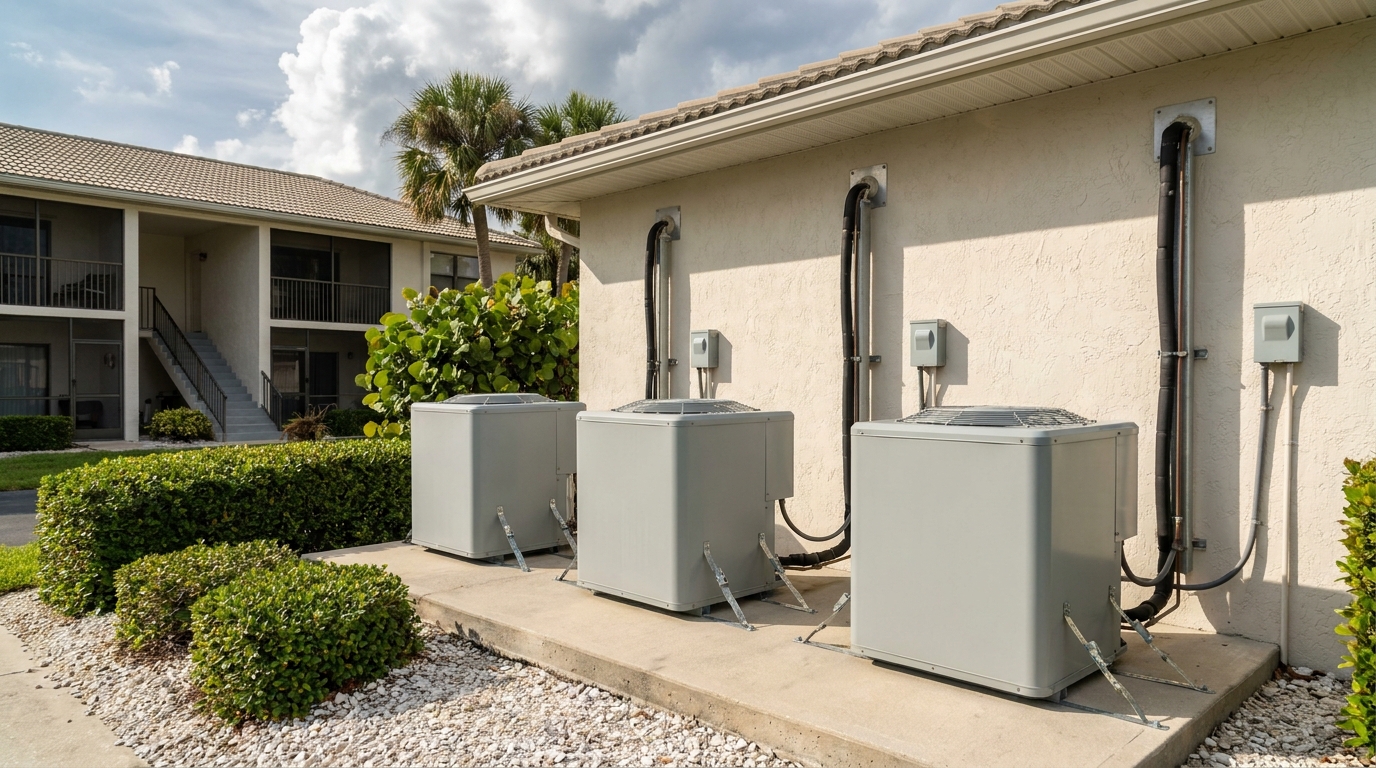
Your declaration and bylaws decide who pays when a condo AC wears out. They also decide board approval, contractor approval, and whether moving the condenser is a material alteration. Florida Statutes s. 718.111 does not name air conditioning in its insurance exclusion list. Those words do not appear in that section at all. The statute does not settle by itself whether the equipment is yours or the association’s. If you own in Englewood, Venice, Port Charlotte, or nearby, pull those documents before you request a quote. A like-for-like swap on the existing pad is ordinarily not a material alteration. Relocating the outdoor unit can be.
Who decides whether your condo AC gets replaced?
A hallway rumor won’t decide this for you. Neither will a statute screenshot. You need the recorded declaration, the bylaws, and any rules on equipment location. Read the maintenance article first, then the insurance article. They don’t always point the same way, so you need both.
Florida Statutes s. 718.113(1) says, “Maintenance of the common elements is the responsibility of the association, except for any maintenance responsibility for limited common elements assigned to the unit owner by the declaration.” That sentence puts common-element maintenance on the association. The declaration can assign a limited-common-element duty to the unit owner. It still doesn’t classify your condenser, air handler, or lineset. Your documents do that, and this post doesn’t.
If you’re seasonal, do the reading before the next cooling stretch. Englewood’s cooling season runs nine months a year. A failed system in May isn’t a short inconvenience. It’s the start of the humid stretch through Osprey, Nokomis, North Port, and Punta Gorda. Email the manager while you can still reach someone who signs.
A licensed local HVAC pro can tell you what failed. Englewood Air Pro is a referral service that connects homeowners with those pros. It doesn’t hold a contractor license or employ technicians. The pro can’t invent your approval path. You and the association have to know who owns the work before anyone orders equipment.
Does Florida law say the AC is yours or the association’s?
It doesn’t. That’s the point of this post.
Florida Statutes s. 718.111(11)(f)3 lists what an association’s property insurance policy must exclude. The list covers personal property within the unit or limited common elements. It also names floor, wall, and ceiling coverings, electrical fixtures, appliances, water heaters, water filters, built-in cabinets and countertops, and window treatments. Everything on that list is excluded only where it sits, in the statute’s words, “within the boundaries of the unit and serve only such unit”. The next sentence is, “Such property and any insurance thereupon is the responsibility of the unit owner.”
Air conditioning and heating equipment isn’t named anywhere in that exclusion list. The words air condition don’t appear anywhere in section 718.111. Don’t read that list as making the AC the owner’s responsibility. Don’t read it as making the AC the association’s. The declaration is what decides.
What happens when the system just wears out?
Age and wear aren’t a storm. They’re not an insurable event. Florida Statutes s. 718.111(11)(j) splits those paths. Property the association must insure, if damaged by an insurable event, is reconstructed, repaired, or replaced by the association as a common expense. Then the statute says, “In the absence of an insurable event, the association or the unit owners shall be responsible for the reconstruction, repair, or replacement as determined by the maintenance provisions of the declaration or bylaws.”
A system that simply wore out isn’t an insurable event. The declaration or bylaws decide who pays. The statute doesn’t.
That’s true if the outdoor unit sits on a pad in Grove City, Rotonda West, or Deep Creek. It’s true if it sits on a balcony in Venice. Location still matters for alteration rules, covered below. Location doesn’t, by itself, rewrite the maintenance article.
If the equipment can still be saved, start with an air conditioning repair visit so you know what actually failed. If the system is at the end of its life, you’re looking at replacement. Who pays still follows the same documents either way.
Can the board approve or reject your contractor?
Your documents can require written board consent before any owner work starts. Don’t send a crew to the pad on your own timetable.
Florida Statutes s. 718.111(11)(g)1 sits inside the insurance subsection. It opens with reconstruction after a property loss. In that setting, “A unit owner may undertake reconstruction work on portions of the unit with the prior written consent of the board of administration.” The next sentence is, “However, such work may be conditioned upon the approval of the repair methods, the qualifications of the proposed contractor, or the contract that is used for that purpose.”
That paragraph doesn’t govern every routine condo AC change-out. It’s a reconstruction-after-loss rule. Many declarations still carry a parallel written-approval requirement for owner work generally. Read yours. If the board uses an alteration application, use that form even for a same-pad swap.
The board can ask who will do the work. It can ask how the pad, disconnect, and lineset will be handled. It can ask for the contract. If you’re seasonal and you want the job done before you fly south, leave time for that review. Board consent and a building permit are different gates. One doesn’t replace the other.
When does moving the condenser become a material alteration?
Florida Statutes s. 718.113(2)(a) limits material alterations and substantial additions to the common elements, and to real property that is association property. They may occur only in the manner the declaration provides, as originally recorded or as amended under its procedures. If the declaration doesn’t specify that procedure, “75 percent of the total voting interests of the association must approve the alterations or additions before the material alterations or substantial additions are commenced”.
Keep the conditional. A like-for-like swap on the existing pad is ordinarily not a material alteration. Relocating a condenser can be. Adding a new roof or wall penetration can be. Putting equipment on a common-element surface that had none can be.
That fork is what stalls a quote. If the new unit stays on the same pad, you’re ordinarily inside replacement. Keep the same penetrations and the existing footprint. If the installer wants a different wall or a new roof curb, stop. A slab on lawn or walkway that never held equipment is the same problem. Read the alteration article. Any required vote happens before the work starts, not after the pad is poured.
Don’t pour a new pad and ask later. Don’t shift the cabinet a few feet onto common lawn to chase shade or a shorter lineset. Those moves can be the difference between a same-pad swap and a material alteration. Tell the contractor, in writing, that the replacement must sit on the existing pad unless the board has already cleared a relocation.
Check your rules on equipment location and screening before you treat any of that as trim.
If your condenser sits on Boca Grande or Palm Island, placement is also a salt and access issue after you sort approval. See HVAC service on Boca Grande and Palm Island. Barrier-island condos from Manasota Key through Cape Haze should also read salt-air AC protection on the barrier islands, which is about coil care, not the alteration vote.
What about the permit?
You still need the required local permit before the crew starts. Board approval isn’t a permit. A permit isn’t board approval.
We keep the permit steps on a dedicated page. Read the Englewood AC replacement permit guide before you schedule the swap. The licensed contractor pulls the permit. Your association still has to clear the job if your documents require it.
What to pull together before you call for a quote
You want a clean air conditioning installation quote, not a guessing session. Bring the papers that decide who pays and who signs. A seasonal owner can scan these from up north.
- The declaration’s maintenance article
- The declaration’s insurance article
- The bylaws
- Any rules on equipment location, screening, or sound
- Current photos of the pad, balcony, roof well, or closet
- The model and serial of the existing indoor and outdoor equipment
- The association’s approval form, if one exists
- The name of the person who signs approvals
Ask the manager for the recorded declaration if you don’t have it. Don’t rely on a neighbor’s summary. Photos should show the pad or closet, the disconnect, and the wall or roof penetrations. Serial plates on both the indoor and outdoor cabinets matter. Once you know who is paying, you can open the Englewood air conditioning replacement cost guide as a separate conversation. This post doesn’t price the job. It only covers who approves and who pays.
Frequently asked questions
Does a same-pad swap need a unit-owner vote?
Ordinarily no. A like-for-like swap on the existing pad is ordinarily not a material alteration. Relocating the condenser, cutting a new roof or wall opening, or setting equipment on a common-element surface that had none can be. Read the declaration’s alteration procedure before you assume either answer.
What if my declaration never mentions air conditioning?
The statute still doesn’t fill the gap by naming the equipment. When there’s no insurable event, Florida Statutes s. 718.111(11)(j) sends you back to the maintenance provisions of the declaration or bylaws. Have the board read that article against the actual location of the indoor and outdoor equipment. This post doesn’t decide that for your building.
Can the board reject my contractor if I am the one paying?
Your documents may still require written consent, contractor qualifications, and a copy of the contract. The reconstruction rule in the insurance subsection isn’t a blanket rule for every change-out. Many declarations impose a similar written-approval path for owner work. Ask for the approval form before you lock a start date.
What should I send the manager if I am out of state?
Send the maintenance article, current photos, and the model and serial numbers. Ask who signs approvals and whether an application form exists. Stay reachable during Englewood’s long cooling season. The manager can coordinate access, but the manager can’t rewrite the declaration.
If the indoor unit still runs, can I replace only the outdoor condenser?
Who pays still follows the same maintenance language. Approval still follows the same board process if your documents require it. Moving only the condenser can still raise the material-alteration question if the new cabinet needs a different pad or a new penetration. Keep the indoor and outdoor decisions on the same paper trail.
Get the documents straight, then get a licensed pro on site
Don’t guess from a statute excerpt in a group chat. Read the declaration. Confirm whether the board must approve the contractor. Confirm whether the new condenser stays on the existing pad. Then have a licensed local HVAC pro look at the equipment.
Englewood Air Pro can connect you with that pro for condos from Placida and El Jobean through Deep Creek and North Port. Call (941) 292-6250 Monday through Saturday, 7am to 7pm. Emergency service is available 24/7. Bring the checklist above so the quote matches the approval path you actually have.