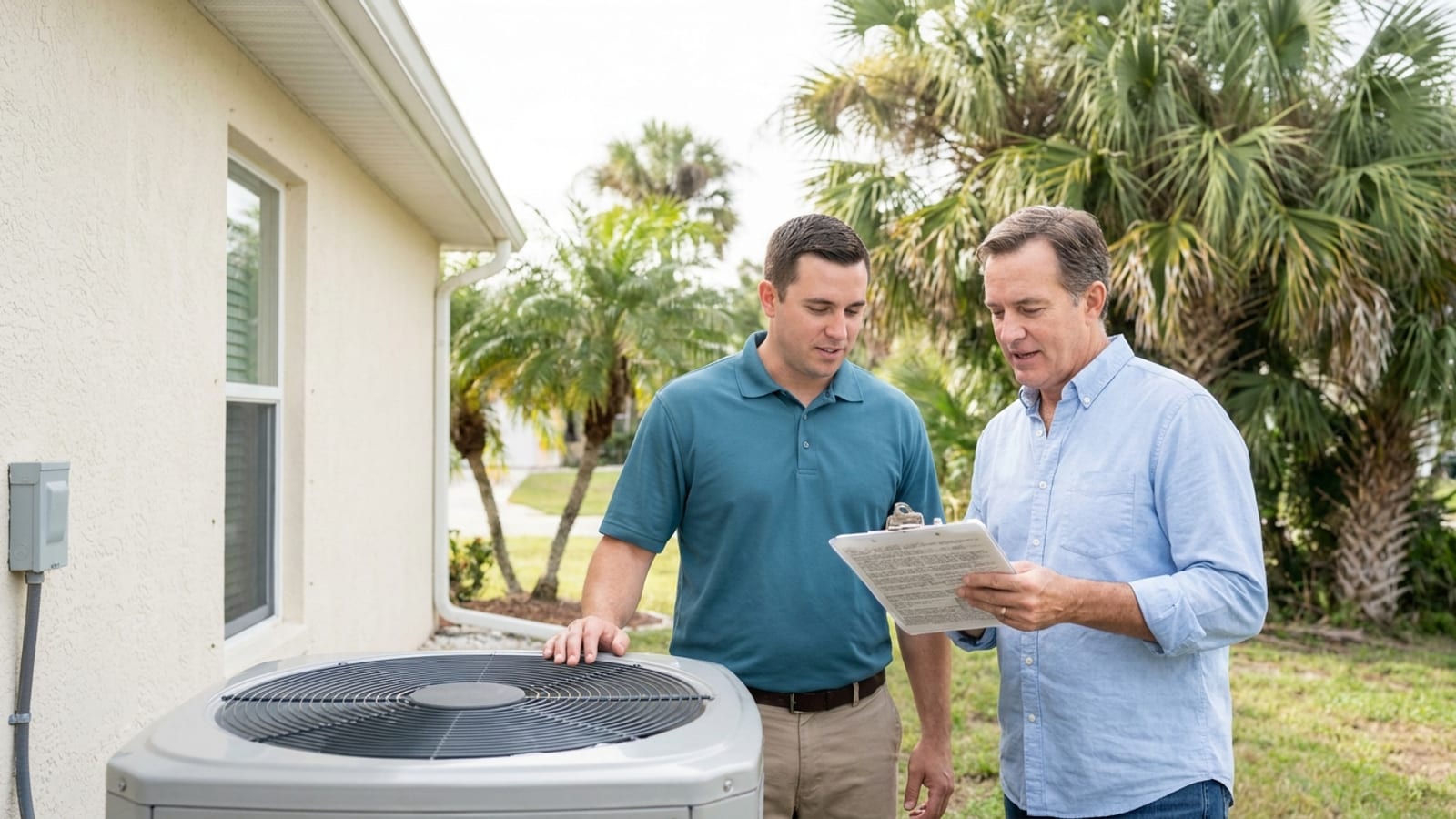
Yes, replacing an AC system in Englewood requires a permit. Florida’s new law that waives permits for work under $7,500 specifically excludes mechanical work on a single-family home, and AC replacement counts as mechanical. What changed on July 1, 2026, is the timeline: on a qualifying job the county now has to decide on a mechanical permit application within 5 business days instead of 30. The pros in the Englewood Air Pro network are licensed Florida HVAC contractors who pull the permit and schedule the inspection as part of the job, across both Sarasota and Charlotte county communities in this service area.
For what a licensed replacement actually involves, start with AC installation.
What does Florida’s new $7,500 permit exemption actually say?
CS/CS/HB 803, effective July 1, 2026, added a new exemption to s. 553.79(1)(g), F.S. It requires a local government to exempt a single-family homeowner or their contractor from needing a building permit for work valued under $7,500. That sounds like it would cover a lot of small HVAC jobs, but the law writes in two specific carve-outs, and one of them removes AC work entirely.
Why doesn’t the exemption cover an AC replacement?
The statute excludes two categories from the $7,500 exemption. The first is any work on a property partially or entirely inside a flood hazard area. The second, and the one that matters here, is any electrical, plumbing, structural, mechanical, or gas work on a property with a single-family dwelling. AC replacement is mechanical work, so it falls outside the exemption at any price, not just above $7,500. The law also blocks splitting one project into smaller pieces to try to dodge the requirement. For the work that does qualify, the exemption isn’t automatic either: the owner or the contractor has to send the local enforcement agency a written request along with the contract or other proof of what the work is and what it’s worth.
Which Englewood AC jobs need a permit, and which don’t?
Installing new equipment needs a permit. That covers a full system replacement, a new heat pump, or a new mini split installation. Charlotte County’s own guidance is specific about what doesn’t need one: portable heating appliances, portable ventilation equipment, portable cooling units, portable evaporative coolers, and replacing a part that doesn’t change its approval or make it unsafe. In plain terms, swapping a failed capacitor or contactor during an AC repair doesn’t need a permit. Putting in different or new equipment does, and that includes a storm-driven post-Ian AC replacement, because the permit rule turns on the work being done, not on who’s paying for it.
How long does an AC permit take now that the law changed?
This is the part that actually shifted on July 1. New s. 553.792(1)(a)1, F.S. requires a local government to approve, approve with conditions, or deny a mechanical permit application within 5 business days, down from the old 30-business-day tier. Three conditions all have to be true for that faster clock to apply: the applicant is using a local government plans reviewer, the home is an existing single-family residential dwelling, and the value of the work is under $15,000. It’s a decision deadline, not a guarantee the permit lands in your hand that day, and the clock only starts once the application is complete and sufficient. That $15,000 ceiling sits above the range a full replacement runs here, $5,500 to $12,000 installed for a single-family home, so a straight system swap generally lands inside the faster tier.
Can the county still charge an inspection fee based on my system’s price?
No. HB 803 also amended s. 553.79(1)(f), F.S. to say inspection fees can’t be based on a project’s total cost and can’t exceed the actual inspection costs the local enforcement agency incurred. Sarasota County says the same thing on its own building page: building inspection fees will no longer be based on the value of the work performed. Ask your contractor for the actual permit and inspection cost before the job starts, and take fee questions on the Sarasota side to [email protected], which is where the county directs them.
What does a flood zone change about replacing an AC in Englewood?
Sarasota County tells homeowners that an exterior appliance, including an HVAC unit, that sits in a flood hazard area and gets damaged by flooding has to be elevated when it’s replaced. That’s a narrow rule: it applies to equipment in a flood hazard area that was actually damaged by flooding, at the point of replacement, not to every outdoor unit in a flood zone. Sarasota County points to its property search at sc-pa.com, where the required elevation shows up at the bottom of a property’s record. Charlotte County runs a separate Find Your Flood Zone tool on its building pages, plus its own FEMA 50% Rule under its Floodplain Management Ordinance. That rule applies to a building in a FEMA-designated high-risk flood zone that’s undergoing improvements or repairs and doesn’t already meet current elevation code requirements. If the cost of the improvement or repair exceeds 50 percent of the building’s value, the county requires it to be brought up to Florida Building Code standards, elevation included. The code section behind all of this is R322.1.6, and it only reaches an existing house through three specific doors; we break those down in does your AC have to be raised in an Englewood flood zone.
Do I need a notice of commencement for an AC replacement?
Only at $15,000 or more, and that’s a different $15,000 line than the permit review timeline above. Under s. 713.135(1)(e), F.S., the permit-issuing authority has to make you file a copy of the notice of commencement before the first inspection once the direct contract is greater than $5,000. Heating and air conditioning then gets a carve-out no other trade gets, in the last sentence of s. 713.135(1)(f): “This subsection does not apply to a direct contract to repair or replace an existing heating or air-conditioning system in an amount less than $15,000.” Charlotte County’s own residential mechanical permit page matches that, requiring a notice of commencement when the direct contract price is greater than $15,000, submitted before the first inspection is scheduled. A standard split system swap at $5,500 to $8,500 stays well inside the carve-out. A variable-speed system at $9,000 to $12,000, or a heat pump at up to $14,000 bundled with $1,500 to $6,000 of new ductwork, can cross $15,000, and once it does both the notice of commencement and the slower permit review tier come back into play. That’s the same math worth running before duct system replacement in an older Port Charlotte home, since bundling a full duct swap into the same contract as the AC pushes the total up fast.
Sarasota County or Charlotte County: which one is yours?
Englewood straddles the county line. The 34223 ZIP is on the Sarasota County side, and 34224 is Charlotte County. Boca Grande falls in Lee County, outside both, and homeowners there should weigh salt air and equipment placement on the barrier islands alongside whatever permit process their county requires, since it’s a separate factor that shapes the same installation project. Charlotte County’s residential mechanical permit specifically covers replacement of heating and air conditioning equipment at a residential location; reach its building division at [email protected] or 941.743.1201. Sarasota County takes permit applications through its online Accela portal and can be reached at [email protected] or 941-861-5000. If you’re not sure which county your street falls in, a licensed contractor working in Englewood should be able to tell you before they ever pull the paperwork.
Frequently asked questions
Do I need a permit to replace my AC in Englewood, Florida?
Yes. AC replacement is mechanical work, and Florida’s new $7,500 no-permit exemption specifically excludes mechanical work on a single-family home. A permit is required regardless of the system’s price.
Does the new $7,500 Florida permit exemption cover HVAC work?
No. The exemption carves out two categories: work in a flood hazard area, and electrical, plumbing, structural, mechanical, or gas work on a single-family dwelling. AC replacement falls under the mechanical carve-out.
How long does the county have to approve an AC permit now?
Five business days, for an application using a local government plans reviewer on an existing single-family home where the work is valued under $15,000. That’s down from the old 30-business-day tier, and it’s a decision deadline, not a promise the permit is issued same-day.
Do I need a notice of commencement to replace my AC?
Only if the direct contract is $15,000 or more. Florida law carves heating and air conditioning out of the usual $5,000 notice-of-commencement threshold that applies to other trades. A standard Englewood split system replacement runs $5,500 to $8,500 installed, which sits inside that carve-out.
Will my county charge more for inspecting a more expensive AC system?
No. Inspection fees can no longer be based on a project’s total cost and can’t exceed the local agency’s actual inspection costs. Sarasota County says on its own building page that building inspection fees will no longer be based on the value of the work performed.
Does my AC have to be elevated if I live in a flood zone?
Only if it’s an exterior unit in a flood hazard area that was damaged by flooding, at the point it gets replaced. That’s Sarasota County’s stated rule, not a requirement that applies to every unit sitting in a flood zone. Check your property’s flood zone and required elevation at sc-pa.com in Sarasota County or through Charlotte County’s Find Your Flood Zone tool.
Getting the permit handled without the guesswork
A licensed contractor should be pulling the permit, scheduling the inspection, and telling you upfront whether your job crosses the $15,000 notice-of-commencement line, not leaving you to figure it out mid-project. Call (941) 292-6250 and we’ll connect you with a local Sarasota or Charlotte County HVAC pro who handles the paperwork as part of the AC installation or ductwork repair job, not as a surprise add-on. For the fuller cost picture, see what a replacement actually costs here.