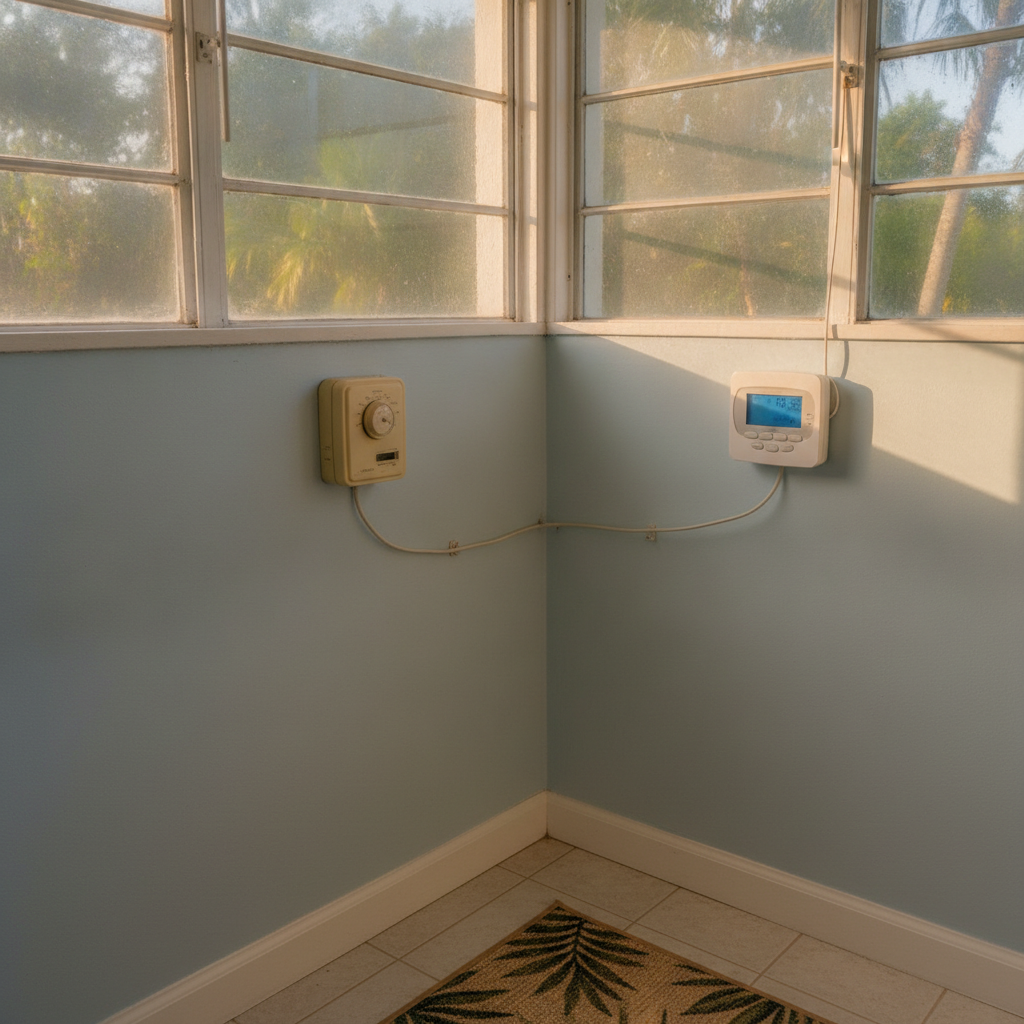
A Florida house is not one climate with one dial. A Dearborn Street cottage with a window unit in the Florida room and a later split serving the bedrooms is two systems. One sensor in the hall cannot honestly run both.
That is the homeowner problem behind searches for a Florida building code thermostat. The volume to open is the Florida Building Code, Energy Conservation. The Florida Building Commission publishes the edition in force: the 8th Edition (2023), effective December 31, 2023, with a 2026 update already in progress. Sarasota County or Charlotte County, matching the address, is who reads that volume on a real permit.
Why a second system needs a second thermostat
A thermostat only calls the equipment it is wired to, and it only feels the room it sits in.
If the air handler and condenser that cool the original cottage are one plant, they answer to the thermostat that sits in that living space. If a later split, a leftover window unit, a package unit, or a ductless system cools a different part of the house, that plant answers to its own thermostat. Sharing one wall control across two plants is how you get a Florida room that sweats while the bedrooms freeze, or a compressor that short-cycles because the sensor is in a hallway the second system never serves.
The reason is physical, not bureaucratic. A thermostat is a switch with a temperature sensor. It closes a call when the room it lives in drifts off the setpoint. It cannot feel the bonus room over the garage, the Venice addition on a west wall, or the closed-up guest suite. Put two independent systems on one sensor and one of them is flying blind. The blind one either runs too long, never starts, or fights the first system until the house feels cold and clammy instead of cool and dry.
Zoning is a different animal. One central system with dampers can feed several rooms from a single plant, and that conversation lives on our HVAC zoning in Englewood page. A zoned house still has one heating and cooling system. A second outdoor unit, a second air handler, a window unit left in place after a split went in, or a ductless system added later is a second system. Second system, second control.
| What is in the house | How the control is supposed to work |
|---|---|
| One split serving the original cottage | One thermostat for that plant |
| Original split plus a window unit or a later mini split | Two systems, two thermostats |
| One system with dampers to several rooms | Still one plant. Zoning is not a second system. |
The licensed contractors we send read the Energy Conservation volume that applies to the permit, not a blog paraphrase. For a homeowner, the test is simpler: count the plants. Each plant that can heat or cool on its own should have a thermostat that can call it on its own. That is also why a thermostat installation on a second system is not a swap of the old hallway unit. It is a new control, wired to the equipment it actually runs.
On this side of the Gulf, the county line makes the same sentence land on two desks. ZIP 34223 is Sarasota County. ZIP 34224 is Charlotte County. Boca Grande and Palm Island are reached through Charlotte County and are not Charlotte County addresses. The building department for the parcel is who tells you how the current energy-conservation language applies to that job.
Additions, bonus rooms, and a second mini split
A Venice addition, a Rotonda West bonus room, and a Dearborn Street Florida room that never got ducted are how a second system shows up in real houses.
The original cottage often kept a window unit because the later split never reached that room. The window unit is still a heating or cooling system. It still needs a way to be controlled in that room. The central thermostat in the hall cannot run it. Same story when someone finishes the space over a garage in Rotonda West and hangs a ductless head instead of punching new supply runs through attic ductwork that has been up there since the 1960s. That indoor unit is its own system. It ships with its own controller for a reason.
Mini split installation is the usual path when an addition or a bonus room cannot share the original ducts. A licensed and insured HVAC contractor sizes the head to that room, sets the outdoor unit, and sets the control that belongs to that equipment. Market ranges on this footprint for a ductless job run $3,500 to $8,000 depending on zone count. That is a range, not a quote, and it moves with how many indoor units you add and how far the line set has to run.
Rotonda West also cares what equipment the street or the golf course can see. Deed restrictions there often push the condenser out of sight. That can put the outdoor unit on the far side of the house and lengthen the line set on a bonus-room mini split. A longer line set is more copper, more insulation, and more labor. It does not change how the control has to work. The new system still needs a thermostat that can call that equipment on its own, usually on the wall in the room it serves, not daisy-chained to the house stat in the foyer.
Wellen Park new construction in North Port tends to arrive with one plant and one control from day one. The code question hits older stock harder: the cottage that grew a Florida room, the Venice house that added a suite, the Port Charlotte ranch that closed in a lanai and then tried to cool it off the original air handler. Those jobs create a second system whether anyone planned for a second thermostat or not.
An added system is mechanical work. Florida law exempts some small jobs under $7,500 from a building permit, and that exemption does not reach electrical, plumbing, structural, mechanical, or gas work on a single-family dwelling. An air-conditioning changeout is mechanical work at any price. A new mini split on an addition is mechanical work too. The licensed contractor we send pulls the permit. On the Charlotte County side, the county’s residential mechanical permit is written for replacement of heating and air conditioning equipment at a residential location. Confirm the exact permit path with the building department for the address, especially when the job is a new system on an addition rather than a straight swap.
You can confirm the contractor is licensed on the Florida DBPR license search before anyone orders equipment.
Snowbird setbacks versus a working thermostat
A setback is a schedule on a thermostat that already works. It is not a substitute for a second control, and it is not a diagnosis when the screen is blank.
Venice and Punta Gorda fill with snowbird houses that sit closed from spring into fall, thermostat left on a high cooling setback so the place is not a steam bath in August. That is a programming choice on one system. It does not give a window unit in the Florida room a brain, and it does not let a bonus-room mini split follow the main house. If you leave in April and the addition has its own plant, that plant needs its own setpoint for the months the house is empty. Otherwise the addition either cooks behind a closed door or the original system runs itself ragged trying to feel a room it cannot reach.
People mix this up with a dead thermostat. Batteries, a blank display, or a unit that lost its call to the air handler is a different problem, and that walkthrough is on thermostat not working in Englewood. Whether the Energy Conservation volume requires a given control on a given job is what the plans reviewer answers. Troubleshooting is whether that control still closes a circuit.
A programmable wall control can hold a snowbird schedule. Whether you want one is a product and labor question, covered on programmable thermostat cost in Englewood. Thermostat installation on this footprint, including install, runs $250 to $500 as a market range. That figure is for the control job, not for adding a second system. A schedule on the hallway unit does not run a second plant in the addition. That plant still needs a control of its own, and the control has to actually close a call.
On a house that sits empty through the Atlantic hurricane season, June 1 to November 30, a working thermostat also means a neighbor or a caretaker can see a failure before the attic turns into a swamp. Most of that season’s activity falls between mid-August and mid-October. A setback that nobody can change because the only thermostat died in July is how you come back in November to stained ceilings and a house that smells like a closed cooler.
Common questions
Does every room in a Florida house need its own thermostat?
No. Rooms that share one air handler and one condenser share that system’s thermostat, even when dampers split the airflow. A second plant, a leftover window unit, or a ductless system added later is what picks up a second thermostat.
Does adding a mini split to a bonus room need a permit?
Adding heating and cooling equipment is mechanical work, and Florida’s small-job permit exemption does not cover mechanical work on a single-family dwelling. The licensed contractor we send pulls the permit. Charlotte County publishes a residential mechanical permit for replacement of heating and air conditioning equipment. Ask the building department for the parcel how they classify a new system on an addition.
Which Florida Building Code edition applies to a thermostat on a new system?
The Florida Building Commission presents the Florida Building Code 8th Edition (2023), effective December 31, 2023, as the code in force, with a 2026 update in progress. The plans reviewer in Sarasota County or Charlotte County, matching the address, reads the edition that governs that permit, including the energy-conservation volume.
When to call us
When you are adding a system, replacing a dead control, or trying to give a Venice addition or a Rotonda West bonus room a thermostat that actually belongs to that equipment, that is licensed HVAC work. We match you with a licensed and insured contractor who can set the control and pull the mechanical permit the job requires. Call us at (941) 292-6250.