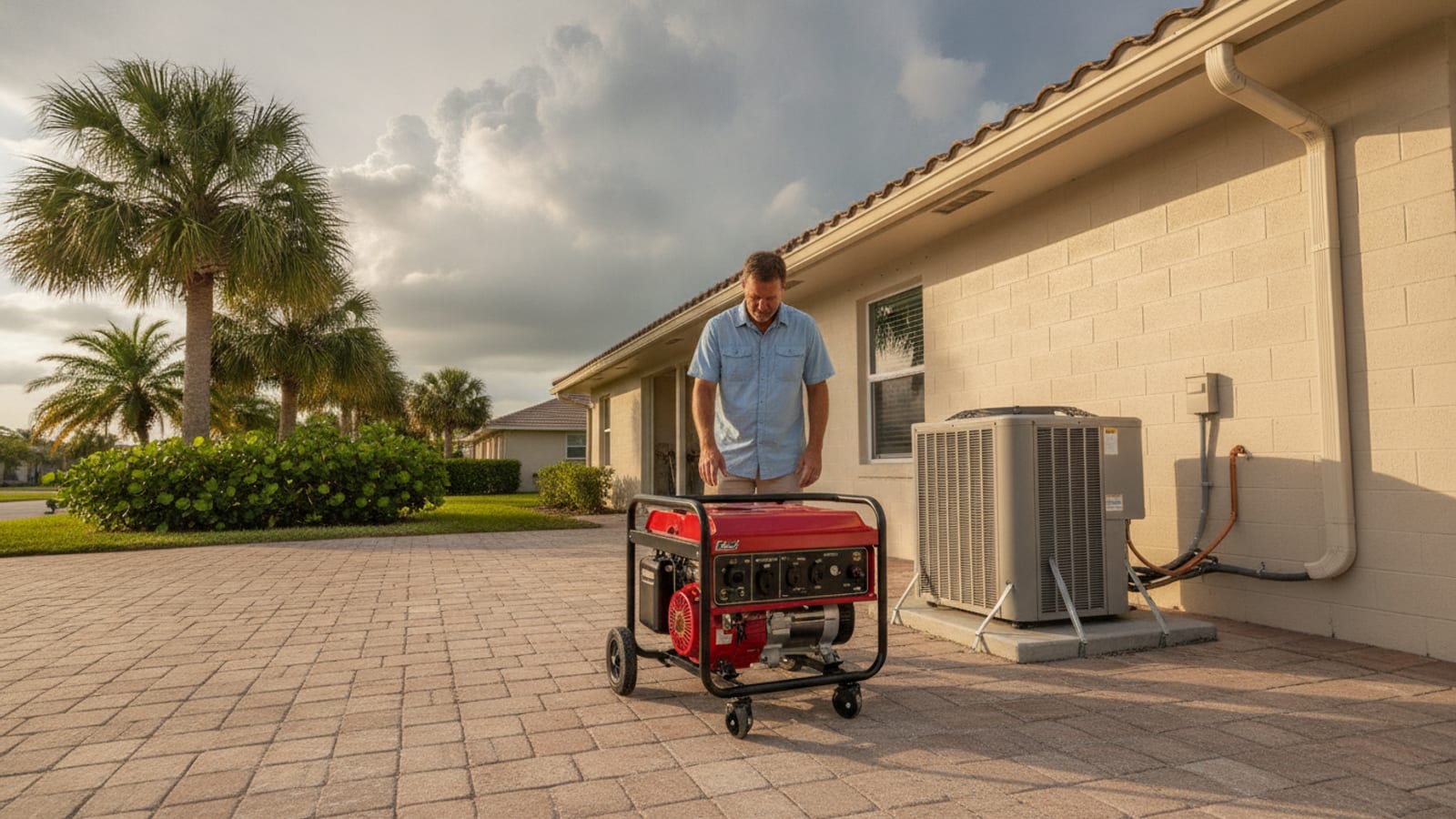
A generator to run AC must handle the compressor’s starting demand, not only its running draw. Goodman’s GSXN4 table shows separate RLA and LRA values. Its GSXN4 03610A model lists 16 RLA and 91.9 LRA. Your unit’s rating plate, not a generic wattage chart, provides the numbers needed for planning.
What must a generator to run AC handle?
The generator must support the AC during startup and continued operation. Those are different electrical conditions, with separate values on manufacturer documents.
Goodman’s GSXN4 table demonstrates why that difference matters. Across its seven listed models, RLA spans 6.1 to 25.6 amps. LRA spans 35.1 to 150 amps in the same table.
The 36,000 BTU/h model lists 16 RLA and 91.9 LRA. The 60,000 BTU/h model lists 25.6 RLA and 150 LRA. Those figures apply only to the named Goodman product family.
A generator selected around running demand can miss the startup requirement. That’s why generic wattage charts don’t answer the whole question. The generator must also support every other connected household load.
The manufacturer’s guidance directs installers to check the actual unit’s rating plate. Read only the exterior plate and don’t open electrical panels. The equipment’s own electrical data should guide the conversation.
Why does the voltage window matter?
The equipment maker also publishes an acceptable supply-voltage window. Goodman’s GSXN4 table labels that row “Min / Max Volts.” It shows 197/253 across all seven listed models.
That window applies only to this Goodman product family. Your condenser may carry different information on its own rating plate. An HVAC pro can compare that information with the proposed electrical setup.
When utility power fails, shut the system off at the thermostat. This keeps it from attempting a restart on unstable voltage. Bring it back through the properly planned generator connection.
Don’t keep resetting a breaker that trips during startup. The guide explaining why an AC keeps tripping the breaker covers that utility-power problem separately.
Why does this project cross two trades?
Florida defines electrical and air-conditioning contracting as separate scopes. A generator-plus-AC project touches both sides of that boundary.
Florida Statutes section 489.505(12) defines the electrical contractor’s scope. It reaches “electrical wiring, fixtures, appliances, apparatus, raceways, conduit, or any part thereof, which generates, transmits, transforms, or utilizes electrical energy in any form.”
Section 489.105(3)(f) separately defines Class A air-conditioning work. That scope includes installing, maintaining, and repairing central air-conditioning systems.
The definitions don’t make an HVAC proposal an electrical plan. They also don’t make an electrical proposal an AC assessment. Each provider should identify their work before you approve anything.
The licensed HVAC pros we connect you with can assess the system side. That includes checking the condenser’s electrical data and startup requirements. A qualified electrical provider can scope the generator connection separately.
Homeowners considering new AC installation should coordinate both plans early. Doing so keeps the equipment decision connected to the electrical design.
What does a transfer switch add-on cost?
A generator transfer switch add-on typically costs $1,500-$4,000. The final amount depends on generator size and the home’s electrical setup.
That range covers the transfer switch add-on specifically. It isn’t the generator price, AC price, or complete project total. Written quotes should separate each provider’s scope and pricing.
A properly installed transfer switch lets the AC restart safely. It avoids tripping the generator or damaging the compressor during restart.
Transfer-switch planning should happen before hurricane season begins. It shouldn’t start after an outage has already affected the home.
How should Englewood homeowners plan the project?
Start with the AC equipment, then coordinate the electrical connection. This sequence keeps the decision tied to the home’s actual system.
-
Read the condenser’s exterior rating plate. Record its listed electrical data without removing any panels.
-
Identify every household load the generator would carry. The complete connected load affects the final plan.
-
Ask an HVAC pro to review startup requirements. Don’t rely only on the system’s running demand.
-
Have the electrical side scoped as separate work. Ask how the proposed connection matches the generator plan.
-
Request written pricing for each project component. Keep the $1,500-$4,000 transfer switch add-on clearly identified.
-
Complete the planning before storm season arrives. Last-minute outage decisions leave little room for coordination.
Englewood Air Pro connects homeowners with licensed and insured HVAC providers. We don’t perform the electrical or air-conditioning work ourselves.
How do local outage risks change the plan?
Englewood homeowners need a plan shaped around Gulf Coast conditions. Most local homes use heat pumps instead of separate AC and gas furnaces.
That makes the heat pump central to year-round climate control. Review its condition through local heat pump service before depending on backup power.
The need also changes across the local service area. Parts of Port Charlotte lost power for a long stretch after Hurricane Ian. Generator transfer switches paired with AC systems became common requests there.
Palm Island owners also plan around extended power and ferry interruptions. A generator-paired system can keep the home dry and climate-controlled while access remains limited.
Cape Haze owners often leave waterfront homes for part of the year. Backup-power planning can help maintain cooling and moisture control while they’re away. The snowbird AC shutdown checklist covers the separate process of leaving seasonally.
For homeowners throughout Englewood, the narrow question remains the same. The generator plan must match the actual AC equipment and electrical setup.
The Hurricane Ian AC replacement guide covers post-storm replacement decisions. It doesn’t replace generator planning for the existing system.
What should happen when utility power fails?
Shut the AC off at the thermostat when power disappears. That prevents an attempted restart while the incoming voltage remains unstable.
Restore cooling only through the planned generator and transfer-switch setup. Don’t improvise wiring or open the outdoor disconnect. Electrical work at the unit isn’t a DIY project.
If the breaker won’t reset, stop trying immediately. A breaker that won’t reset qualifies for emergency AC service. The guide to emergency AC after a storm explains the separate post-storm service call.
Frequently asked questions
Can a portable generator run a central air conditioner?
It can, but sizing must reflect the AC’s startup load. A small portable generator often can’t handle a central system’s heavy startup demand. Check the unit’s rating plate before selecting equipment.
What size generator do I need to run AC?
There isn’t one generator size that fits every AC system. Your condenser’s electrical data and the complete connected load determine the plan. Don’t choose from running demand alone.
Why are RLA and LRA both important?
They represent different operating conditions in the manufacturer’s table. The Goodman GSXN4 03610A lists 16 RLA and 91.9 LRA. Those numbers apply only to that named model.
How much does a transfer switch add-on cost?
A transfer switch add-on typically costs $1,500-$4,000. The amount depends on generator size and the home’s electrical setup. That range doesn’t include the generator or AC system.
Should I turn off my AC during a power outage?
Yes, shut the system off at the thermostat. This prevents it from trying to restart on unstable voltage. Use the planned transfer-switch setup before restoring generator-powered cooling.
Who should plan the generator and AC connection?
The project crosses separate electrical and HVAC scopes. An HVAC pro can assess the AC equipment and startup requirements. The electrical provider can scope the generator connection and related electrical work.
Plan the project before the next storm threatens Englewood. Call (941) 292-6250 to connect with licensed local HVAC pros who can review your system’s requirements.