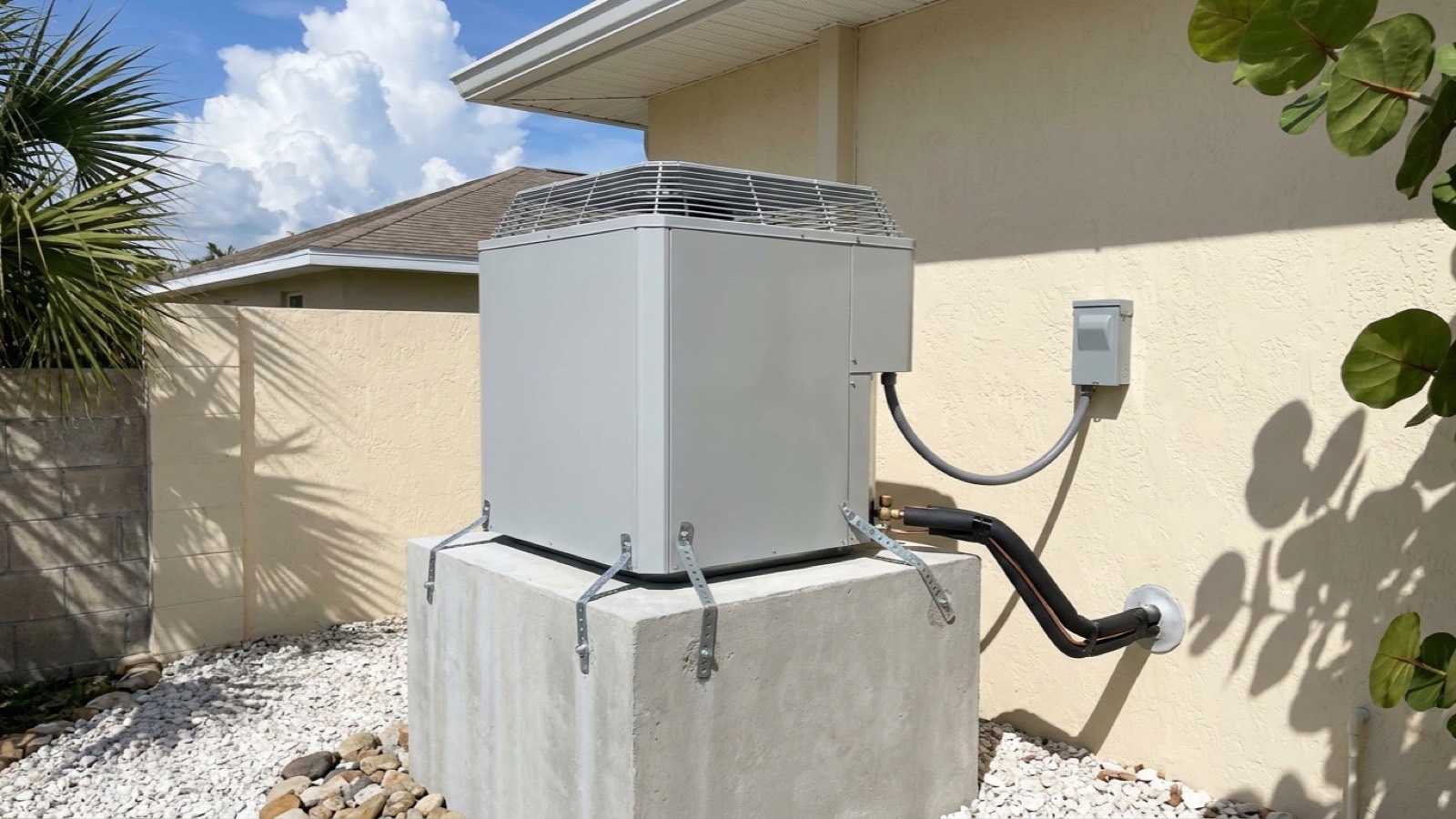
Being in a flood zone does not, by itself, mean your air conditioner has to sit up on a stand. That surprises most homeowners here, and it surprises a fair number of salespeople too. Florida’s code reaches an existing house through three specific doors, and if you don’t walk through one of them, a like-for-like swap on the old pad is legal.
The three doors are worth knowing before you sign anything. One of them was added in the current edition of the code, and it catches exactly the house that flooded.
What the code actually says
The rule lives in Section R322.1.6 of the Florida Building Code, Residential, 8th Edition. Here is the operative language, in full:
“Electrical systems, equipment and components; heating, ventilating, air conditioning; plumbing appliances and plumbing fixtures; duct systems; and other service equipment shall be located at or above the elevation required in Section R322.2 or R322.3. Replacement of exterior equipment and exterior appliances damaged by flood shall meet the requirements of this section. If replaced as part of a substantial improvement, electrical systems, equipment and components; heating, ventilating, air conditioning and plumbing appliances and plumbing fixtures; duct systems; and other service equipment shall meet the requirements of this section.”
Read it slowly and the structure shows up. The first sentence governs new work. The second and third sentences are the ones that reach a house that’s already standing.
The Florida Division of Emergency Management, which compiles the code’s flood provisions for local building departments, lists that second sentence as one of the significant changes from the 7th Edition. Its summary says R322.1.6 was “Modified to specify that replacement of exterior equipment and exterior appliances damaged by flood must meet the requirements of the section.”
The same requirement appears again in the Florida Building Code, Existing Building at Section 701.3, which covers Level 1 alterations:
“Replacement of exterior equipment and exterior appliances damaged by flood shall meet the requirements of Section 1612 of the Florida Building Code, Building, or Section R322.1.6 of the Florida Building Code, Residential, as applicable.”
The three doors
New construction. A house going up in a flood hazard area puts its equipment at or above the required elevation from day one. That’s the first sentence of R322.1.6, and it’s why new builds out toward Wellen Park and North Port come with the condenser already standing high.
Flood-damaged equipment. If the outdoor unit sits in a flood hazard area and flooding damaged it, the replacement has to meet the elevation rule. This is the door that catches the Ian and Milton houses. The trigger is water damage to the equipment itself, not water in the yard and not water in the living room.
Substantial improvement. If the AC is being replaced as part of a job that qualifies as a substantial improvement, the elevation rule applies even if the old unit was working fine. More on that math below.
Miss all three and the code does not require you to raise anything. A condenser at the end of its life, in a flood zone, that never took on water, in a house nobody is remodeling, can be swapped on its existing pad. That’s the honest answer, and it’s the one a lot of quotes skip past.
How high is high enough
“At or above the elevation required in Section R322.2 or R322.3” is doing real work in that sentence, and the number depends on your zone.
In A and AE zones, Section R322.2.1 sets it at “the base flood elevation plus 1 foot (305 mm), or the design flood elevation, whichever is higher.” In shallow flooding AO zones, it’s the depth number printed on the flood map plus one foot, and not less than three feet.
Out on the coastal high-hazard side, VE zones and designated Coastal A Zones, Section R322.3.2 raises the bar again and measures it differently. It puts the bottom of the lowest horizontal structural members at or above base flood elevation plus one foot, or the design flood elevation, whichever is higher. If you’re on Manasota Key or out toward Boca Grande and Palm Island, that’s the section your building department is reading.
Section R322.1.4 defines the design flood elevation as the higher of the base flood elevation, including wave height, or the elevation of the design flood the community adopted on its own map. When no design flood elevation is specified, R322.1.4.1 lets the building official make the applicant obtain federal or state data, or have it determined by accepted hydrologic and hydraulic engineering practice.
The practical version: nobody can tell you how high your pad needs to be from a photo. It comes off your flood map and your community’s adopted elevation, and the permit is where that gets pinned down.
You can stay low, if it’s engineered to stay low
R322.1.6 carries an exception, and it’s the part that saves a lot of tight side yards:
“Locating electrical systems, equipment and components; heating, ventilating, air conditioning; plumbing appliances and plumbing fixtures; duct systems; and other service equipment is permitted below the elevation required in Section R322.2 or R322.3 provided that they are designed and installed to prevent water from entering or accumulating within the components and to resist hydrostatic and hydrodynamic loads and stresses, including the effects of buoyancy, during the occurrence of flooding to the required elevation in accordance with ASCE 24.”
Two things to notice. Resisting buoyancy means the anchoring has to hold the unit down when the water tries to float it, which is a different load case from the wind tie-downs everyone here already knows. And “in accordance with ASCE 24” means a referenced engineering standard, not an installer’s judgment call. In practice that’s a designed solution somebody signs for, which is why raising the pad is usually the cheaper road.
The same exception carves out pool and spa equipment on easier terms. That gear can sit below the required elevation as long as it’s “elevated to the extent practical,” anchored against flotation and flood forces, and fed by branch circuits with ground-fault circuit interrupter protection.
Sarasota County asks for more than the state code
Here’s where the county line through Englewood actually changes the answer. The 34223 side is Sarasota County, and Sarasota County’s floodplain ordinance is stricter than R322.1.6.
Section 54-516(a)(9) of the Sarasota County Code covers utilities servicing elevated buildings:
“In Zones A, A1 through A30, and AE, as designated on the adopted Flood Insurance Rate Maps (FIRM), and in Community Flood Hazard Areas, all electrical, heating, ventilation, plumbing, air conditioning, mechanical equipment, and other service facilities shall be elevated to or above the Base Flood Elevation (B.F.E.), or one foot above the 100-year 24-hour maximum flood stages established by the adopted Community Flood Hazard Areas, whichever is higher, or designed to prevent water from entering or accumulating within the equipment during conditions of Flooding (this requirement does not apply to water pumps or pool equipment that are located outside of the footprint of the Structure).”
Notice what’s missing from that sentence. There’s no “damaged by flood” qualifier and no “substantial improvement” qualifier. It reads as a standing requirement for air conditioning equipment in those zones.
A county is allowed to do that. Florida Statutes section 553.73(5) says counties and municipalities may adopt a technical amendment to the code relating to flood resistance in order to implement the National Flood Insurance Program, and that “A technical amendment is authorized to the extent it is more stringent than the code.” The same subsection protects such an amendment from being wiped out at the next code update when it was adopted for Community Rating System participation or when it requires a design flood elevation above the base flood elevation.
So the same condenser, same zone, same age, can get a different answer depending on which side of the line the house sits on. Sorting out which county you’re in is the first step, and our guide to AC replacement permits in Englewood walks through the 34223 and 34224 split and who to call at each building division.
Charlotte County’s 50% rule, in plain terms
The 34224 side is Charlotte County, and there the substantial improvement door is the one that catches people.
Charlotte County publishes the rule as its 50% FEMA Rule, mandated by the county’s Floodplain Management Ordinance. The county’s own description: the rule applies to any building or structure in a FEMA-designated high-risk flood zone that’s undergoing improvements or repairs and does not meet current elevation code requirements. If the cost of the improvement or repair exceeds half the value of the building, it has to be brought up to Florida Building Code standards, elevation requirements included.
The county spells out both halves of that fraction. Market value of the structure excludes the land and other improvements on the parcel, and can be established by a qualified independent appraiser or by tax assessment value adjusted to approximate market value. The value of the work is total materials and labor for the improvement or repair, and the county has a Detailed Cost Breakdown form for tallying it, with an affidavit signed by an architect, engineer, contractor or the property owner.
The county also says plainly that it’s watching for phased work. Plans reviewers verify whether a permit application adequately identifies all the work required to complete the improvement or repair, so splitting one project across three permits is not a way around the threshold.
The federal definition behind all of this sits at 44 CFR 59.1. It defines substantial improvement as work whose cost “equals or exceeds 50 percent of the market value of the structure” before construction starts, and it says the term covers structures that have incurred substantial damage “regardless of the actual repair work performed.” The Florida Building Code’s own Section 202 definition matches it, in nearly the same words: any repair, reconstruction, rehabilitation, alteration, addition or other improvement whose cost “equals or exceeds 50 percent of the market value of the structure before the improvement or repair is started.” That last clause matters after a hurricane: once a building is declared substantially damaged, the repairs count as substantial improvement no matter what the repair invoice says.
It isn’t only the condenser
R322.1.6 is written to cover service equipment generally, and the 8th Edition ran cross-references out to the appliances that sit near it.
Section M1905.2.2 is new in this edition and sends permanently installed standby generators to the same rule: in flood hazard areas, they “shall be located or installed in accordance with Section R322.1.6.” If you’re pairing a new system with backup power, that’s the same elevation conversation, and it belongs in the plan before the slab goes in rather than after. Our rundown on running an AC on a generator covers the sizing side of that decision.
Section M2001.4 does the same for boilers and water heaters. Air handlers and duct systems are named directly in R322.1.6 itself, which is worth remembering in a house where the air handler sits in a low garage or a ground-floor closet rather than the attic.
Manufactured homes get their own path. Section R322.1.9 says installation in flood hazard areas is subject to the applicable provisions of the local floodplain management ordinance, on top of the requirements of the state agency with jurisdiction over installation. That’s a county-level answer, not a state-level one, which is a recurring theme in manufactured home AC work around Englewood.
What to sort out before you sign
Pull these four things together and the quote stops being a guess.
Find your flood zone first. Sarasota County property records carry the required elevation on the property’s record, and Charlotte County runs its own flood zone lookup on its building pages. The zone letter decides which elevation section applies.
Decide honestly whether the old unit was flood damaged. Storm-driven failures on this coast often surface a year or two later, and a corroded coil traced back to surge is a different conversation from ordinary wear. Our post on post-Ian AC replacement covers how those slow failures present.
Price the whole project, not just the AC. If a duct replacement, a panel upgrade and a remodel are landing in the same year, the substantial improvement threshold is the thing to check before the first permit goes in.
Ask the contractor which section they’re working to. A pro who can name R322.1.6 or Sarasota’s 54-516 has read the rule. One who says “flood zone means you have to raise it” has not, and that answer costs you money on a job the code never required.
Frequently asked questions
My yard floods every summer. Does that put me in a flood hazard area?
Not necessarily. Flood hazard areas are the ones mapped by FEMA on the Flood Insurance Rate Map and adopted by your community, plus any Community Flood Hazard Areas the county designates. Section 1612.3 of the code says the local governing authority adopts a flood hazard map by ordinance, and that map has to include at minimum the special flood hazard areas FEMA identified. Standing water in the yard after a storm is not the test.
The unit wasn’t flooded but it’s old. Can I replace it on the same pad?
In Charlotte County, if the job isn’t a substantial improvement and the old equipment wasn’t damaged by flood, R322.1.6 doesn’t reach it. In Sarasota County, section 54-516(a)(9) is written without those qualifiers for A and AE zones, so ask the building division before you assume. Either way the permit review is where it gets settled.
How much clearance is enough if we do raise it?
There’s no single number. It’s base flood elevation plus one foot, or the design flood elevation, whichever is higher, under R322.2.1 for A and AE zones, and the coastal sections measure differently. The figure comes off your flood map and your community’s adopted elevation, and R322.1.10 requires a licensed professional surveyor and mapper or registered design professional to prepare and seal the as-built elevation documentation.
Can the unit stay low if it’s a sealed or flood-rated model?
Only through the exception, and the exception has teeth. The equipment has to be designed and installed to keep water out and to resist hydrostatic and hydrodynamic loads including buoyancy, in accordance with ASCE 24. That’s an engineered solution documented for the building official, not a manufacturer’s marketing claim.
Does this apply to my pool heat pump?
The exception treats pool and spa equipment more gently. It can sit below the required elevation if it’s elevated to the extent practical, anchored against flotation and flood forces, and supplied by branch circuits with ground-fault circuit interrupter protection. Sarasota County’s ordinance also exempts pool equipment located outside the footprint of the structure from its utilities rule.
Who decides, in the end?
The building official in your county. The code gives them the call on design flood elevations where none are specified, and the permit is the moment the elevation question gets answered on paper. Getting that determination early is cheaper than getting it at inspection.
Getting a straight answer for your address
Englewood Air Pro is a referral service, not the licensed contractor doing the work. We connect homeowners with licensed local HVAC pros who work both sides of the county line and deal with these building departments regularly.
The pros we send can tell you which section applies to your address before anyone quotes a stand or a pad. Florida requires a CAC license for this work, and you can check any contractor’s license for free at myfloridalicense.com. We’d rather you check than take anyone’s word for it.
If you’re weighing a replacement in Englewood, Rotonda West or anywhere along this stretch of coast, get the flood zone question settled first. It changes the scope of the job, and it’s a lot easier to handle before the old unit comes out.
Code references are to the Florida Building Code, 8th Edition (2023), which took effect December 31, 2023. The Florida Building Commission’s code update workplan sets December 31, 2026 as the effective date for the 9th Edition, so recheck these sections after that date.