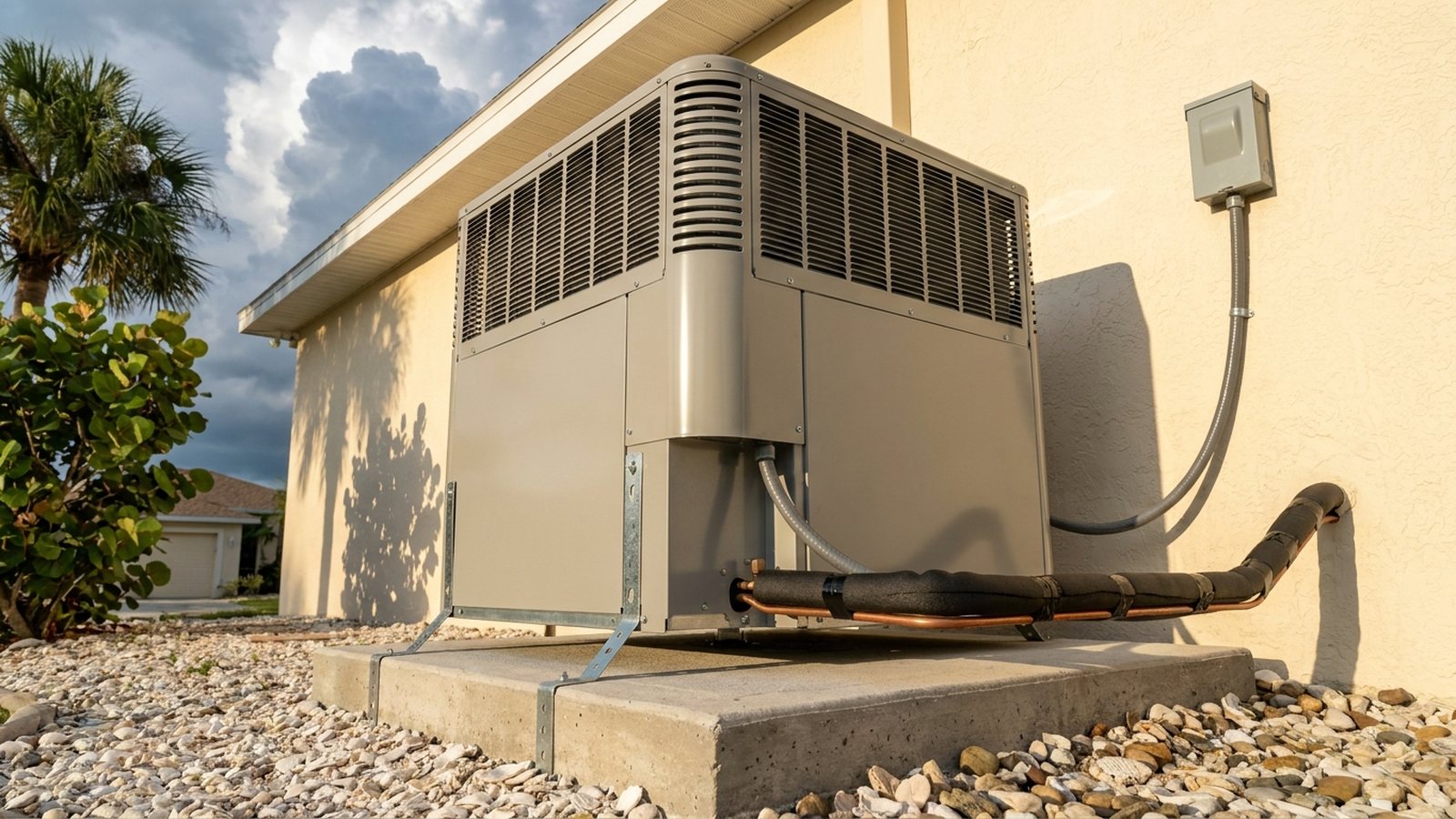
If you’re replacing an air conditioner in Englewood this year, the quote in your hand almost certainly names a refrigerant you’ve never heard of. R-454B and R-32 are A2L refrigerants, which means mildly flammable. Florida’s building code handles them differently from the R-410A in your old system, and the difference is written down. It sends the design and installation of an A2L system to a safety standard, and that standard has specific rules about labels, ductwork and detection.
Why your new system doesn’t use R-410A
The federal rule changed what manufacturers are allowed to build, not what you’re allowed to own. Since the start of 2025, new residential systems have to come in under a global warming potential of 700, and R-410A sits well above it.
The restriction is at 40 CFR 84.54, and paragraph (c)(1) is the line that reaches a house:
“Effective January 1, 2025, residential or light commercial air-conditioning or heat pump systems using a regulated substance, or a blend containing a regulated substance, with a global warming potential of 700 or greater, except for variable refrigerant flow air-conditioning and heat pump systems.”
The same paragraph carries an allowance that most cost guides online still get wrong:
“New residential and light commercial air-conditioning and heat pump systems using a regulated substance, or a blend containing a regulated substance, with a global warming potential of 700 or greater may continue to be installed where all specified components of that system are manufactured or imported prior to January 1, 2025.”
So pre-2025 R-410A equipment can still go in. That allowance has no end date in the current rule text. What it doesn’t do is put R-410A back into production, so the real limit is whatever inventory a supplier still has on the shelf.
Your existing system is a separate question, and the answer is friendlier than the sales pitch you may have heard. The federal layer on repairs is covered in our guide to AC refrigerant leak repair cost in Englewood.
What A2L actually means
A2L is a safety classification, not a brand. The A means lower toxicity. The 2L means flammable with a low burning velocity, which is where the phrase mildly flammable comes from.
That classification is the hinge the code turns on. Refrigerants get sorted by that system, and the Florida Building Code, Mechanical says so in Section 1103.1: refrigerants are classified in accordance with ASHRAE 34 as listed in the code’s own table.
Once a refrigerant lands in the A2L group, a different set of design and installation rules applies to the system holding it. That’s the part worth understanding before you sign, because it shows up as real work on your property.
Florida sends A2L systems to ASHRAE 15
Here’s the specific thing Florida did, and it isn’t buried. The Florida Building Commission approved a supplement to the 8th Edition code on December 10, 2024, and it revised the general refrigeration section to add an exception.
Section 1101.6 sets the baseline:
“Refrigeration systems shall comply with the requirements of this code and, except as modified by this code, ASHRAE 15.”
Then the supplement adds this:
“Exception: Refrigeration systems that use A2L refrigerant shall be designed and installed in accordance with ASHRAE 15.”
Read the two together and the routing is clear. For most systems the code modifies the standard. For an A2L system, the standard itself governs the design and the installation. The same supplement also moved the referenced edition of ASHRAE 15 from 2019 to 2022, including addenda published through July 31, 2024.
The code in force today is the Florida Building Code, 8th Edition (2023), effective December 31, 2023. The Commission’s own code update workplan lists December 31, 2026 as the effective date for the 9th Edition (2026), so expect this material to move again in a year.
A Florida building department asked about this, and got an answer
This is not a theoretical reading. In 2024 the Broward County Board of Rules and Appeals petitioned the Florida Building Commission for a declaratory statement about A2L refrigerants under Chapter 11 of the mechanical code. The Commission answered on August 13, 2024, in DS2024-024.
The first question asked whether an A2L system can be designed and installed under ASHRAE 15 even though the code’s own Chapter 11 is more restrictive. The Commission’s answer:
“Designing and installation of A2L refrigerant using ASHRAE 15 would meet the minimum requirements of the 8th Edition (2023) Florida Building Code, Mechanical.”
The second question asked whether an A2L charge can exceed the quantity limits in the mechanical code’s table. The Commission said an answer wasn’t possible, because the table it named and the matching ASHRAE table “do not apply to A2L refrigerants”.
The third question asked whether an alternative design method can be used. The answer was yes, because under the code “the building official has the authority to accept alternative design to that of the prescriptive requirements of the code”.
That’s three useful things in one document. The standard governs, the old A2 quantity tables aren’t the test, and your local building official holds real discretion over an alternative approach.
One honesty note, because it matters if you go reading. The Commission’s answers and its staff analysis both quote ASHRAE 15-2019, and the December 2024 supplement moved the code’s reference to the 2022 edition. We haven’t read the 2022 text, so nothing below is presented as the current edition’s wording.
What the standard requires at your house
The requirements reproduced in the Commission’s own record are concrete, and a few of them are visible on a finished job. Under ASHRAE 15-2019, Section 7.5.2:
“Group A2, A3, B1, B2L, B2, and B3 refrigerants shall not be used in high probability systems for human comfort. Use of Group A2L refrigerants shall be in accordance with Section 7.6.”
Your house is a human comfort application, and a direct-expansion AC system is the high probability kind. So Section 7.6 is the section that governs your install. It opens by saying exactly that:
“High probability systems using Group A2L refrigerants for human comfort applications shall comply with this section.”
From there, four requirements are worth knowing by name.
Listing and installation. “Refrigeration systems shall be listed and shall be installed in accordance with listing, the manufacturer’s instructions, and any markings on the equipment restricting the installation.” Installing to the manufacturer’s instructions stops being good practice and becomes the code path.
A label you can look for. “A label indicating a flammable refrigerant is used shall be placed adjacent to service ports and other locations where service involving components containing refrigerant is performed, as specified by the product listing.” After the install, walk out to the condenser and find it.
Ignition sources in ductwork. “Open-flame-producing devices shall not be permanently installed in the ductwork that serves the space.” The next line adds that “Unclassified electrical devices shall not be located within the ductwork that serves the space.”
Hot surfaces. Devices with surfaces above 1290 degrees F are barred from that ductwork unless there’s a minimum airflow of 200 feet per minute across the heating device and proof of airflow before it energizes.
That last pair is the one that quietly touches Englewood homes. Duct-mounted accessories are common here because of humidity and air quality concerns, and an A2L system changes the conversation about what can live inside a supply plenum. If you’re weighing an add-on, raise it during the design, not after. Our guide to whole-home dehumidifiers in Englewood covers the equipment side of that decision.
There’s also a charge threshold that keeps small equipment simple. Exception 1 to Section 7.2 exempts “Listed equipment containing not more than 6.6 lb (3 kg) of refrigerant” from the concentration limits, provided it’s installed per its listing and the manufacturer’s instructions. That’s the practical reason a single-zone ductless unit is a lighter lift than a whole-home system. Sizing and application are covered in our guide to ductless AC in Englewood.
They can’t put the new refrigerant in your old system
This comes up constantly, and the code answers it in one sentence. Section 1102.2 of the mechanical code:
“The refrigerant shall be that which the equipment or appliance was designed to utilize or converted to utilize. Refrigerants not identified in Table 1103.1 shall be approved before use.”
Equipment runs the refrigerant it was designed for, or one it was actually converted to use. Nobody drops an A2L charge into an R-410A condenser on a service call. If a quote suggests otherwise, get it in writing and take it to the building department that will inspect the work.
We’re a referral service, not the contractor doing the install. Englewood Air Pro connects homeowners with licensed and insured HVAC contractors across Sarasota and Charlotte counties, and the pro we send sets their own pricing and terms.
What this changes about an Englewood quote
Less than the marketing suggests, and more than nothing. A changeout is still a permitted job with an inspection at the end, and our Englewood AC replacement permit guide walks that process. What’s new is that the design and install of an A2L system answer to a safety standard with named requirements.
Published AC installation costs on this site run $5,500 to $12,000 installed for most single-family homes. That band covers the work, not the refrigerant market, and we don’t publish a price for any refrigerant by the pound. Our AC replacement cost guide breaks down what moves a project inside that range.
Four questions get you what you need from a bidder:
| Ask this | Why it matters |
|---|---|
| Which refrigerant does this system use | It tells you whether you’re buying an A2L system or pre-2025 inventory |
| Are you installing to the manufacturer’s instructions and the listing | That’s the code path for an A2L system, not a courtesy |
| Where will the flammable refrigerant label go | It’s required adjacent to service ports on a listed A2L system |
| Is anything being added inside the ductwork | Ignition source rules apply to devices in the ductwork serving the space |
Licensing is the other half of this. Who’s allowed to handle refrigerant at all is covered in our breakdown of handyman AC repair in Florida, and choosing between bidders is covered in finding the right AC company in Englewood.
If you own in a condo, add one more layer before scheduling. Approval and cost responsibility are set by your association documents, and replacing the AC in an Englewood condo covers who signs off.
Englewood Air Pro serves Englewood, Placida, Cape Haze, Rotonda West, and the communities around them, with emergency dispatch available around the clock across Sarasota and Charlotte counties. Call (941) 292-6250 and we’ll connect you with a licensed, insured local HVAC contractor. You can also start an AC installation request and ask these questions before anyone quotes a price.
Frequently asked questions
What are A2L refrigerant requirements for a new Englewood AC?
A2L refrigerant requirements follow ASHRAE 15: the system has to be listed and installed to its listing and the manufacturer’s instructions, a flammable-refrigerant label goes adjacent to the service ports, and open-flame or unclassified electrical devices stay out of the ductwork that serves the space.
What is an A2L refrigerant?
It’s a refrigerant safety classification for lower toxicity and low burning velocity flammability, which is why you’ll see it called mildly flammable. R-454B and R-32 are the A2L refrigerants showing up in new residential systems. Florida’s mechanical code classifies refrigerants in accordance with ASHRAE 34.
Is R-454B dangerous in a house?
Florida’s code doesn’t treat it as unsuitable for homes. It routes A2L systems to ASHRAE 15, whose Section 7.6 sets the conditions for using them in human comfort applications, including listing, installation to the manufacturer’s instructions, labeling at service ports, and limits on ignition sources in the ductwork.
Can my R-410A system be converted to R-454B?
No. The mechanical code says the refrigerant has to be the one the equipment was designed to use or was actually converted to use, and refrigerants outside the code’s table need approval before use. A service call isn’t a conversion.
Can I still buy an R-410A system in Florida?
Yes, if it exists. The federal rule allows new residential systems above the 700 limit to be installed where all specified components were manufactured or imported before January 1, 2025. Production of new R-410A residential systems stopped, so availability is the constraint rather than the rule.
Does an A2L system need a refrigerant detector?
Sometimes. ASHRAE 15 requires a detector under specific conditions rather than on every system, and the conditions depend on the system and the space. Ask the contractor which provision applies to your design and what equipment satisfies it.
Does my new AC still need a permit in Englewood?
Yes. A changeout is permitted and inspected work regardless of refrigerant. Englewood crosses a county line, so the department reviewing your job depends on your address.
Which Florida code edition applies right now?
The 8th Edition (2023), effective December 31, 2023, with the A2L exception added by the supplement the Commission approved on December 10, 2024. The Commission’s code update workplan lists December 31, 2026 as the effective date for the 9th Edition (2026).