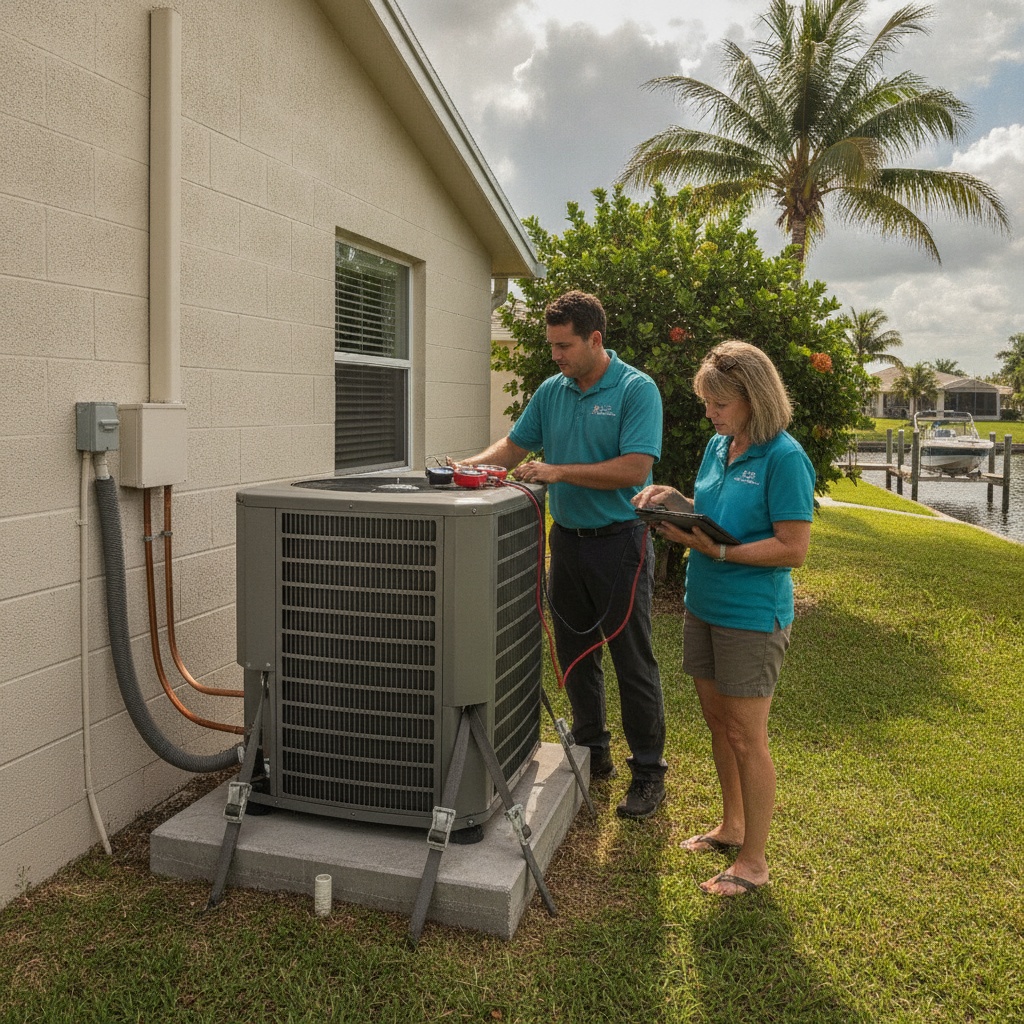
The compressor quote lands, then the office says the part is covered and the visit is on you. That split is what AC warranty coverage actually means in Englewood, Venice, and Port Charlotte. The certificate that came with the condenser usually pays for a factory-defective part. The licensed contractor still has to diagnose it, recover the charge, and set the new compressor, and that clock is a different piece of paper.
Parts vs labor
A manufacturer’s parts warranty pays for a component that failed because of how it was built. The compressor, the condenser fan motor, a control board, an expansion device, and similar factory parts sit on that list when the failure traces to a defect. The installing contractor files the claim through a distributor, the replacement part shows up, and you still owe the trip, the diagnosis, and the hours on the job unless a separate labor term is still open.
Labor coverage, when it exists, comes from the contractor who set the system or from an extended agreement sold at install. It runs on its own calendar. A parts claim can be alive while the labor term is already closed, which is how a homeowner ends up with a “free” compressor and a paid repair. Most AC repairs after the diagnostic run $150 to $650 for parts and labor in this metro. The diagnostic itself is $89 to $150. A compressor job with recovery, brazing, and a vacuum sits at the hard end of that work even when the manufacturer ships the part.
Registration changes the parts clock on many brands. The certificate names a window after installation. Miss it and the shorter base term is what you have. The dealer often files that registration, and you should still ask for the printout with the serial numbers for the outdoor unit and the air handler. A Venice snowbird house closed from April to November is a common place for that packet to disappear into a drawer. Pull it before the first failure, not after.
A home warranty is a third contract. It is an annual service plan, often tied to a real-estate closing, with its own cap, its own exclusions, and its own assigned technician. It does not extend the manufacturer’s parts term, and it does not automatically pick up labor the factory skipped. Read that agreement as its own deal.
When the failed part is the whole matched system, the conversation shifts to AC installation. A full changeout on a single-family home, condenser and air handler, runs $5,500 to $12,000 installed in this footprint. A standard split system is $5,500 to $8,500. A higher-efficiency variable-speed system is $9,000 to $12,000. Heat pumps are the usual replacement here because one system carries the cooling load and the occasional cool snap.
| Contract | What it pays | What it leaves with you |
|---|---|---|
| Manufacturer parts warranty | A factory-defective part, once the claim is accepted | Diagnosis, labor, shipping, and anything the certificate calls a service issue |
| Installing contractor labor term | Labor to put a covered part in, while that term is open | Work by another company, neglect, and failures outside the labor calendar |
| Annual home warranty | A repair or replacement through the plan’s network, up to that plan’s own cap | Anything the plan excludes, anything over the cap, and the manufacturer’s separate parts rules |
The maintenance log manufacturers ask for
Manufacturers treat a recorded tune-up as proof the system was cared for. A stack of filter-change photos helps. It rarely replaces a dated invoice from a licensed HVAC contractor that lists the model, the serial number, the date, and the work. If a compressor fails in year six and the file is empty, the claim reviewer can call the failure a maintenance issue and close the ticket.
That clause bites hardest on this coast. A condenser on a canal-front lot in Placida picks up salt crust on the fins after two summers. A Dearborn Street cottage still running original 1960s ductwork leaks return air in a hot attic, so the indoor coil ices and the compressor sees liquid. A Rotonda West house with a clogged condensate line trips the float switch on an August afternoon. A Port Charlotte ranch that took wind damage during Hurricane Ian’s September 2022 landfall near Charlotte Harbor may have run “fine” for a season and then failed a board. None of those look like a clean factory defect on paper.
HVAC maintenance visits in this metro run $89 to $150 per visit, and less on an annual plan. The visit is where a contractor rinses the outdoor coil, checks the drain, measures the electrical load on the motors, and writes the record the warranty desk will ask for later. Keep every invoice. A Wellen Park new-build and a Grove City cottage need the same paper trail, even though the equipment ages differently.
Snowbird houses need the log across the months the house is empty. A thermostat left on a deep setback in a closed Venice or Punta Gorda home from spring to fall does not count as a tune-up. Have the system checked before you leave and after you return. The snowbird shutdown checklist is the homeowner-side list. The warranty file wants the contractor’s dated work order.
Unlicensed work can unwind the rest. A neighbor who opens the refrigerant circuit, or a handyman who swaps a capacitor on a live disconnect, gives the manufacturer a clean reason to deny the next claim. Florida’s air-conditioning contractor classes live in F.S. 489.105(3). A Class A contractor’s services are unlimited on central air-conditioning, refrigeration, heating, and ventilating systems. A Class B contractor is limited to 25 tons of cooling and 500,000 Btu of heating in any one system. You can confirm a licence on the Florida DBPR License Search. Refrigerant work is a separate federal layer: EPA Section 608 certification is what governs who may maintain, service, repair, or dispose of equipment that could release refrigerant.
What is never covered
Storm damage sits with the homeowners policy. Manufacturer certificates treat wind, surge, lightning, and flood as outside a factory defect. After Ian, a lot of Port Charlotte and Punta Gorda outdoor units ran, then failed a season later. That pattern reads as weather and corrosion, which is why the claim and the insurance file need to stay in their own lanes.
Refrigerant is usually a service cost. The charge people still call Freon is not a “part” in the way a compressor is a part. A slow leak on a salt-exposed line set in Cape Haze, a rubbed-through suction line in an attic, or a coil that perforated is a leak repair, and leak repair is the kind of work a parts warranty is written to skip. Only an EPA Section 608 certified technician may open that circuit. Do not add charge, recover charge, or crack a service port. The diagnostic and the leak work are paid repair unless a labor agreement or a home-warranty rider says otherwise in writing.
Neglect is the other door the manufacturer keeps closed. A condenser buried in grass clippings, a filter left in for a year, a drain line that has not been cleared, a system short-cycling because it was oversized for a small cottage: those failures get written up as use and care. Predictive parts, a weak capacitor that has not failed yet, thermostat reprogramming, and moving a condenser for a lanai addition are the same kind of exclusion. Cosmetic rust on a cabinet in Boca Grande salt air is environmental wear. The city pages already point coastal homes toward coated or marine-grade condenser coils. That is protection going forward. It does not rewrite an old certificate.
A home warranty can still say no. Pre-existing conditions, work the plan’s technician did not perform, and anything above that plan’s cap stay with you. The plan also sends its own contractor. That person may be a stranger to the system that was registered under the installing company’s account, which is how a parts claim and a home-warranty dispatch miss each other.
Florida paperwork a warranty does not skip
A warranty replacement of a condenser or an air handler is still mechanical work. F.S. 553.79 exempts some single-family jobs valued under $7,500 from a building permit, and it expressly keeps electrical, plumbing, structural, mechanical, and gas work outside that exemption. An AC changeout is permitted work at any price. The pro we send pulls that permit. Inspection fees may not be based on the total cost of the project, which is F.S. 553.79(1)(f).
Englewood straddles the county line, so the department changes with the address. ZIP 34223 is Sarasota County. ZIP 34224 is Charlotte County. Boca Grande and Palm Island are reached through the Charlotte County mainland and sit in Lee County, so they are not Charlotte County addresses. On the Charlotte side, the county’s residential mechanical permit covers replacement of heating and air conditioning equipment at a residential location. The qualifications listed as able to obtain that permit are Owner-Builder, Certified HARV Class A, Certified HARV Class B, Certified Mechanical, Registered HARV Class A, Registered HARV Class B, and Registered Mechanical.
Notice of commencement is the other Florida figure people mix up with warranty talk. F.S. 713.135 requires the applicant to file a copy of the notice of commencement before the first inspection when the direct contract is greater than $5,000. That same subsection does not apply to a direct contract to repair or replace an existing heating or air-conditioning system in an amount less than $15,000. Charlotte County’s mechanical page restates the $15,000 notice-of-commencement line for that permit. F.S. 553.792 gives a five-business-day decision window on a complete mechanical permit application for an existing single-family dwelling when the value of the work is less than $15,000. It is a decision deadline, not a promise the card is in the window that afternoon.
A new matched system can also meet FPL’s residential A/C rebate: $200 as an instant credit on the invoice, on a SEER2 15.2 rated unit and above, for a new A/C system purchase that includes both indoor and outdoor units, delivered by FPL’s participating contractor. That rebate is FPL’s program. It is not a warranty payout.
Common warranty questions
Does an AC warranty cover refrigerant?
Manufacturer parts warranties typically leave the refrigerant charge with the homeowner. A leak is treated as a service failure, corrosion, or installation issue. Some extended labor agreements and some home-warranty riders pick up a limited charge, and that language lives in that contract. Whoever handles the circuit still needs Section 608 certification. Existing R-410A equipment may still be serviced. The 2025 federal limit in 40 CFR 84.54 changed what may be installed new. It did not make an older system illegal to own.
How long does an AC have a warranty?
The certificate on your serial numbers is the term. Many brands run a shorter parts period if the product was never registered, and a longer one if it was registered inside the window printed on that form. The compressor sometimes carries a longer parts term than a fan motor or a board because it is the expensive heart of the outdoor unit. Labor, if you bought it, is a second clock. Transfer rules when you sell a Venice or North Port house are also on that certificate, including any window after closing.
Is a 10-year labor warranty worth it?
Labor is the bill the factory skips, and the expensive failures here are labor-heavy: a compressor, an evaporator coil, a condensing fan motor on a salt-crusted Boca Grande or Manasota Key unit. A long labor term has the most value while that calendar still covers those jobs, and less value if the installing company is gone and the term is not transferable. Compare it against the repair range of $150 to $650 and against a full replacement of $5,500 to $12,000. Ask, in writing, what happens to that labor term if you sell the house.
What is the $5,000 rule for HVAC in Florida?
Florida uses $5,000 as the notice-of-commencement threshold in F.S. 713.135, with a carve-out for a direct contract to repair or replace an existing heating or air-conditioning system under $15,000. That is permit paperwork. It is not a warranty cap and it is not a legal cutoff that says a repair must become a replacement. For the money decision, use the published ranges: diagnosis $89 to $150, most repairs $150 to $650, full system replacement $5,500 to $12,000. A denied compressor claim is often the moment a matched replacement is the cleaner path, and that job still needs the mechanical permit.
When to call us
When a compressor, coil, or board fails, a licensed HVAC contractor is the person who reads the serial numbers, files or declines the parts claim, and prices the labor the certificate skipped. We match you with licensed and insured contractors who do that work in Englewood, Venice, Port Charlotte, Punta Gorda, and North Port. Call us at (941) 292-6250.