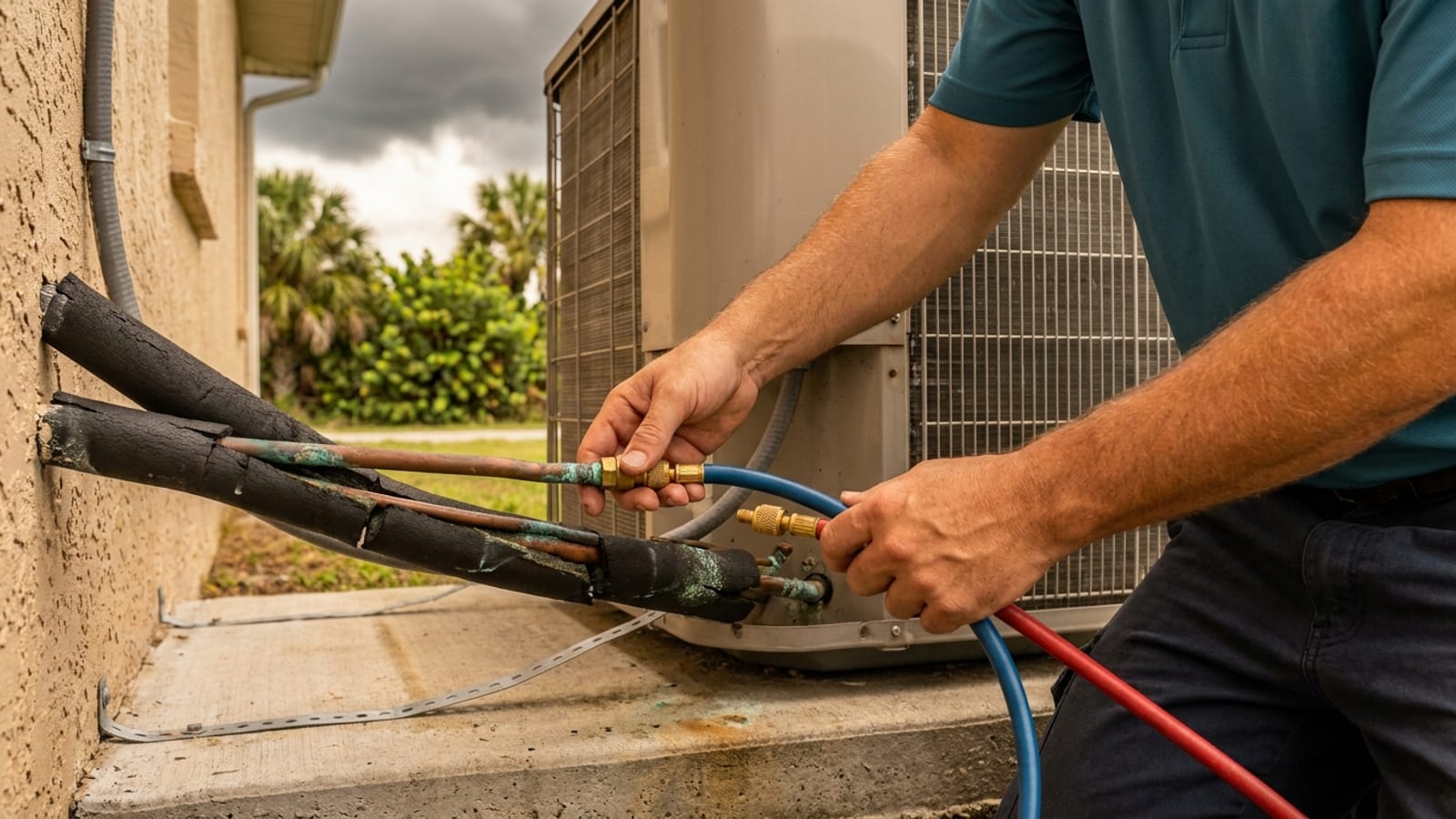
A refrigerant leak on an R-410A system doesn’t force a full replacement, and the federal rules moved in the homeowner’s favor this summer. What you pay comes down to where the leak sits and whether reaching it turns into a component swap. Most AC repairs in Englewood, Venice, and Port Charlotte run $150 to $650 for parts and labor once the diagnostic is done, and the diagnostic itself runs $89 to $150.
What drives AC refrigerant leak repair cost in Englewood
Nobody can quote the fix until they’ve found the leak. That’s why the diagnostic is its own line on the invoice, and the pros we send quote that fee before they start looking.
After that, it’s mechanics. A leak in the copper line set is a different job from a leak in the outdoor condenser coil, and both are cheaper than one buried in the indoor evaporator coil. How much of the cabinet has to come apart to reach it matters just as much as the leak itself.
Our climate stacks the deck toward the expensive end. The cooling season here runs nine months, and salt-laden air works into connections and coils on homes near the Gulf and the bay. Corrosion doesn’t leave one tidy pinhole. It leaves a coil that’s failing in several places at once, which is the point where a patch stops being worth it. Our guide to AC repair costs in Englewood breaks down what the individual parts run.
Does a leak mean you have to replace the system
No. Plenty of homeowners get told a leak means a whole new air conditioner, and the EPA says otherwise in plain language: “Homeowners can maintain and repair their systems throughout the useful life of the equipment.”
You’re allowed to fix what you own. The agency puts it directly: “A homeowner can replace a faulty component (e.g., condensing unit, indoor coil, other smaller parts) with a similar R-410A component.” If the outdoor unit is shot and the indoor air handler is fine, the outdoor unit can be replaced on its own. Half a working system doesn’t have to go in the dumpster to satisfy a rule.
What counts as a repair and what counts as a new system
This is the fork that decides the whole bill. Replace one major component and it’s a repair. Replace both halves together and you’ve installed a new system, which has to meet the current 700 GWP limit.
The EPA’s line is exact: “A new system would also be installed if both the condensing unit and indoor coil are replaced together.” The condensing unit is the outdoor box holding the condenser coil and compressor. The indoor coil is the evaporator, sitting in the air handler.
Reusing your existing refrigerant lines doesn’t change the answer. EPA addresses that case head on, because the line set usually stays put during a changeout. Both coils replaced together is a new installation either way. One coil is a repair.
What changed in the federal rules in 2025 and 2026
Two dates matter, and the second one is recent enough that most cost guides online still have it wrong.
From January 1, 2025, new residential air conditioners and heat pumps have to use a refrigerant under 700 GWP. That limit sits on manufacturing and import, and it hasn’t moved.
The second date is the one that changed. A final rule published at 91 FR 31284 on May 26, 2026, and effective July 27, 2026, “Removes the January 1, 2026, installation compliance date for equipment using refrigerants above the 700 limit that were domestically manufactured or imported into the United States before January 1, 2025”, and it “Allows pre-2025 inventory of air conditioning systems to be installed until supply runs out”.
In plain terms, the clock people were told to beat is gone. Pre-2025 R-410A equipment sitting in a warehouse can still be installed. If a quote leans on a deadline to push you into replacing instead of repairing, that deadline no longer exists.
Are you required by law to fix a leak
Not by the federal government, not on a house. The leak repair provisions at 40 CFR 84.106 went live on January 1, 2026, and they reach appliances holding 15 pounds or more of refrigerant, which is commercial territory.
The EPA states the exclusion outright: “Appliances used in the residential and light commercial air conditioning and heat pumps subsector are not included in the leak repair provisions.” There’s no federal repair-or-retire clock on your air conditioner.
The mechanical argument is a different story. A system running short on charge works itself to death, and the compressor is the part that pays for it. Our guide to an AC that isn’t cooling walks through what a low charge actually does to the equipment.
Is it true they don’t make that refrigerant any more
Mostly not, and it’s the most common bad reason to replace a working system. Factories stopped building complete new R-410A residential systems at the start of 2025. They did not stop building parts.
Components made with R-410A after January 1, 2025 must carry a label, in EPA’s words, noting that the component may be used “for servicing existing equipment only”. That label is exactly what keeps a component repair legal and available. The parts exist, and a licensed contractor can get them. For who’s allowed to buy and handle refrigerant in the first place, read our breakdown of handyman AC repair in Florida.
When replacing does make more sense in an Englewood house
Sometimes chasing a leak is throwing money at a system that’s already done. The clearest case is an older unit still running R-22, which is expensive and hard to source now. Patching one of those rarely pencils out.
Age is the other case. Once a system is past 12 to 15 years old in this climate, a leak is usually one of several things about to go. Our guides to AC replacement costs and how long AC units last here cover where that line sits.
Sizing is worth checking at the same time. Humidity load matters as much as heat load in a Gulf-coast house, and a system that never pulled moisture out properly won’t start doing it just because it’s back to full charge. The contractors we route to run a real load calculation rather than carrying over the old tonnage, and our guide to oversized AC units explains why that matters.
What to ask for on the quote
When a technician comes out to your home in Englewood or Port Charlotte, ask them to locate the leak before they price anything. A number given before the diagnostic is a guess.
Then ask which component is leaking, and whether the fix replaces one part or two. That single answer tells you whether you’re looking at a repair or a new system, and it’s the difference between the two ends of the price range.
If replacement is on the table, ask what refrigerant the proposed equipment uses and what its SEER2 rating is, in writing. Whether the job turns out to be an AC repair, a full AC installation, or a case for HVAC maintenance, the mechanics belong on paper.
Frequently asked questions
What do I do if my AC is leaking refrigerant in Florida?
Leave it running only if it still cools. Do not DIY-recharge as a fix. Get the leak located before anyone prices the repair.
Can I just recharge the system without fixing the leak?
You can, and it buys time rather than a fix. The new charge leaks back out at the same rate, and a system running low keeps stressing the compressor until it fails. Recharging is a stopgap while you decide, not a repair.
Does a leak mean I have to replace my whole system?
No. The EPA states that homeowners can maintain and repair their systems throughout the useful life of the equipment. A single faulty component, including the outdoor condensing unit, can be replaced on its own with a similar R-410A part.
Are R-410A parts still available for repairs?
Yes. Manufacturers still build components for R-410A systems. Federal rules require parts made after January 1, 2025 to carry a label saying they are for servicing existing equipment only, which is what keeps those repairs legal.
Will I be fined for having a refrigerant leak at home?
No. The federal leak repair provisions took effect January 1, 2026 for appliances holding 15 pounds or more, and residential air conditioning and heat pumps are excluded from them outright. There’s no federal deadline to repair or retire your system.
What turns a repair into a new system installation?
Replacing both the condensing unit and the indoor coil together counts as a new system, and a new system has to use a refrigerant under 700 GWP. Replacing only one of the two is still a repair, and it can still use R-410A.
Does reusing my refrigerant lines keep it a repair?
No. The existing line set usually stays in place during a changeout, so it doesn’t change the classification. Swap both the indoor coil and the outdoor condensing unit at once and it counts as a new installation.
Get the leak found before you price the fix
A refrigerant leak is stressful enough without a sales pitch built on a deadline that was removed in July. The question worth answering first is which component is leaking, because that’s what decides whether this is a few hundred dollars or a replacement conversation.
Englewood Air Pro connects homeowners with licensed and insured local HVAC contractors. The assigned provider sets availability, pricing, warranties, and service terms.
Call (941) 292-6250 to request a connection for refrigerant leak diagnosis, repair, or a replacement quote.