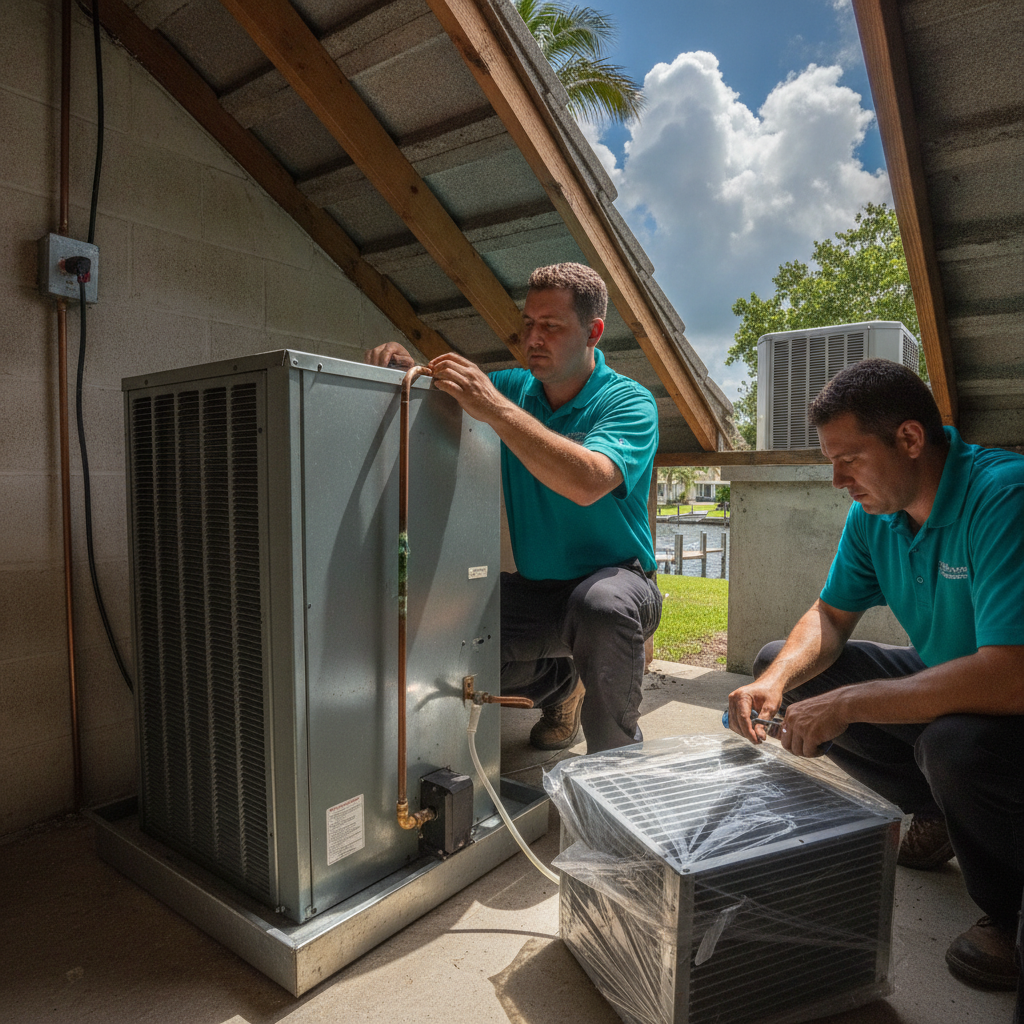
The evaporator coil is the cold indoor coil in your air handler. Gulf-coast air blows across those fins all summer, the refrigerant inside picks up the heat, and the house stays dry enough to live in. When a pinhole opens in that coil, the charge leaks down, the vents go lukewarm, and ice can crust the fins.
Evaporator coil replacement is a sealed-system job, not a parts-counter purchase. The licensed HVAC contractor we send starts with a diagnostic at $89 to $150. Most ordinary AC repairs after that run $150 to $650 for parts and labor. A leaking indoor coil sits above that band, because the circuit has to be opened and the new coil has to match the outdoor unit. The figure that actually frames the choice is a full system replacement, condenser and air handler, at $5,500 to $12,000 installed on a single-family home.
A coil leak vs a line leak
A coil leak and a line leak both starve the system of refrigerant. They are not the same repair, and they do not cost the same kind of day.
The evaporator coil lives indoors. In a 1960s cottage near Historic Dearborn Street the air handler is often jammed in a closet with original ductwork still leaving the top of the cabinet. In a Port Charlotte ranch it may sit in the garage or a hallway. In some Venice and North Port houses it is a horizontal unit in a hot attic. The coil itself is a packed maze of small tubing and fins. Formicary corrosion on copper, acidic condensate sitting in the pan, and freeze-thaw from a clogged filter all punch pinholes in that tubing. The leak is inside the cabinet. You may see ice on the coil, a wet pan, or oil staining on the fins. Cooling drops off. The outdoor fan still spins.
A line leak is on the copper that runs between that indoor coil and the outdoor condenser: the line set, a service valve, a braze joint, or a fitting at the cabinet. Salt air on a Placida, Cape Haze, or Manasota Key condenser eats the outdoor fittings and fins first. A canal-front unit with white crust on the grille is a different failure than a pinhole buried in an A-coil. Barrier-island stock on Boca Grande and Palm Island takes the worst salt in this footprint, but those addresses sit in Lee County, so the permit path is not Charlotte County’s even when the truck rolls in from the mainland.
The cost difference is the work after the leak is found. A line leak can sometimes be isolated, repaired, evacuated, and recharged without pulling the indoor coil. A leak in the evaporator coil itself is almost always a coil replacement. You cannot patch a pinhole maze packed in fins in a way that holds through another August. The refrigerant leak repair visit starts the same way either way: a licensed contractor recovers what is left, finds the leak, and then decides whether the indoor coil, the line set, or the whole system is the failing piece.
A frozen indoor coil is a clue, not a diagnosis. Low charge from a coil leak makes the remaining refrigerant colder, so moisture in the air ices the fins. A dirty filter can freeze a healthy coil too, which is why a frozen AC coil still needs a real leak check. Do not add refrigerant yourself. EPA Section 608 requires certification for anyone who maintains, services, repairs, or disposes of equipment that could release refrigerant.
R-410A vs A2L coil swaps
The refrigerant family decides whether a coil-only swap is even on the table.
Most systems in Englewood, Venice, and Port Charlotte that went in before 2025 run R-410A. That existing equipment is legal to own and legal to service. The federal change that landed on January 1, 2025, is about what may be installed new. Under 40 CFR 84.54, new residential and light commercial air-conditioning or heat pump systems using a regulated substance with a global warming potential of 700 or greater are restricted. New systems in that class may still be installed where every specified component was manufactured or imported before January 1, 2025. Availability, not a ban on the unit already in your yard, is the practical limit. The EPA Technology Transitions program is the HFC rule behind that switch, and our A2L refrigerant rules post is how it reads on a changeout in this metro.
A coil-only replacement on an R-410A system means the new indoor coil has to match that outdoor unit’s refrigerant, capacity, and metering device. Drop the wrong coil on an older condenser and the charge, the superheat, and the compressor all suffer. The contractor we send is hunting a compatible replacement coil, not a generic slab from a surplus bin.
A2L is the informal name for the newer, lower-GWP refrigerants in equipment built for the post-2025 rules. Those coils, leak sensors, and outdoor units are a matched set. You do not put an A2L coil on an R-410A condenser and call it a repair. If the outdoor unit is already tired, or the matching coil for the old family is scarce, the quote slides toward a full AC installation instead of a coil swap.
Heat pumps are this metro’s usual replacement recommendation, because one system covers the long cooling season and the occasional cool snap. A coil leak on a heat pump is the same sealed-system problem. The indoor coil works in both modes, so a pinhole that shows up as weak cooling in August can also show up as weak heat on a January morning.
What the quote includes
The quote for an evaporator coil replacement is a stack of labor and materials, not a coil SKU.
A complete quote from the licensed and insured contractor we send should name the diagnostic that found the leak, billed in the $89 to $150 range we publish for AC repair. It should name recovery of the remaining refrigerant, removal of the old coil, and installation of a coil matched to the outdoor unit. It should name evacuation of the circuit, a new charge, and any metering device or drain pan that has to travel with that coil. Access labor moves the number: a Dearborn closet, a Venice attic slab coil, and a screened mechanical space in Rotonda West are three different days of work. The permit path belongs on the page too, because this is mechanical work.
The $7,500 owner exemption in F.S. 553.79 does not reach mechanical work. Replacement of heating and air-conditioning equipment is mechanical work, so it is permitted work at any price. Charlotte County’s residential mechanical permit covers replacement of heating and air conditioning equipment at a residential location. Englewood straddles the county line. ZIP 34223 is Sarasota County. ZIP 34224 is Charlotte County. The same coil job files with a different building department depending on the address. F.S. 553.792 gives a five-business-day decision window on a complete mechanical permit application for an existing single-family dwelling when the value of the work is less than $15,000. That is a decision deadline, not a promise the permit prints that afternoon. Florida also carves out the notice of commencement for a direct contract to repair or replace an existing heating or air-conditioning system in an amount less than $15,000.
Manufacturer parts coverage, when it still applies, usually pays for the coil itself. Labor, refrigerant handling, and the rest of the visit stay on the homeowner. That coverage lives in the registration paperwork from the original install, not in a guess about the system’s age. Confirm it before you compare a coil-only number to a changeout.
A longer line set, a coil that is not an exact cabinet match, and an air handler that has to come apart in an attic all add copper, time, and fittings. Those are the levers. They are why two houses on the same street can see two very different coil quotes.
Coil swap or a full changeout
A coil-only job makes sense when the outdoor unit is sound, the refrigerant family still has a matching coil, and the rest of the air handler is not next in line. A full changeout makes sense when the condenser is already tired, the indoor and outdoor pieces would be mismatched, or you would rather put the money into one permitted system than into a coil that still sits on an aging compressor.
| Coil-only swap | Full system changeout | |
|---|---|---|
| What you are buying | A new indoor coil on the existing refrigerant circuit | A new outdoor unit and air handler together |
| Refrigerant | Stays on the family the outdoor unit already uses | New equipment follows the 2025 GWP limit for new systems |
| Permit | Mechanical work, so the cheap-job exemption does not apply | The same: permitted mechanical work at any price |
| FPL residential A/C rebate | Does not apply. That program needs a new indoor and outdoor unit | May apply at SEER2 15.2 and above, as a $200 credit on the participating contractor’s invoice |
A standard split system, installed, runs $5,500 to $8,500 in this footprint. A higher-efficiency variable-speed system, installed, runs $9,000 to $12,000. A heat pump system, installed, runs $6,000 to $14,000. Those are market ranges for a single-family home, not a quote. Put a coil-only repair next to those numbers and the decision gets honest fast, especially on a Port Charlotte house that already took outdoor-unit damage in Ian’s September 2022 landfall near Charlotte Harbor, or on a snowbird place in Venice that sat closed from spring to fall with a filter that never moved.
FPL’s published residential rebate is $200 off a new A/C, for a SEER2 15.2 rated unit and above, on a residential install that includes both indoor and outdoor units. The credit shows up on the invoice the participating contractor provides. A coil swap does not meet that description. If the quote is already sliding toward a changeout, read the FPL A/C rebate page and our AC replacement cost breakdown before you pick a path.
Skipped filters are how a healthy coil becomes an iced coil, and an iced coil is how pinholes start. Regular HVAC maintenance is the cheap side of this story: a clear filter, a clear drain, and a coil that actually sees airflow. The Florida Building Code in force is the 8th Edition (2023), effective December 31, 2023, per the Florida Building Commission. The contractor we send pulls the mechanical permit. You can confirm that person is licensed through the Florida DBPR license search.
Is it worth replacing an evaporator coil?
It is worth it when the outdoor unit still has life, a matching coil exists for that refrigerant family, and the rest of the air handler is not failing with it. It is the wrong spend when you would be hanging a new coil on a condenser that is already noisy, stained, or short on parts. Compare the sealed-system repair to a full changeout at $5,500 to $12,000 installed, and decide once.
How do I tell if my evaporator coil is bad?
Lukewarm air with the outdoor unit running, ice on the indoor coil, a wet or stained drain pan, and a system that short-cycles without drying the house are the usual picture. A clogged filter can mimic some of that, so the licensed contractor still has to recover charge and find the leak. Warm air on a heat pump in heating mode is the same coil, working the other direction.
Can I replace only a Rheem evaporator coil?
A Rheem coil, like any other brand’s, has to match that outdoor unit’s refrigerant, capacity, and metering device. There is no separate published Rheem coil price for this metro. Brand is a compatibility problem first and a parts-cost problem second. If the matching coil is available and the condenser is sound, a coil-only swap is still a real option. If it is not, the quote should be a matched system, not a mismatched indoor slab.
When to call us
Ice on the indoor coil, lukewarm air in a closed-up Venice house, or a leak already found in the evaporator is the moment to get a licensed HVAC contractor on site. The pros we send recover the charge, confirm whether it is the coil or the line set, and quote a coil swap or a matched changeout. Call us at (941) 292-6250.