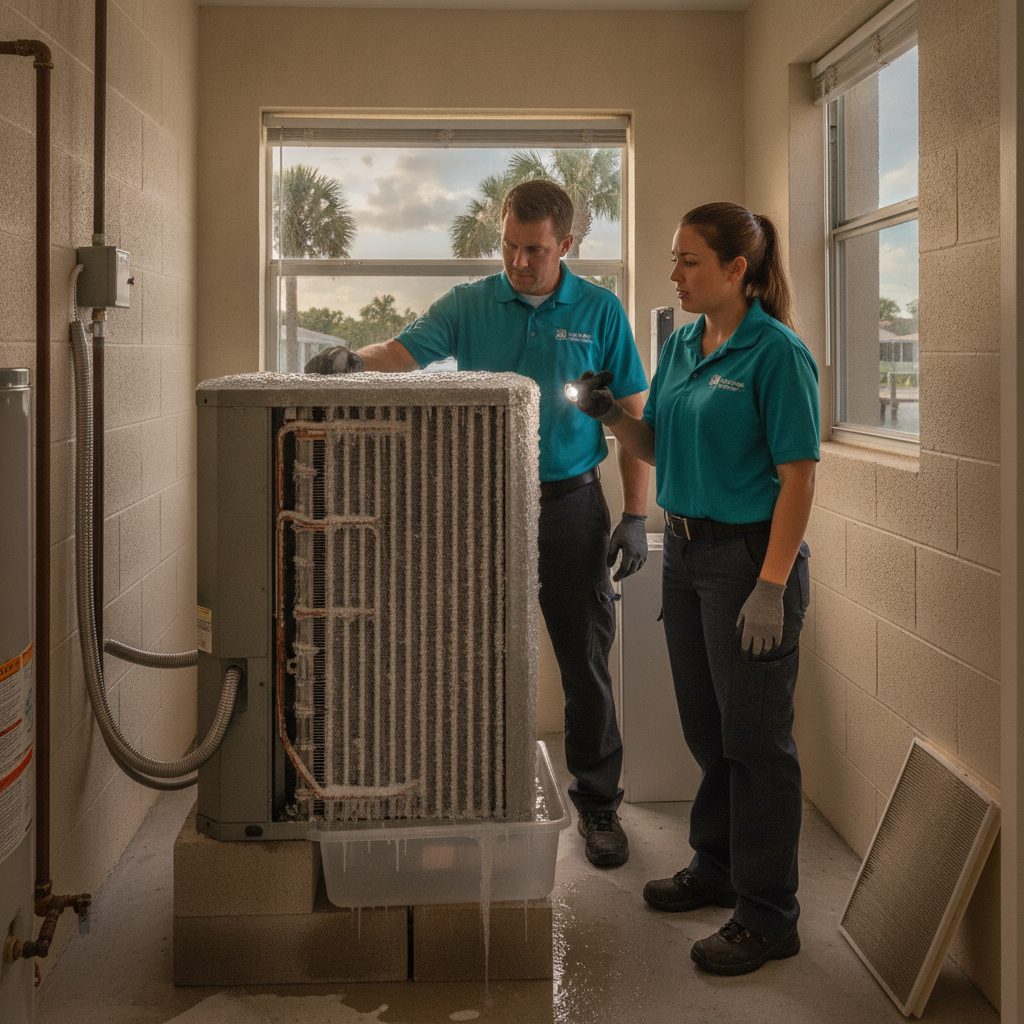
Ice on the indoor coil is why the vents go weak and the house stays sticky. The evaporator is supposed to run cold so it can pull heat and moisture out of the air. When Gulf humidity hits a starved coil, that moisture turns into a shell of ice, airflow collapses, and cooling stops even while the outdoor unit keeps humming.
Why a coil ices in humid Gulf air
Englewood air is wet. Lemon Bay, Charlotte Harbor, and the Gulf keep indoor humidity high even when the thermostat is set where you like it. Warm, damp return air is supposed to wash over the evaporator coil so the refrigerant inside can absorb heat. Water then beads on the fins and runs to the drain pan. That drip is the system doing its job.
Ice starts when the coil surface gets colder than it should, or when too little air moves across it. With less heat arriving at the copper, coil temperature falls. Condensation that should drip now freezes. The first frost is a film. The next pass packs it. Pretty soon the fins are a solid block, the blower is pushing against ice, and a cottage near Historic Dearborn Street or a canal lot in Placida stops cooling.
You will see it in a few ways. Frost or a hard crust on the indoor coil. Ice on the insulated copper line leaving the air handler. Weak airflow at the supplies. Air that is moving but not actually cold. A puddle at the indoor unit once the ice starts to melt. Those puddles matter here, because a clogged condensate drain already struggles in this humidity, and a thaw dumps a lot of water into a pan that may not keep up.
The indoor coil is the usual one in cooling season. That is the evaporator, tucked in the air handler or sitting on a closet furnace. The outdoor coil is the condenser. It can ice too, more often on a heat pump during a cool snap, but a house that will not cool in August is almost always an indoor freeze. If you have a heat pump, do not switch it to defrost to clear ice on the indoor coil. Defrost is for the outdoor coil. Using it the wrong way does not thaw the evaporator.
Gulf humidity is the fuel. Restricted airflow or a low charge is the spark. A snowbird house in Venice, closed from spring to fall with the filter untouched, is a classic setup. So is a Port Charlotte ranch with a sofa over the return, or original ductwork in a 1960s Englewood cottage that never moved enough air to begin with. The climate does not freeze the coil by itself. It just gives the coil plenty of moisture the moment something else goes wrong.
The National Weather Service Tampa Bay area office publishes the Punta Gorda and Sarasota-Bradenton climate records that sit behind this. You do not need a chart to feel it. Walk into an air handler closet in Rotonda West on an August afternoon and the air is thick. That moisture has to go somewhere. On a healthy coil it leaves as condensate. On a starved coil it leaves as ice.
Airflow, charge, and a clogged filter
Three things keep an evaporator honest: enough air, a clean coil surface, and the right amount of refrigerant. Knock any one of them out and the coil can ice.
A packed filter is the common one. Dust, pet hair, and the fine grit that blows off our sandy lots load a filter until the blower cannot pull air. The coil then sits in a still, cold pocket. Change that filter if it is gray, matted, or bowing in the rack. In an older cottage near Historic Dearborn Street, original returns are already tight. A dirty filter on a small return is enough. Same story in a Rotonda West house that sat closed, or a Wellen Park build in North Port where construction dust is still in the ducts.
Blocked returns and closed supplies do the same job. A return behind a sofa, a supply vent shut in unused rooms, crushed flex in a hot attic: each one starves the coil. The blower may sound fine. The coil still does not see enough warm air to stay above freezing.
A dirty evaporator is next. When the filter has been neglected, dust coats the fins and acts like a blanket. Heat cannot reach the refrigerant. Surface temperature drops. Ice follows. Indoor coil cleaning is not a garden-hose job. The licensed and insured contractors we send handle that during HVAC maintenance, along with a look at the blower wheel and the drain.
Low refrigerant is the other big path. A leak drops the pressure in the coil. Lower pressure means a colder coil, even with decent airflow. You might see oily film near a fitting, hear a faint hiss, or simply get air that will not cool while ice builds on the suction line. Do not add refrigerant yourself. EPA Section 608 is the federal rule that says who may maintain, service, repair, or dispose of equipment that could release refrigerant. The contractors we send hold that work. If the leak is the story, the repair is about finding it and fixing it, not topping off a system that will ice again. Our page on refrigerant leak repair walks through that path.
A weak blower, a thermostat that never stops calling for cool, and an oversized system that short-cycles can all land in the same ice. Oversizing is a real local pattern: a changeout sized for the hottest hour, not for how a humid house actually sheds moisture. Short, hard runs leave the coil wet and the house clammy. Long, starved runs freeze it.
None of this is a DIY refrigerant or electrical job. A filter, open vents, and a thermostat battery are the homeowner side. Everything that opens the sealed system, the high-voltage disconnect, or the coil itself belongs to a licensed HVAC contractor. You can confirm a contractor’s license on Florida’s DBPR License Search before anyone opens a panel.
What to do while it thaws
Turn the system off at the thermostat. Switch it from Cool to Off. Leave the fan on if you can, so room air washes over the ice and speeds the melt. Do not keep running the compressor against a frozen coil. Liquid refrigerant can slug back toward the compressor, and that is the part you do not want to lose on an August afternoon in Port Charlotte.
Let it thaw. A light frost may be gone in a couple of hours. A solid block on the coil and suction line can take most of the day. There is no honest clock that fits every air handler. The ice has to melt, and the pan has to take the water. Put towels around the indoor unit. In a closet air handler, that water has nowhere polite to go. If the drain is already slow, the pan will overflow. That is when you get stained ceiling tile in a Punta Gorda condo or a wet closet in a North Port ranch.
Do not chip at the ice. The fins are thin aluminum. A screwdriver through them is a new problem. Do not pour hot water on the coil. Thermal shock and a warped pan are not a thaw. A hair dryer on high, a heat gun, boiling water: skip all of it. Room air and time are the safe tools.
Once the copper is bare and the drip has stopped, look at the obvious. Pull the filter. If it is packed, replace it before anyone restarts the system. Walk the house and open supplies and returns. Move the furniture off the grill. If the ice came back last summer after the same filter trick, stop there. Restarting into the same restriction or the same leak puts ice back on the coil, often the same afternoon.
A frozen coil is not automatically a dead system. Many of them thaw, get airflow back, and run. The ones that ruin a compressor are the ones that keep running while iced, or that ice again because the charge is low. If you smell burning, hear the outdoor unit struggling, or the breaker has been tripping, leave it off. That is AC repair territory, not another restart.
Salt air on a Manasota Key or Placida condenser is a different failure. Crusted outdoor fins make the outdoor unit work harder, but the ice you are staring at on the indoor copper is still an airflow or charge problem. Fix the indoor cause first. If the outdoor coil is packed with salt and grass, the pro we send can rinse and inspect it once the house is cooling again.
Questions homeowners ask after a freeze
Is my AC ruined if the coil freezes?
Usually no. Ice is a symptom, not a death sentence. The coil itself is copper and aluminum, and ice on it does not mean the metal is finished. What wrecks equipment is running the compressor while the coil is blocked, or ignoring a leak until the compressor is starved. After a full thaw, a licensed contractor can tell whether you are looking at a filter and a cleaning, a sealed-system repair, or a system that is ready for replacement. Heat pumps are the usual replacement conversation in this metro, because one system handles the cooling load and the occasional cool snap.
How long should I leave the AC off if the coils are frozen?
Leave it off until you can see bare metal on the coil and the suction line, and until the dripping has stopped. Light frost can clear in a few hours with the fan running. A heavy shell can sit all afternoon. Restarting while ice is still in the fins puts you right back where you started. There is no universal hour count that fits a closet air handler in Grove City and a garage unit in South Venice. Watch the coil, not the clock.
Will a frozen AC unfreeze on its own?
Not while it is still calling for cool. If you leave it in Cool, the compressor keeps driving the coil colder and the ice grows. Turning it Off, and running the fan, is what lets room air thaw it. The ice will melt. The cause will not fix itself. A dirty filter you can replace. A leak, a failed blower, or a packed coil will ice again as soon as the system runs.
How much does it cost to fix a frozen evaporator coil?
The diagnostic visit for AC repair in this footprint runs $89 to $150. Most repairs after that, parts and labor, land between $150 and $650. That band covers a lot of frozen-coil work: a blower, a control, a cleaning, a straightforward repair. A sealed-system leak can sit in that band or climb with the scope of the work. If the compressor is gone and the house needs a new condenser and air handler, full-system replacement on a single-family home is $5,500 to $12,000 installed. Those are market ranges, not a quote. After-hours emergency dispatch and diagnostic runs $200 to $450, at the high end on holidays.
When to call us
Call when the ice returns after a thaw and a new filter, when you see oil on a refrigerant fitting, when the air handler is wet, or when the house will not cool once the coil is clear. The licensed and insured contractors we send diagnose the airflow and the charge, and they are the ones who open a refrigerant circuit. Call us at (941) 292-6250.