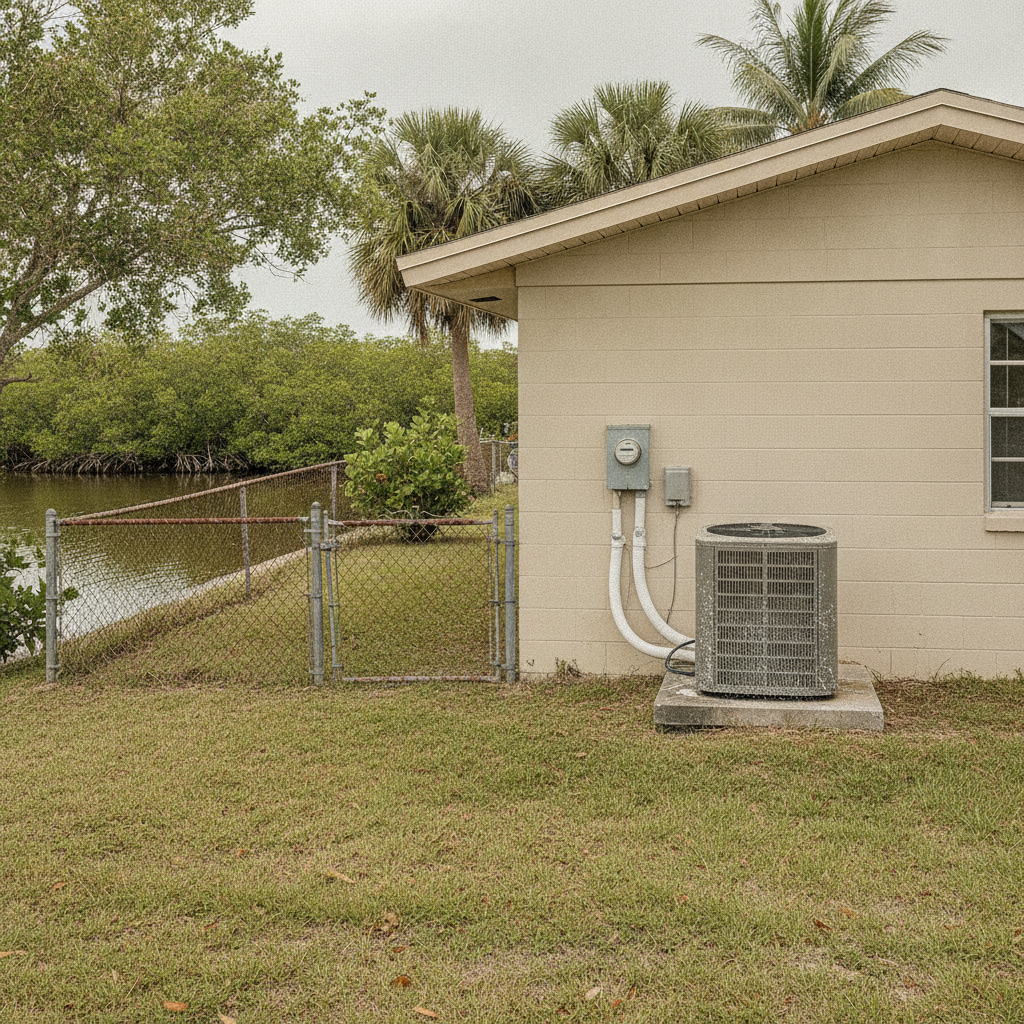
The outdoor unit on a canal lot off the Myakka in El Jobean lives in salt air, brackish spray, and river weather that a house a few miles inland never sees. When cooling stops, the usual culprits here are salt crusted on the fins, a fan cage bent into the blade, standing water on a low pad, or a float switch that opened after the drain backed up. We match El Jobean homeowners with licensed and insured HVAC contractors who already work this stretch of Charlotte County.
A condenser on the Myakka that has lived in salt air
A condenser sitting behind a chain-link fence on a Myakka canal lot takes salt in every onshore breeze. Brackish water and mangrove air leave a white crust on the aluminum fins. That crust closes the gaps the fan is supposed to pull air through. The coil cannot dump heat. Head pressure climbs. The compressor runs longer and hotter than it should. The fan motor works against a dirty, clogged face. Eventually the system blows lukewarm air, short-cycles, or will not start at all.
This is a different life from a unit on a dry inland lot in North Port. El Jobean sits on the Myakka, west of Port Charlotte, with canal cuts and small-lot block ranches that put the outdoor unit a few yards from the water. Lawn irrigation overspray adds minerals on top of the salt. After a summer afternoon the cabinet is wet, the fins are sticky, and the salt dries in place overnight. A garden hose rinse on the outside of the coil is the honest homeowner-side limit. Anything that opens the refrigerant circuit belongs to a technician with EPA Section 608 certification, because federal rules under the Clean Air Act govern who may service equipment that could release refrigerant.
A coated or marine-grade condenser coil is the usual recommendation for equipment this close to the water. That does not make the unit immune. It slows rust on the cabinet and pitting on the fins. The fan cage still takes debris. The electrical whip still sits low. If the outdoor fan hums and the blades do not spin, salt and a seized bearing are a common pair on this river. The motor tries to turn. The shaft will not. The overload opens. The house climbs through the eighties while the unit sits there making a noise that is not cooling.
When that happens, AC repair is the call, not a guess with coil cleaner and a screwdriver. The contractors we send are licensed and insured. A homeowner can confirm a Florida air-conditioning license on the DBPR license search before anyone opens a panel.
The same salt story shows up on Charlotte Harbor, but the fetch and the spray are not the same. Harbor-front lots take open-water wind. El Jobean takes river and canal air, with mangrove mud and a tighter lot. AC repair on Charlotte Harbor is a neighboring problem with a different shoreline. Keep the diagnosis on this address: the pad you can see from the dock, the cage around the fan, and the fins facing the canal.
Canal ranches, Ian, and a pad that still sits low
El Jobean is block-ranch and canal-front territory inside Hurricane Ian’s landfall zone. Ian was a Category 4 storm that made landfall near Charlotte Harbor in September 2022. Outdoor units here took wind, water, and flying debris. Some were replaced on insurance. Some went back on the same low pad and have been running that way since.
A pad that sits low on a canal lot is a standing problem. Stormwater sheets off the driveway. The canal comes up after a hard rain. The disconnect and the control compartment sit inches above a wet slab. Water in that box corrodes terminals. A control board that took a bath may boot once and fail on the next hot afternoon. A bent fan cage from a falling branch or a rolling trash can is the other leftover. The shroud is pushed in. The blade ticks metal. The motor trips on overload, or it will not spin at all.
The Atlantic hurricane season runs from June 1 to November 30, with the peak around September 10 and most activity between mid-August and mid-October. That is the window when a unit that already sits low is most likely to take water again. After a storm, emergency AC work after a storm in Charlotte and Sarasota counties is a different job than a capacitor that opened on a quiet Tuesday. For a system that will not start after weather, emergency HVAC service is how we get a licensed contractor out to you.
Punta Gorda is the next city over, with condo and mid-rise stock where an association often decides what can be replaced and when. El Jobean is not that. These are small-lot ranches, river access, and a pad you can walk around. Air conditioning repair in Punta Gorda covers a different housing mix, including the “ac not working” call from a building with shared rules. Work at a Punta Gorda address still goes through the same Charlotte County building department. El Jobean does too. If a repair turns into a changeout, that replacement is mechanical work, so it is permitted work at any price. Charlotte County issues a residential mechanical permit for replacement of heating and air conditioning equipment at a residential location. The qualifications on that page include owner-builder and the certified and registered HARV Class A, HARV Class B, and mechanical licenses the county lists. The pro we send pulls that permit. We do not.
A flooded pad does not always mean a new system. It does mean the tech has to dry, inspect, and test before anyone talks replacement. Heat pumps are this metro’s usual recommendation when a system is done, because one machine carries the cooling load and the occasional cool snap. That is a later conversation. First comes the pad, the cage, and whether the unit still has a path for air and a dry electrical box.
What a licensed tech checks on the first visit
The first visit is a diagnosis, not a parts run. A licensed HVAC contractor starts outside, because El Jobean failures often live at the condenser.
They look at the fins for salt crust and flattened leading edges. They look at the fan cage for a dent that fouls the blade. They look at the pad for standing water, a tilt toward the canal, and a disconnect box that sat in it. They listen for a hum with no spin, which is often a capacitor that can no longer give the compressor or the fan motor a starting kick. They check whether the outdoor fan is moving air at all. A still fan on a hot afternoon is why the house feels like the system is “running” and doing nothing.
Inside, they check the air handler closet. On a small-lot ranch, that closet is tight, the drain line is long, and algae loves the dark. A clogged condensate drain fills the pan. The float switch opens and the system dies on purpose so water does not run into the hall. Resetting the switch without clearing the drain just trips it again on the next cycle. That is a common August failure on canal ranches along this river. The indoor coil is still cold. The pan is full. The switch did its job.
They do not add refrigerant on a hunch. A sealed system that is low has a leak. Charging and recovery stay with a technician who holds EPA Section 608 certification. The homeowner side of this is a clean filter, a thermostat that still has power, a breaker that is on, and a hose rinse of the outdoor coil from the outside. High-voltage disconnects, the whip, brazing, and the refrigerant circuit stay with the licensed tech.
If the compressor is locked, the coil is eaten through, or the cabinet is rusted out at the base, the conversation shifts from repair to replacement. New residential equipment also answers to the federal HFC limits that took effect January 1, 2025. Those limits changed what may be installed new. They do not make an existing R-410A system illegal to own or service, and they do not require a working El Jobean unit to come out. Repair on the system you have is still ordinary licensed work.
How do I know if my AC needs to be serviced?
Warm supply air, a house that will not reach the setpoint, an outdoor fan that sits still while the compressor hums, ice on the copper, or water at the air handler are the usual tells. On an El Jobean canal lot, add white crust on the fins, standing water around a low pad, and a fan cage pushed in toward the blade. Short cycling, a breaker that will not stay on, and a musty smell from the vents belong on that list too. A dirty filter is the first homeowner check. Past that, a licensed HVAC contractor should open the system.
What is the 3-minute rule for air conditioners?
After a compressor stops, the high side and the low side of the refrigerant circuit need a short pause so pressures can equalize. Restarting immediately makes the compressor try to start against high pressure, which is hard on the windings and the start components. Many thermostats and control boards already enforce a short anti-short-cycle delay. That delay is a protection practice, not a Florida statute. If the system starts, runs a minute, and dies, that is a different failure, often a float switch, a thermal overload, or a weak capacitor, and it still belongs to a licensed tech.
What changed for new air conditioners in 2025?
Federal rules under the AIM Act Technology Transitions program limit new residential and light commercial air-conditioning and heat pump systems that use a regulated substance with a global warming potential of 700 or greater, effective January 1, 2025. New systems using those refrigerants may still be installed where all specified components were manufactured or imported before that date. Availability is the practical limit. The rule does not require an existing El Jobean system to be replaced. If the repair on your canal lot turns into a changeout, the contractor we send handles the equipment choice and the Charlotte County mechanical permit.
When to call us
When the condenser on a Myakka canal lot will not cool, when the pad is wet, or when the float switch keeps opening, that is licensed HVAC contractor work. We’ll match you with a licensed and insured pro and get them out to your El Jobean address. Call us at (941) 292-6250.