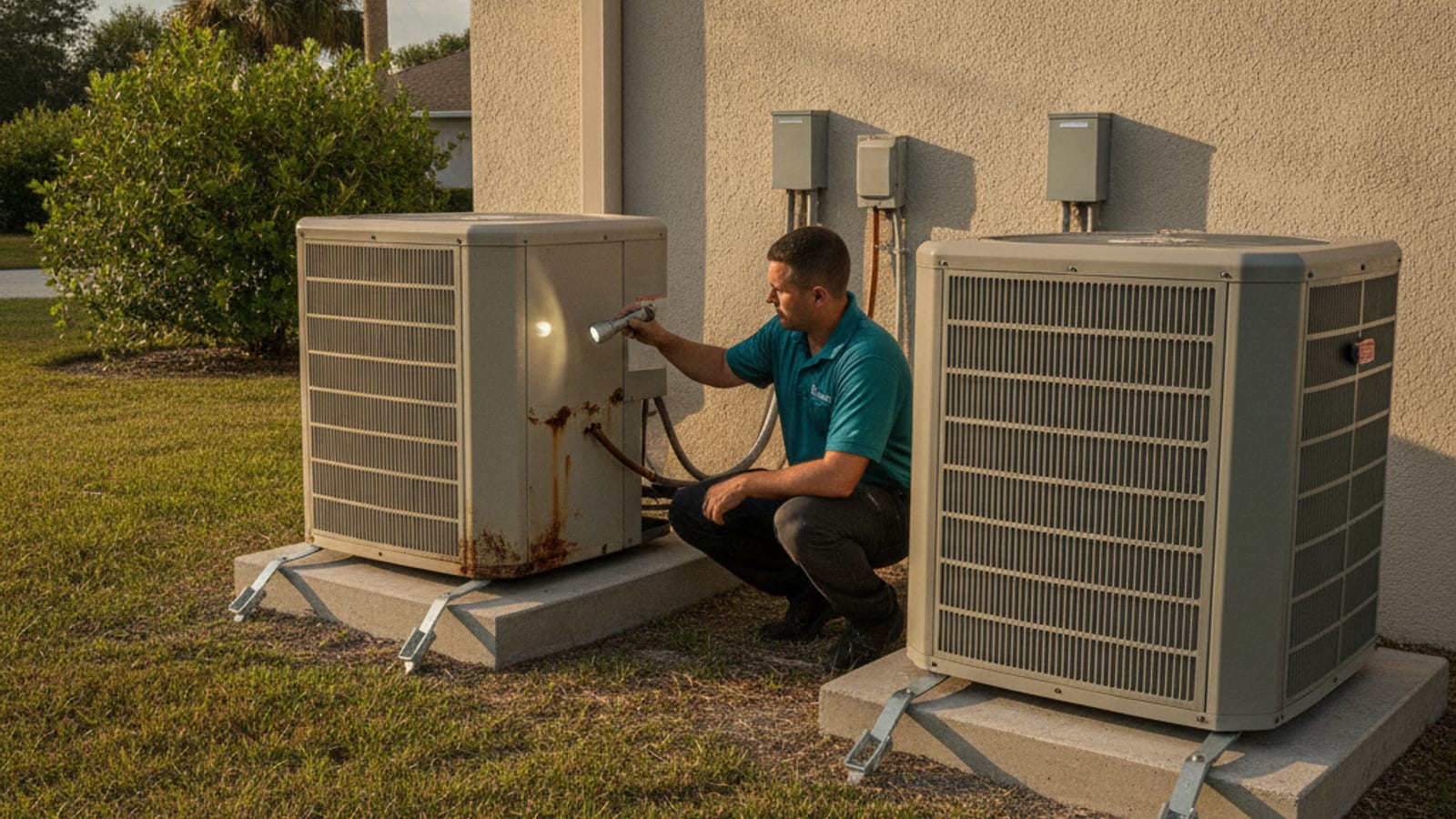
A straight AC system lasts 15 to 20 years for an inland Englewood home, and the heat pumps most homes here actually run last 10 to 15 years. Near the Gulf, in places like Manasota Key and Boca Grande, salt air cuts those AC lifespans down to 8 to 12 years without protective coatings. The gap comes down to two things: how many hours the system runs each year, and how much corrosion the outdoor unit takes on.
Englewood Air Pro connects Sarasota and Charlotte county homeowners with local HVAC pros for AC installation and repair, with 24/7 emergency service available and free quotes on any replacement. Knowing where your system realistically sits in its lifespan changes whether the next issue is worth repairing or replacing.
How long does a standard AC system last inland in Englewood?
Fifteen to 20 years is the realistic range for a well-maintained system away from direct salt-air exposure. That’s shorter than the equipment’s theoretical rating in a milder climate, since a nine-month cooling season means the system logs far more run hours per year here than a comparable unit in most of the country. Regular HVAC maintenance matters more in this kind of near-constant-use climate, since it catches wear on capacitors, coils, and motors before that wear turns into an early failure.
Why does equipment fail so much faster near the coast?
Salt air corrodes condenser coils, fins, and electrical connections years before it would fail further inland. A standard condenser near Manasota Key, Boca Grande, or a canal-front lot often needs replacing in 8 to 12 years instead of 15 to 20, even with regular upkeep. Coastal-rated equipment with a coated or marine-grade coil closes some of that gap, though it doesn’t eliminate it entirely, which is why we default coastal installs toward that upgrade rather than treating it as optional.
How long do heat pumps last compared to AC-only systems?
Similarly, though heat pumps see slightly more wear given their added winter-mode use. Most heat pumps in this metro run 10 to 15 years given how many hours they log each year in a climate this humid. The reversing valve, the component unique to heat pump operation, is often the first sign of age-related trouble, showing up as a system that cools fine but won’t properly switch to heat mode on a rare cold morning.
What actually shortens a system’s life beyond age alone?
A few things compound with time in this climate. Ductwork that leaks conditioned air makes the system run longer to hit the same setpoint, adding hours to the equipment’s total workload every single day. Skipped maintenance lets small issues, like a drifting capacitor or a dirty coil, go unnoticed until they cause bigger, more damaging failures. Hurricane exposure adds a less predictable factor: systems that took wind, debris, or flood damage during a storm like Ian sometimes run rough for years afterward even without an obvious point of failure.
At what age does repair stop making sense?
Once a system passes 12 years old and needs a major repair, replacement usually pencils out better than continuing to patch it, especially if it’s also showing signs of reduced efficiency like climbing bills with no change in use. A technician can walk through that comparison honestly during an AC repair diagnostic rather than defaulting to whichever option is easier to sell. If replacement does make sense, our guide on AC replacement cost in Englewood breaks down what a new system actually costs installed, and the permit side covers what Sarasota and Charlotte counties require before the work starts.
Can regular maintenance meaningfully extend a system’s life?
Yes, and it’s one of the more reliable ways to get toward the higher end of the expected lifespan range rather than the lower end. A twice-yearly AC tune-up catches a failing capacitor, a refrigerant leak, or a clogged condensate drain well before any of those turn into a bigger repair or a shortened equipment life. It’s a modest, predictable cost compared to the alternative of an early, unplanned replacement.
Does a mini split have a different lifespan than a central system?
Roughly similar, though it depends more on individual zone usage than a central system’s single compressor does. A mini split installed in a room that runs hard all day, like a sun-facing Florida room, tends to show wear on that specific indoor head sooner than a lightly used zone sharing the same outdoor compressor. Since each zone operates somewhat independently, a mini split system rarely fails all at once the way a central system can, which makes gradual, zone-by-zone replacement a realistic option as equipment ages rather than an all-or-nothing decision.
Does ductwork age at the same rate as the AC equipment?
Not necessarily, and it’s worth checking separately. Ductwork in a lot of Englewood’s older homes, especially the boom-era construction across Port Charlotte and North Port, can outlast two or three AC replacement cycles if it was installed well originally, or it can fail years before the equipment does if it was undersized or poorly sealed from the start. A duct cleaning or inspection visit at the same time as an AC tune-up is a reasonable way to catch a duct problem before assuming the AC unit itself is the source of declining performance.
How does a home’s specific location change the lifespan math?
The type of home matters too. A mobile or manufactured home runs different equipment on a duct system with its own certified capacity limit, which changes what a replacement looks like when the time comes. Our guide to mobile home AC repair in Englewood walks through that.
Beyond the general inland-versus-coastal split, a few more specific factors matter. A condenser tucked in shade with good airflow around it runs cooler and lasts longer than one baking in full sun against a west-facing wall. A unit near a dryer vent or exposed to direct irrigation overspray corrodes faster than one that isn’t. None of these factors override the broader salt-air pattern, but they explain why two similar homes a few blocks apart, both the same distance from the water, can see meaningfully different equipment lifespans.
Frequently asked questions
How long does a typical AC unit last in Englewood, Florida?
Fifteen to 20 years for an inland home with regular maintenance. Homes within a few miles of the Gulf or a bay typically see 8 to 12 years due to salt-air corrosion on the outdoor unit, even with the same maintenance schedule.
Does salt air really cut an AC unit’s lifespan in half?
It can come close. A standard condenser that would last 15 to 20 years inland often fails in 8 to 12 years within a mile or two of the coast without a coated coil or other corrosion protection, which is a meaningful difference over the life of the equipment.
How do I know if my AC is nearing the end of its life?
Rising energy bills with no change in usage, more frequent repairs, uneven cooling between rooms, and an age past 12 to 15 years are the main signals. A diagnostic visit can confirm whether the system is genuinely failing or just due for a tune-up.
Do heat pumps wear out faster than standard AC systems?
Not dramatically. Most heat pumps in this climate run 10 to 15 years, a similar range to standard AC-only equipment, though the reversing valve is a heat-pump-specific part worth having checked during an annual tune-up.
Is it better to repair or replace an AC system that’s 15 years old?
At that age, replacement usually makes more financial sense than a major repair, especially for anything beyond a simple capacitor or contactor fix. A technician can quote both options honestly so you’re deciding with real numbers instead of a guess.
How do I verify an HVAC contractor’s Florida license before hiring?
Check the contractor’s CAC (air conditioning contractor) license at myfloridalicense.com before signing anything. We connect Englewood homeowners with experienced, insured local HVAC pros, and confirming that license yourself takes just a couple minutes.
If you’re not sure where your system stands, call (941) 292-6250 and we’ll connect you with a local pro who can give you an honest read on repair versus replacement.