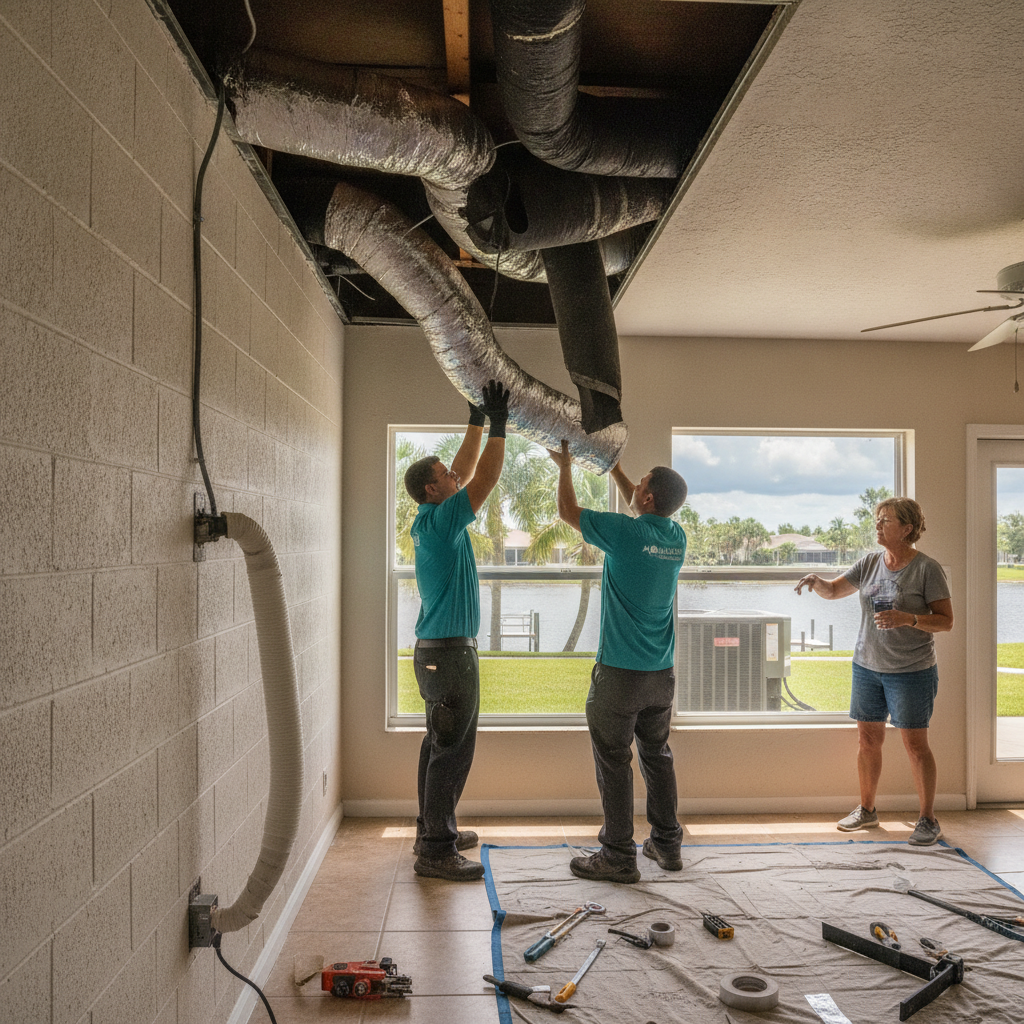
A crushed flex run over a Port Charlotte ranch is one kind of job. Original 1960s duct still hanging in a Dearborn Street cottage, joints open and insulation gone, is another. In this footprint, ductwork repair or replacement typically runs $1,500 to $6,000 depending on scope, and the number moves with how much of the maze has to come out, how hard it is to reach, and whether the air handler is staying.
Repair vs replace on Gulf-coast ductwork
Repair wins when the rest of the system still holds shape. A supply that pulled off a collar in a Venice attic, a kinked flex to a back bedroom in Grove City, a return boot that came loose after furniture got dragged across the floor: those are patches. The contractor we send reseals the joint, swaps the damaged stick of flex, and leaves the rest of the run in place.
Replacement starts to win when the leaks are the system. Flex that has walked off its straps and now rests in the insulation, baking through every August afternoon. Metal trunk in a 1970s Englewood core house with the wrap shredded and the seams daylighting into a hot attic. Fiberboard that has taken on Gulf humidity until the facing is soft. One bad room is a repair. Four rooms that never catch up, a musty blast on startup, and an air handler that short-cycles because it cannot move air against collapsed runs: that is a different conversation.
This climate is hard on hidden duct. Unconditioned attics run hot for most of the year. Canal-front and barrier-island air carries salt that never shows up on the flex itself, but it does show up on the air handler cabinet and the condensate pan the ducts connect to. Snowbird houses in Venice and Punta Gorda sit closed five to seven months with the thermostat on a setback, so a slow leak does not announce itself until the first May cooldown. After Hurricane Ian’s Category 4 landfall near Charlotte Harbor in September 2022, a lot of Port Charlotte and Punta Gorda houses got new outdoor equipment on insurance money and kept the attic maze that had already been tired. A new condenser feeding old, leaky duct cools the attic. The house stays clammy.
| What you are looking at | Repair is usually enough | Replacement starts to make sense |
|---|---|---|
| One torn or crushed flex run, the rest still round and strapped | Swap that run and reseal the collars | Leave the rest of the layout alone |
| Flex sagging off the straps through most of the attic | A strap here and there is a stall | New runs, new supports, new seal |
| Original metal or board in a 1960s cottage, joints open | Tape on a joint does not restore the layout | Pull it and size the new run to the equipment |
| Equipment already due for a changeout | Patching ducts under a dying air handler | Pair new duct with the new system so the air has a path |
Cleaning is not replacement. Whole-home duct cleaning here typically runs $400 to $900, and it is the right move when the liner is intact and the problem is dust. It does nothing for a collapsed run. If the house is uneven after a cleaning, the ducts themselves are the job.
A tune-up can tell you which side of that line you are on. Static pressure that stays high after a clean filter, rooms that never match the thermostat, and a coil that ices because return air is leaking into the attic are duct symptoms wearing an equipment costume. Fixing the capacitor will not fix the maze.
What a replacement quote includes
A useful quote names the work, not a lump. Removal of the old run is its own labor. So is hanging the new one, sealing every collar, insulating what sits in an unconditioned attic, and tying supply and return back to the air handler that is actually in the house. Partial replacement of a few branches costs less than pulling every trunk. Whole-house work sits toward the top of that $1,500 to $6,000 range when access is ugly and the layout has to be redesigned, not just swapped stick for stick.
Material choice changes the job more than it changes a spreadsheet. Flexible duct goes in faster in a tight Englewood attic and through a Rotonda West truss maze. It also sags if the straps are lazy, and a kink is a permanent restriction. Sheet metal holds its shape and takes more time to fabricate in a finished house. Duct board can look tidy on day one and soak up humidity if the facing fails. The contractor we send should say which one they are hanging and why it fits this house, not which one is fashionable.
Access is the quiet multiplier. Open attic, walkable, with a plywood run to the air handler: the crew can work. Knee-wall storage packed to the rafters, a low crawl under a Port Charlotte block ranch, or supply boots punched through a finished ceiling: every foot takes longer. Drywall patching, if the run is buried, is not ductwork, but it still shows up on the invoice because someone has to close the house.
The permit is mechanical work. Florida’s $7,500 owner exemption does not cover electrical, plumbing, structural, mechanical, or gas work on a single-family dwelling, so a duct job is not the kind of work that skips the building department on price. On a Charlotte County address, residential mechanical permitting is described on the county’s residential mechanical permit page as replacement of heating and air conditioning equipment; a duct replacement that rides with a changeout is part of that conversation, and a ducts-only job is one the licensed contractor confirms with the same department. Englewood straddles the line. ZIP 34223 is Sarasota County. ZIP 34224 is Charlotte County. The same house style on the other side of the line answers to a different building department. Boca Grande and Palm Island are reached through Charlotte County and are Lee County addresses, so their permit path is not Charlotte’s and not Sarasota’s.
If the direct contract is greater than $5,000, Florida generally wants a notice of commencement on file before the first inspection. There is a carve-out: that subsection does not apply to a direct contract to repair or replace an existing heating or air-conditioning system for less than $15,000. Most duct jobs in the published range sit under that line. It is a paperwork rule, not a fee schedule. Inspection fees, under Florida law, may not be based on the total cost of the project and may not exceed the actual inspection costs. Do not budget a made-up permit number. Ask the contractor who is pulling it.
The licence class matters because a bid is contracting. A Class A air-conditioning contractor’s services are unlimited for installing, maintaining, repairing, fabricating, altering, or extending central air-conditioning, heating, and ventilating systems. Class B is the same work with a 25-ton cooling and 500,000 Btu heating cap on any one system, which still covers a normal house. You can confirm a licence on Florida’s DBPR license search. The contractors we send are licensed and insured. This brand matches you with them. It does not hold the licence and it does not pull the permit.
If the air handler is coming out with the ducts, keep the two prices in their own buckets. A full system replacement, condenser and air handler, for a single-family home here typically runs $5,500 to $12,000 installed. That is not a duct number. An FPL residential rebate of $200 on a new A/C at SEER2 15.2 and above, indoor and outdoor units together, is an equipment rebate delivered on the participating contractor’s invoice. It is not a duct rebate. Do not fold it into the duct line.
Attic vs crawl vs package-unit ducts
Most of this metro hangs duct in a hot attic. Supply air that leaks there is air you already paid to cool, dumped into a space that will never be a bedroom. Thin or missing insulation on those runs lets the attic heat the air on the way to the register, so the vent in the living room feels weak while the compressor outside keeps running. A Dearborn Street cottage with original duct still in that attic is often past sealing. The layout was built for a different machine, a different load, and a house that may have picked up additions since.
Crawl-space duct is the Port Charlotte and Punta Gorda ranch problem. Low clearance, damp ground, and long supplies that rust or separate at the joints. Labor goes up because the work is on someone’s back, not on plywood. A crushed return in a crawl also pulls air from the dirt, which is how a house picks up a smell the filter never catches. Repair can close one joint. Replacement is the call when the trunk has been in the wet for decades.
Package units sit on a slab or beside a garage and feed shorter runs, often through a dropped ceiling or a small attic. Those jobs look cheaper because there is less linear footage, then they get expensive if every boot is buried in a finished ceiling. Wellen Park’s new construction in North Port is the other extreme: ducts that were sized with the house, still round, still strapped. A 1980s or 90s North Port house on its second or third system is the one where the equipment has been swapped and the original flex has not.
Barrier-island stock is its own layout. Ductwork on Boca Grande and Palm Island deals with the worst salt exposure in the footprint, causeway and ferry access, and Lee County permitting. A quote that treats Boca Grande like a Rotonda West attic is the wrong quote.
When the existing maze is a lost cause, especially in a small Old Florida cottage, a ductless system can be the cleaner path. Mini-split installation here typically runs $3,500 to $8,000 depending on zone count. That is an alternative to rebuilding ducts, not a price for rebuilding them.
Common questions about replacement
How much does it cost to replace ductwork in a 2,000 square foot house?
Square footage is a planning shorthand, not a quote. Two houses with the same floor area can hide completely different duct. A single-story ranch with an open attic and a few crushed branches is not a two-story with trunks buried in finished ceilings. The published range for ductwork repair or replacement in this footprint is $1,500 to $6,000 depending on scope. Where a given 2,000-square-foot house lands inside that range is about linear footage, access, material, how much of the old run has to come out, and whether the air handler is part of the same visit.
Is replacing ductwork worth it?
It is worth it when the ducts are the reason the house will not cool. Leaked supply air that never reaches the register, a return that sucks attic heat, rooms that stay uneven, and an air handler that runs long because it is fighting restrictions: those are duct failures. A repair on one branch is worth it when the rest of the system is sound. A full replacement is worth it when you would otherwise put a new condenser on top of a leaky maze, or keep paying to condition the attic. Pairing new duct with AC installation is how a changeout actually delivers the air the new equipment was sized for.
Does homeowners insurance cover air duct replacement?
Your policy is the document that decides, and the carrier is the one who reads it. Wear, sagging flex, dried-out mastic, and original duct that has been in an Englewood attic since the house was built are maintenance. A named-storm event that crushed a return chase or tore a trunk is a different conversation with the adjuster. We do not speak for any insurer. If Ian-related equipment work already happened and the ducts were left behind, that leftover maze is usually on the homeowner, not on a new claim.
Should I replace 20-year-old ductwork?
Age alone does not decide it. Flex that is still round, still strapped, and still sealed can stay. Flex that has cooked, dropped, and pulled off its collars should go, whether the calendar says fifteen years or forty. Original duct in a 1960s or 70s cottage near Historic Dearborn Street is often older than any “twenty year” rule of thumb, and the layout may never have matched a modern air handler. The test is condition and airflow, which is what a licensed HVAC contractor sees in the attic, not a birthday on a box.
When to call us
Call when rooms will not even out, when attic flex is off the straps, or when a replacement quote for the outdoor unit assumes the old ducts will suddenly work. That is licensed mechanical work, and we will get a licensed and insured HVAC contractor out to look at the runs. If the system is down while you wait, AC repair is the other door in. Call us at (941) 292-6250.