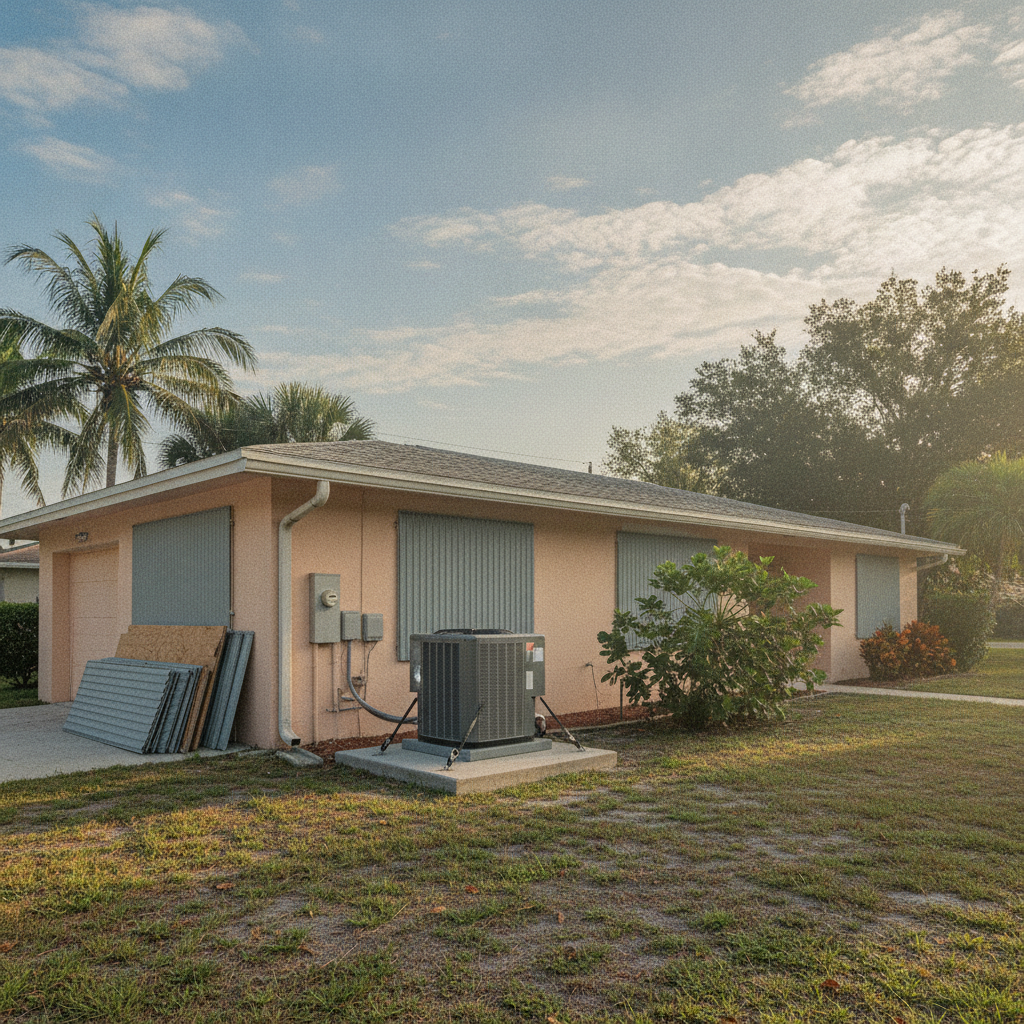
The house on a South Venice ranch lot has been shut since Easter. Thermostat on a setback, hurricane panels stacked by the garage, the outdoor unit sitting through a full Gulf summer with nobody home to notice a drain pan overflow or a fan that seized in August. When you fly back in November, the first night is supposed to be cool and dry. Often it is neither.
That is the Venice install problem. This city carries the heaviest seasonal occupancy in the Englewood-to-North Port footprint, and AC installation here has to be designed for a house that sits empty from April to November, then has to wring moisture out of closed-up air the week the snowbirds return.
A Venice house that sits empty from April to November
Venice, South Venice, Venice Gardens, Nokomis, and Osprey are established Sarasota County suburban stock. Block ranches and 1980s splits. Original air handlers still in the garage. Original flex still running through a hot attic. A condenser that has seen more empty summers than occupied winters.
A closed house in this climate is not a resting house. Indoor humidity keeps climbing while the system is off. Dust settles on the evaporator. The condensate trap dries, then the first long run in November pulls humid air across a dirty coil and the drain line clogs. Outside, salt off the Gulf sits on the fins. A unit that would have been rinsed and checked on an HVAC maintenance visit in June instead sits through hurricane season untouched.
The Atlantic hurricane season runs from June 1 to November 30, with most activity between mid-August and mid-October. The empty Venice house is closed for almost that entire window. After Hurricane Ian’s Category 4 landfall near Charlotte Harbor in September 2022, insurance-driven replacements moved through this stretch of the Gulf coast. Some of those systems are already on their second coastal summer. Some of the ones that were not replaced still carry storm-stressed cabinets and coils.
Homes west of Tamiami Trail, and the ones on the South Venice finger canals, take the salt first. The city pages already point those lots toward coated or marine-grade condenser coils. That is a hardware choice, not a promise about how many seasons a cabinet will last. A coated coil still needs a pad that drains, a clear airflow path, and someone who actually rinses the fins when the house is occupied.
If the old system still cools on the first November afternoon, a licensed contractor’s restart and inspection may be enough. If it short-cycles, ices, or blows lukewarm air after months of sitting, you are looking at replacement, not another round of parts on a unit that cooked all summer. The no-cool cluster lives on our Venice repair page. This page is the install decision.
How you leave the house in April changes what you walk into in November. The snowbird shutdown checklist covers that half of the year: the setback, the breaker, the outdoor unit, the drain. A cover that traps moisture against the condenser, or a float switch with nobody home to hear it trip, shows up as a failed first-night cooldown.
Sizing for humidity, not just square footage
A Venice changeout fails when someone picks a system off the square footage of the slab and calls it done. Square footage tells you how much air to move. It does not tell you how much water to pull out of a house that has been closed, dark, and humid since spring.
An oversized system reaches the thermostat set point in short bursts and shuts off. The air gets a little cooler. The moisture stays. You walk into a house that feels cold and clammy instead of cool and dry, which is the classic oversized AC pattern on this coast. A system that runs longer at a steadier pace wrings water out of the air because the coil stays cold long enough to condense it. That is the humidity job, and it is the job a seasonal Venice house asks for on night one.
A real load calculation looks at glass, insulation, attic temperature, occupancy, and the latent load, the moisture, not only the floor plan. A snowbird house that sits empty most of the year still has to be sized for the week it is packed: guests, cooking, showers, sliders open to the lanai in the afternoon, then everyone wants the bedrooms dry by bedtime. The contractor we send runs that calculation before anyone orders equipment.
Ducts decide whether that new equipment can actually do the work. Plenty of Venice attics still carry original flex from the 1970s and 80s, baked, sagging, and leaking cooled air into a hot attic. A tight new condenser and air handler fighting leaky attic runs will short-cycle for a different reason: it never sees the return air it was sized for. If the ducts are that far gone, air duct repair in Venice belongs in the same conversation as the changeout. Market range on this footprint for ductwork repair or replacement is $1,500 to $6,000 depending on scope. That is a separate job from the equipment, and it moves the comfort more than a bigger condenser will.
Heat pumps are this metro’s standard replacement recommendation, because one system carries the cooling load and the occasional cool snap without a second appliance in the garage. For a house that is empty all summer, that still matters on the handful of January nights you are actually here.
| Heat pump | Straight-cool only | |
|---|---|---|
| Summer in a closed Venice house | Same Gulf humidity load, same salt on the outdoor coil | Same Gulf humidity load, same salt on the outdoor coil |
| The few cool nights you are in town | One system handles them | Needs a separate heat source |
| How it should be sized | For humidity and run time, not a square-footage chart | For humidity and run time, not a square-footage chart |
| Why this metro leans this way | One outdoor unit, cooling plus the cool snap | Cooling only, extra hardware for winter |
A longer refrigerant line set, a condenser placed on the far side of the house to satisfy a setback or a neighbor’s sight line, and extra copper and insulation all add labor. So does an air handler swap in a tight Venice garage versus a closet that was framed around the original unit. Those are the things that move a quote. They are also the things a load calculation and a site visit catch, which a phone-quoted tonnage number will not.
New equipment sits in a different refrigerant world than the R-410A system that may still be in the yard. EPA’s Technology Transitions program changed what may be installed new as of January 1, 2025. Pre-2025 R-410A equipment may still go in where every specified component was made or imported before that date. Availability, not a ban on what you already own, is the practical limit. An existing system does not have to be ripped out because of the rule. Opening a refrigerant circuit is EPA Section 608 work. The contractor we send handles that. You should not.
Sarasota County permits on a changeout
Venice sits entirely in Sarasota County. The permit for a changeout goes to Sarasota County, not Charlotte County, and not to a neighbor’s building department because the house is “close to Englewood.” Englewood itself straddles the line, ZIP 34223 on the Sarasota side and 34224 on the Charlotte side, which is why two houses on the same stretch of the county line answer to different departments. A Venice address does not have that split. The department is Sarasota’s. The work is still mechanical work.
Florida’s $7,500 permit exemption for small jobs on a single-family house does not reach this. Under F.S. 553.79, that exemption stops at electrical, plumbing, structural, mechanical, or gas work. An AC changeout is mechanical work, so it is permitted work at any price. The licensed contractor we send pulls that permit. Englewood Air Pro matches you with that contractor. We do not pull it, and we do not hold the license.
The state’s decision clock, F.S. 553.792, gives the local government five business days to decide a complete and sufficient application for certain existing single-family permits, including mechanical, when the value of the work is less than $15,000 and the applicant is using a local government plans reviewer. All three conditions have to hold. It is a decision deadline, not a promise the permit prints that afternoon, and the clock starts only on a complete application.
Notice of commencement is the other paper homeowners hear about. F.S. 713.135 generally wants a copy filed before the first inspection when the direct contract is greater than $5,000. There is an HVAC carve-out: that subsection does not apply to a direct contract to repair or replace an existing heating or air-conditioning system in an amount less than $15,000. A lot of residential changeouts on this coast land in that window. The contractor we send still has to know which side of the line your contract sits on, because the inspection sequence depends on it.
Inspection fees, under F.S. 553.79, may not be based on the total cost of the project and may not exceed the actual inspection costs the local agency incurred. Confirm the current amount with the county before you budget. The Florida Building Code in force is the 8th Edition (2023), effective December 31, 2023. For the homeowner-facing walkthrough of what gets filed on a changeout in this footprint, use our AC replacement permit guide.
The person who pulls the permit has to be licensed to do this work. Florida’s air-conditioning contractor classes live in F.S. 489.105(3). Class A is unlimited for central air-conditioning, refrigeration, heating, and ventilating systems. Class B is limited to 25 tons of cooling and 500,000 Btu of heating in any one system. A quote or a bid is contracting too, which is why the person selling you the job needs the same kind of license as the person installing it. Verify that license yourself on the Florida DBPR License Search before anyone orders equipment. Search by name, by city or county, and by license type. The contractors we send are licensed and insured. You should still look them up.
If you are an FPL residential customer putting in a new A/C that includes both the indoor and outdoor units, FPL publishes a $200 instant rebate on a SEER2 15.2 rated unit and above. It shows up as a credit on the invoice a participating independent contractor provides. That is FPL’s program and FPL’s threshold, not a promise this brand can make, and it is not a stand-in for every utility on the Gulf coast.
Market ranges on this footprint, not a quote for your house: a full system replacement, condenser and air handler, on a single-family home runs $5,500 to $12,000 installed. A standard split system is $5,500 to $8,500. A higher-efficiency variable-speed system is $9,000 to $12,000. A heat pump system is $6,000 to $14,000. What moves you inside those bands is the load, the line set, the duct condition, the pad and electrical, and whether the air handler comes out of a garage or a closet that was framed around the original box.
How much does AC installation in Venice usually run?
A full condenser and air handler changeout on a single-family home in this footprint sits in the $5,500 to $12,000 installed range, with standard splits toward $5,500 to $8,500 and higher-efficiency variable-speed systems toward $9,000 to $12,000. Those are market ranges, not a price for your lot. A longer line set, rotten attic ducts, and a tight garage air handler all push the number up. FPL’s $200 residential A/C rebate, when it applies, is a credit on the participating contractor’s invoice for a SEER2 15.2 or higher system that replaces both indoor and outdoor units.
Does a Venice changeout need a Sarasota County permit?
Yes. An AC changeout is mechanical work, and Florida’s small-job exemption does not cover mechanical work on a single-family house, at any contract price. Venice addresses file with Sarasota County. The licensed contractor we send pulls the permit and meets the inspections. For the notice of commencement, a direct contract to repair or replace an existing heating or air-conditioning system under $15,000 sits in the statute’s HVAC carve-out.
Who is allowed to install the system?
A licensed air-conditioning contractor. Class A has unlimited scope on central systems. Class B is capped at 25 tons of cooling and 500,000 Btu of heating in any one system. Either way, check the license on Florida’s DBPR portal before the equipment is ordered. Anyone who opens the refrigerant circuit also needs EPA Section 608 technician certification. Englewood Air Pro matches you with licensed and insured contractors. We do not hold those credentials ourselves, and we do not do the install.
When to call us
Call when the Venice house is coming back to life in November and the old system cannot dry it, when you already know this summer’s idle time was the last one you want that condenser to sit through, or when you want a licensed HVAC contractor to size, permit, and install a replacement before the next seasonal close-up. We will match you with a licensed and insured contractor who pulls the permit and does the changeout. Call us at (941) 292-6250.