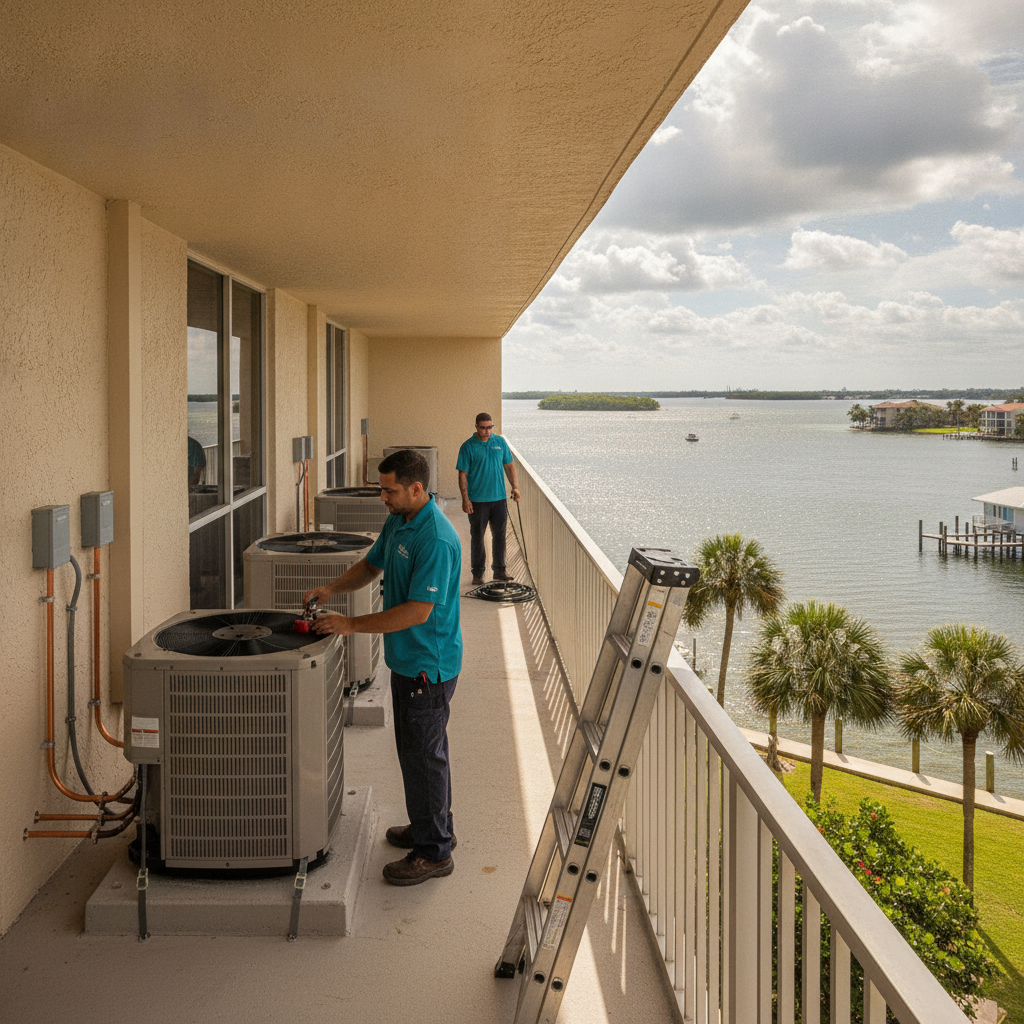
A Punta Gorda condo does not get a new air conditioner the same way a ranch off US 41 does. On a mid-rise, the association owns the schedule, the screening, and often the pad you can see from the walkway. On a canal lot in Punta Gorda Isles, you own the box, and Charlotte Harbor owns the air that eats it. Either way, air conditioning in Punta Gorda is a licensed contractor job with a Charlotte County mechanical permit.
A mid-rise changeout is an association job first
The board’s documents decide the changeout before a condenser ever leaves the truck. In Punta Gorda’s mid-rise stock, the outdoor unit often sits on a lanai, a service walk, or a screened shelf that neighbors can see. That makes the job an association project first and an HVAC project second.
Condo AC replacement rules in this metro turn on who owns the equipment. If the condenser is a limited common element, the association may set the cabinet color, the sound rating, the screening, and whether a crane can occupy the lot on a weekday. If you own the unit, you still need written approval for anything that changes the building’s exterior. Skip that step and the new pad never gets poured. You sit through August with a hole where the old unit was.
Access is the other half of the price. A mid-rise changeout can mean a crane, a reserved loading zone, elevator pads, and a line set that runs farther than a ranch house ever needs. Longer copper, more insulation, more labor. The indoor air handler may live in a mechanical closet, not an attic, so the swap has to fit the door, the condensate drain, and the existing electrical whip. None of that shows up in a single-family quote that assumes a backyard slab and a hallway closet.
Snowbird units sit empty from spring into fall. The association still wants the work done in a window, often before season, when the building is quieter and a crane is easier to book. Atlantic hurricane season runs from June 1 to November 30, with the peak on September 10, so those spring windows fill up. The licensed HVAC contractor we send coordinates that window, pulls the permit, and installs what the documents allow. We match you with that pro. We do not run the crane or rewrite the declaration.
If the unit still cools and the real problem is a capacitor, a drain, or a fan motor, start with air conditioning repair in Punta Gorda before you bid a full changeout.
Canal houses and a condenser in salt air
On a canal-front lot, the condenser sits in salt aerosol coming off Charlotte Harbor, and that is the whole job in one sentence. Fins pit. Cabinets chalk. Electrical lugs corrode. A unit that would look tired inland after a long career looks used up here after a handful of summers, especially on the windward side of the house.
Punta Gorda Isles, Harbour Heights, and the blocks along the Peace River put the outdoor unit a few feet from brackish water. After Hurricane Ian’s Category 4 landfall near Charlotte Harbor in September 2022, a lot of those cabinets were already bent, flooded, or packed with debris. Insurance-driven replacements followed. Some of those systems are now on a second outdoor coil because the first one never got a coated or marine-grade finish. Coated or marine-grade condenser coils are the right ask near the water. Anyone who promises you a set number of extra years is guessing.
The indoor side is a different story. Many canal houses are block-ranch, rebuilt or heavily repaired after storms, with ducts in a hot attic and a closet air handler. An oversized straight-cool system short-cycles. It hits the thermostat, shuts off, and leaves the house cold and clammy instead of cool and dry. A right-sized heat pump is the default replacement across this metro because one system carries the long cooling season and the occasional cool snap. The contractor we send should size the equipment to the house you have, including tighter post-storm envelopes, not a rule of thumb from the square footage on the listing.
Keep the coil rinsed with a garden hose. Change the filter. Leave refrigerant, brazing, and the high-voltage disconnect to a technician with EPA Section 608 certification. Federal rules require certification for anyone who maintains, services, repairs, or disposes of equipment that could release ozone-depleting refrigerants. That is not a DIY exception for a canal-front homeowner.
Charlotte County permits and A2L equipment
An AC changeout is mechanical work, so it needs a permit at any price. Florida’s $7,500 owner exemption for some building work does not apply to electrical, plumbing, structural, mechanical, or gas work on a single-family dwelling, and it does not apply on property in a flood hazard area. The contractor we send pulls Charlotte County’s residential mechanical permit for replacement of heating and air conditioning equipment at a residential location.
Charlotte County lists owner-builders plus certified and registered HARV Class A, HARV Class B, and mechanical contractors as able to obtain that permit. A Class A air-conditioning contractor’s services are unlimited on central air-conditioning, refrigeration, heating, and ventilating systems. A Class B contractor is limited to 25 tons of cooling and 500,000 Btu of heating in any one system. A house or condo changeout sits inside either class. Contracting includes the bid, not just the wrench work, which is why the person quoting you needs the license too. Confirm it on Florida’s DBPR License Search before you sign.
For an existing single-family house, Florida gives the county a five-business-day decision window on a complete mechanical application when the work is under $15,000 and the applicant is using a local government plans reviewer. That is a decision deadline, not a promise the permit prints that afternoon, and the clock starts only on a complete application. Do not stretch that window onto a mid-rise condo. The statute is written for an existing single-family residential dwelling.
Notice of commencement is the other paperwork people call the $5,000 rule. Florida requires the applicant to file a copy with the issuing authority before the first inspection if the direct contract is greater than $5,000. That subsection does not apply to a direct contract to repair or replace an existing heating or air-conditioning system in an amount less than $15,000. Charlotte County’s own mechanical page puts the local line at a direct contract greater than $15,000, submitted before the first inspection is scheduled.
New equipment is a separate, federal question. EPA’s Technology Transitions rule restricts, as of January 1, 2025, new residential and light commercial air-conditioning or heat pump systems that use a regulated substance with a global warming potential of 700 or greater. Pre-2025 R-410A equipment may still be installed where every specified component was manufactured or imported before that date. Availability, not a ban on owning your old system, is the practical limit. Florida’s code edition in force is the Florida Building Code 8th Edition (2023), effective December 31, 2023. The local read of how A2L equipment is treated on the job is on our A2L refrigerant rules page. The licensed contractor we send for AC installation is the one who matches the equipment to that rule and pulls the permit.
What a new system costs in Punta Gorda
A full system replacement, condenser and air handler, on a single-family home in this footprint commonly runs $5,500 to $12,000 installed. That is a market range, not a quote for your lanai. A standard split system often lands at $5,500 to $8,500 installed. A higher-efficiency variable-speed system often lands at $9,000 to $12,000. A heat pump system often lands at $6,000 to $14,000. A ductless mini split often lands at $3,500 to $8,000 depending on zone count.
A condo job moves on access, not on a different magic number. A crane day, a long line set, a closet that will not take the next air handler, and association-required screening all push labor and materials up. A canal lot moves on the outdoor unit: a coated coil, a pad that sits where stormwater actually drains, and copper that is not already green from salt. Stretching a single-family range onto a mid-rise, or the other way around, is how quotes surprise people.
If you have an FPL residential account and the new system is a SEER2 15.2 rated unit or above, FPL publishes a $200 instant rebate on a new A/C that includes both indoor and outdoor units. It shows up as a credit on the invoice from FPL’s participating independent contractor. We do not deliver that credit, and we do not promise you will receive it. Read the current terms on FPL’s A/C rebate page before you budget.
| Setup | Where it fits in Punta Gorda | What changes on the job |
|---|---|---|
| Split system | Canal houses, block ranches, many townhomes | Outdoor condenser, indoor air handler, existing ducts |
| Heat pump | The default replacement on this coast | One system for the long cooling season and the cool snap |
| Ductless mini split | Condos and additions where a trunk will not run | Wall heads, no shared duct, work that stays inside your unit |
There is no honest top-three brand list that fits every canal house and every mid-rise. Match the equipment to the documents, the salt, and the closet. The installer matters more than the badge on the cabinet.
How much is a new air conditioning unit in Punta Gorda?
On a single-family home, a full condenser and air handler replacement commonly runs $5,500 to $12,000 installed in this footprint, with standard splits toward $5,500 to $8,500 and variable-speed systems toward $9,000 to $12,000. Heat pumps commonly run $6,000 to $14,000 installed. A condo or canal lot can sit outside those bands because of cranes, line-set length, screening, and coated outdoor coils.
What is the $5,000 rule for air conditioners?
It is notice-of-commencement paperwork, not a price cap. Florida asks for a copy before the first inspection when the direct contract is greater than $5,000, and then carves out a repair or replacement of an existing heating or air-conditioning system under $15,000. Charlotte County’s mechanical permit page requires that notice when the direct contract is greater than $15,000, before the first inspection is scheduled.
What types of systems go in Punta Gorda homes?
Most canal houses take a split system, and a heat pump is the usual replacement because it cools through the long season and heats the cool snap. Mid-rise condos often stay with a split if the closet and the lanai allow it, or go ductless when the association will not reopen a shared chase. Package units show up on some slabs. The contractor we send sizes the job to the house or the unit you actually have.
When to call us
When the association has a window, the condenser is rusted through, or a canal house is on a cabinet that will not survive another summer of salt, the next step is a licensed HVAC contractor. We match you with licensed and insured pros who install the system and pull the Charlotte County mechanical permit. Call us at (941) 292-6250.