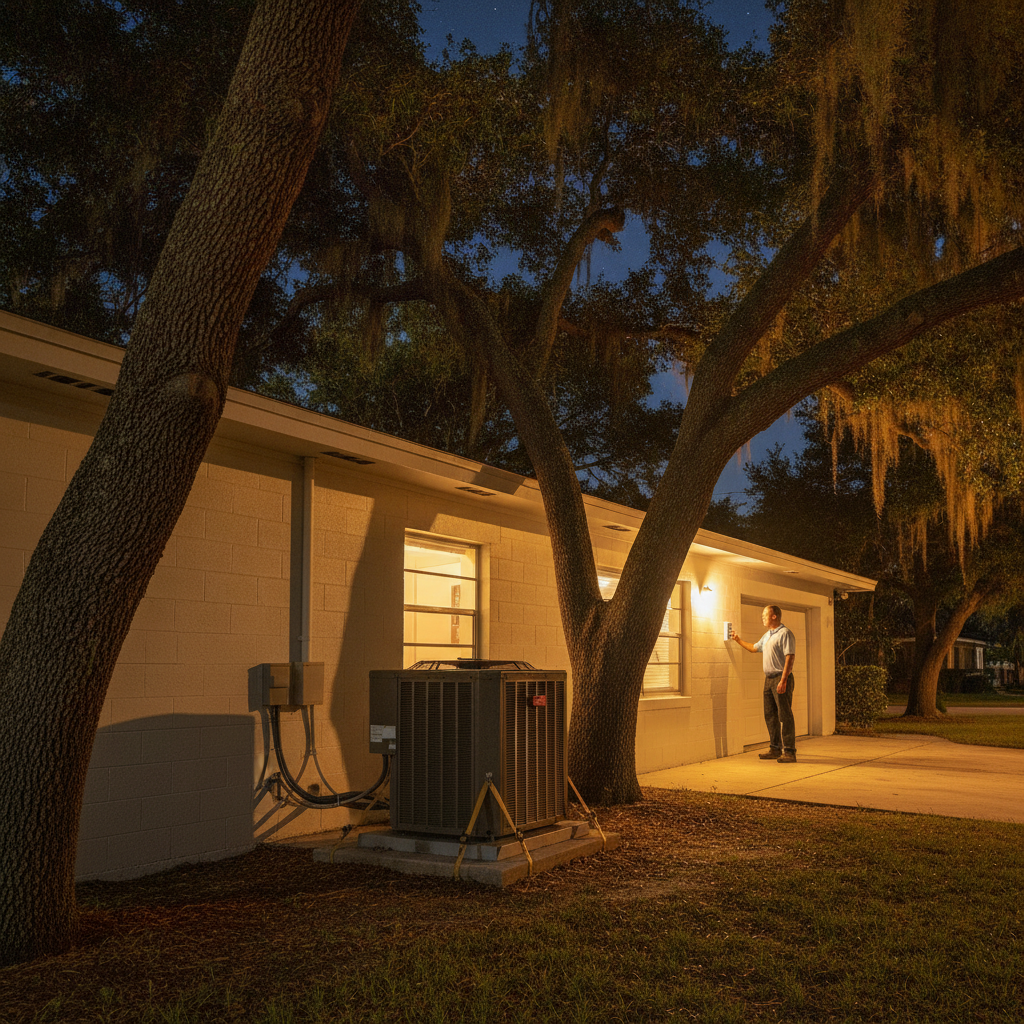
The thermostat on a South Venice hallway wall still reads 74. The rooms do not. It is 11 p.m., the condenser under the live oaks is silent, and Gulf humidity is already filming the windows.
If you searched for 24/7 AC repair in Venice, you want a licensed HVAC contractor at a house that has stopped cooling after dark. The useful first step is telling a true after-hours failure from a job that can wait until morning.
A Venice house that stops cooling after dark
Venice carries the heaviest seasonal occupancy in this footprint, and the failures that hit after dark follow that calendar. An August night in a South Venice ranch is still and wet. The system has been cycling since breakfast. By late evening a weak capacitor, a clogged condensate line, or a breaker that will not hold finally gives up, and the house goes from cool to clammy in an hour. On Venice Island the same night often starts at the outdoor unit, where salt crust on the fins has been making the fan motor work harder all summer. Inland in Venice Gardens the cabinet may look cleaner. The humidity load is the same.
November writes a different script. Snowbird houses here sit closed from spring into fall, often with the thermostat on a setback. The first night back, someone turns the system on, hears it start, and goes to bed. A drain line that sat dry for months has already grown a blockage. The pan fills. The float switch opens. The air handler in the garage closet goes quiet while the bedrooms go warm. That is the Venice restart call, and it is as much an after-hours problem as the August no-cool.
Four failures show up again and again. A tripped breaker that resets once and then pops is a motor or a short, not a fluke. A clogged drain and a tripped float switch leave standing water in the pan and no cooling at the vents. A failed capacitor leaves the outdoor fan still while the compressor hums and strains. A heat pump stuck in heat or emergency heat blows warm air on an 85-degree night because someone used it on a cool snap and never put it back. None of those is a filter. None of them is a thermostat battery.
Daytime air conditioning repair in Venice is the scheduled version of this work: a pro can test, order a part, and come back. After dark you are deciding whether the house can sleep without cooling. The same decision plays out a few miles north, which is why we already wrote emergency AC repair in Nokomis as its own page. Venice streets, island lots, and the November restart still need their own answer.
Storm season sits on top of both calendars. The Atlantic hurricane season runs from June 1 to November 30, and most of the activity lands between mid-August and mid-October, per the National Hurricane Center. When power comes back and the condenser does not, that is a different call than a routine capacitor, and it is the pattern we cover in emergency AC after a storm in Charlotte and Sarasota counties.
What is actually an emergency versus a morning call
An after-hours call is for a house that cannot cool, is taking on water, or is electrically unsafe. A morning call is for a house that is still moving air, even if the air is a little warm or the unit sounds off. That line is the whole decision.
The capacitor failure is the classic still night. You walk outside and the fan is not spinning. The compressor may hum. The disconnect is closed. The house is already warming. Leaving that compressor humming until sunrise is how a cheap part becomes a much larger job. The drain-and-float-switch failure is the August afternoon that quietly becomes an 11 p.m. problem: the unit ran hard, algae or dust packed the PVC, the pan filled, and the float opened the circuit on purpose so water would not hit the ceiling. The breaker that will not stay on is the one you stop resetting. One reset is a homeowner check. A second trip is a locked rotor or a short, and that belongs to a licensed HVAC contractor.
A heat pump in the wrong mode fools people because the unit is “working.” Warm air at the supply vents on a Venice night in October is not a refrigerant mystery. Someone switched to heat during a cool front, or the control is sitting on emergency heat, and the house is being heated while the outdoor air is still in the 80s. Put the thermostat back in cool and give it a few minutes. If it still blows heat, that is an after-hours control problem, not a morning filter change.
What can wait is narrower than people hope, and more honest than a panic call. The vents are a little warm, air is still moving, and no water is showing at the air handler. The outdoor fan is spinning. The breaker is holding. Swap the thermostat batteries if the display is dim, change a packed filter, and rinse the outdoor coil with a garden hose if you can see lint and grass packed on the fins. Then sleep if the house is livable, and book AC repair in the morning.
Do not add refrigerant. Do not open the disconnect and start pulling wires. Do not recover a charge, braze a line, or climb into a tight air-handler closet with a wet pan and a live circuit. EPA Section 608 is the federal rule for who may maintain, service, repair, or dispose of equipment that could release refrigerant. That work is for a certified technician the licensed contractor sends, not for a homeowner with a flashlight.
| What the house is doing | After-hours or morning |
|---|---|
| Outdoor fan still, compressor humming | After-hours. A failed start capacitor often looks like this, and the compressor keeps straining until the disconnect is opened. |
| Air handler silent, overflow pan wet | After-hours. The float switch cut power to keep water off the ceiling. |
| Breaker will not stay on | After-hours. A second reset is how motors burn. |
| Vents a little warm, air still moving | Morning. Filter, batteries, then a scheduled repair. |
| Heat blowing on a hot night | After-hours if switching the thermostat back to cool does not stop it. A heat pump left in heat will cook the house. |
Sarasota County access and a licensed contractor
Venice is Sarasota County from the island through South Venice, Venice Gardens, and the Tamiami Trail corridor. That matters for two reasons that have nothing to do with a slogan. The contractor who works on the system has to hold a Florida air-conditioning license, and a changeout (when a repair turns into a replacement) is mechanical work that a building department permits. The brand you are reading is a referral service. We match you with licensed and insured HVAC contractors. We do not hold the license, pull the permit, or own the truck.
Florida names the classes in F.S. 489.105(3). A Class A air-conditioning contractor’s services are unlimited for central air-conditioning, refrigeration, heating, and ventilating systems. A Class B air-conditioning contractor is limited to 25 tons of cooling and 500,000 Btu of heating in any one system. For a Venice house, either class covers a normal residential repair. Contracting also includes the attempted sale of those services and the negotiation or bid for a contract, so the person quoting the work needs the license too. You verify that yourself on the Florida DBPR Licensing Portal by name, by city or county, or by license type. That search is the honest answer to “who is best.” A ranking is not.
Mechanical work is not plumbing. A plumber does not diagnose a dead condenser on an island side yard. HVAC equipment, the refrigerant circuit, the air handler, and the condensate drain that serves that equipment sit on the air-conditioning side of the license. House water lines, sewer, and a leaking sink sit on plumbing. If someone offers to “top off” the system in the driveway at midnight, that is refrigerant work, and it is the wrong offer.
Access on the ground is local even when the license is statewide. An island condenser tucked against a wall behind a hedge is a different night job than a South Venice unit with a clear side-yard path. Historic downtown houses often hide the air handler in a tight closet with a long drain run. Gated streets and dark snowbird blocks slow a first look. None of that is a promise about when someone arrives. It is why the person we send needs to know whether you are on the island, in South Venice, or off Jacaranda before they load the van.
A capacitor, a drain clear, or a control reset is a repair. If the licensed contractor you get finds a failed condenser or air handler and the job becomes a changeout, Florida treats that as mechanical work. F.S. 553.79’s small-job building-permit exemption does not apply to mechanical work on a single-family dwelling, so an AC changeout is permitted work at any price. The five-business-day decision window in F.S. 553.792 is a decision deadline on a complete application for certain existing-home permits under $15,000, including mechanical. It is not a promise the permit prints that day. For HVAC service in Venice, that paperwork is Sarasota County’s, and the pro we send handles it. After-hours emergency HVAC service is the call that starts the diagnosis. The permit, if one is even in play, comes after everyone can see what failed.
Questions Venice homeowners ask after dark
How much does it cost to repair a central air conditioner?
The after-hours visit costs more than a daytime one because the contractor is coming outside ordinary hours, and the diagnostic is the first bill. Parts and labor stack after that, and they move with what actually failed. A capacitor or a drain clear is a small job. A compressor, a coil, or a control board is not. Line-set length, attic access, and an island condenser boxed in by walls all add copper, time, and difficulty. Ask the licensed contractor to separate the diagnostic from the repair before anyone orders a part.
What is the $5,000 rule for HVAC?
People mean the notice of commencement in F.S. 713.135. Before the first inspection, the applicant files a copy of that notice when the direct contract is greater than $5,000. There is an HVAC carve-out in the same subsection: it does not apply to a direct contract to repair or replace an existing heating or air-conditioning system in an amount less than $15,000. A midnight capacitor swap is not that paperwork. A full changeout might be, and the contractor who pulls the permit is the one who knows whether your contract sits inside the carve-out.
Is mechanical plumbing the same as HVAC?
No. In Florida contractor law, air-conditioning, heating, and ventilation are mechanical work. Plumbing is a different trade. The condensate drain that serves your air handler is part of the HVAC system. The house water heater is not. Call a licensed air-conditioning contractor for a dead condenser, a tripped float switch, or a heat pump in the wrong mode.
Which company is best for AC service in Venice?
The useful test is the license, not a slogan. Search the contractor on the Florida DBPR portal, confirm an air-conditioning class, and work with licensed and insured pros. We match Venice homeowners with those contractors. We do not rank companies, and we do not publish reviews.
When to call us
Call when the house has stopped cooling after dark, the pan is wet, the breaker will not hold, or a heat pump is blowing heat on a hot Venice night. Those jobs need a licensed HVAC contractor, not a second reset and not a refrigerant can. Call us at (941) 292-6250. We will get a licensed HVAC contractor out to you.