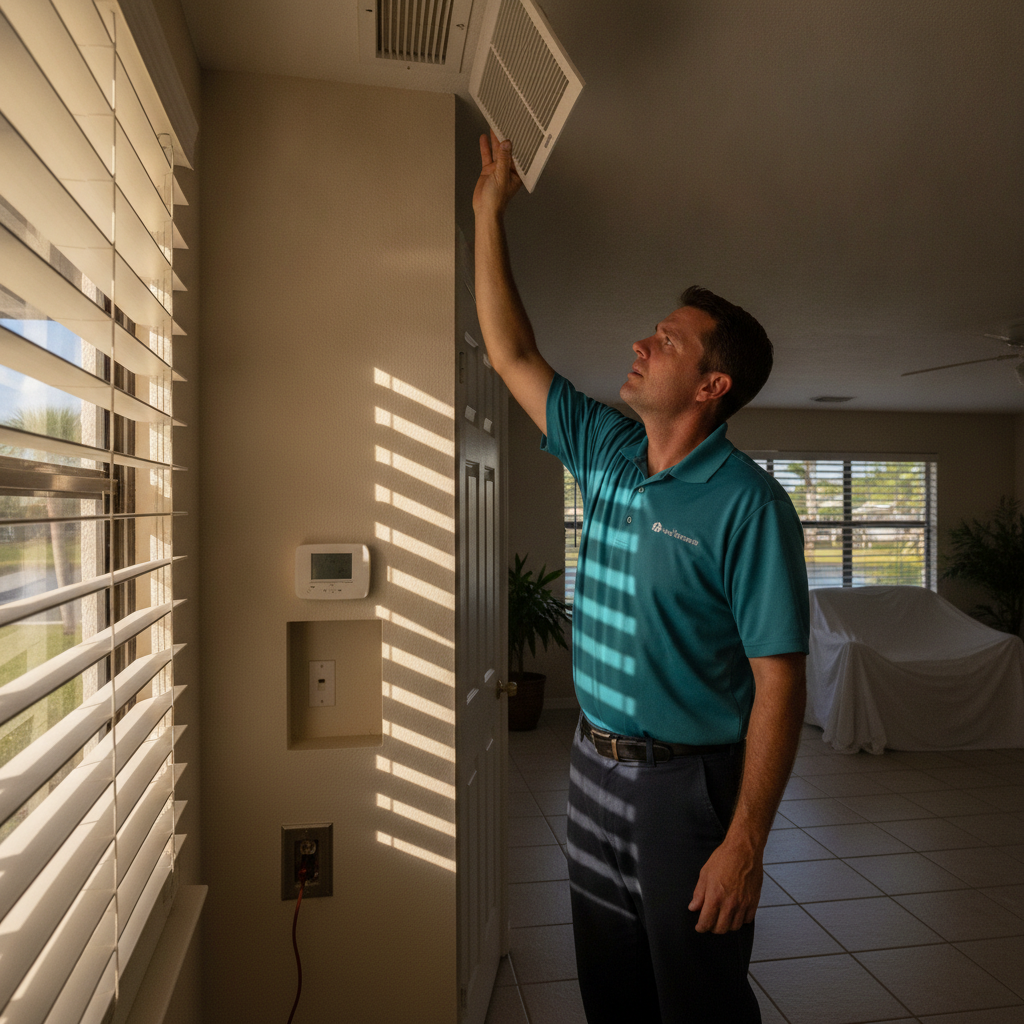
The fan is running in a South Venice ranch and the air at the register still feels like the garage. That is the Venice version of a system that is not cooling: the thermostat is calling, the blower is on, and the house never drops. It is a different problem from a unit that will not start, and it shows up the first week a seasonal house comes back to life.
A Venice system that runs and still leaves the house warm
A Venice AC that runs and still leaves the house warm is usually starving for airflow, stuck in the wrong heat-pump mode, or sitting behind a compressor that never started. Venice, South Venice, Venice Gardens, Nokomis, Osprey, and Laurel sit in Sarasota County, and they carry the heaviest seasonal occupancy in this footprint. A house west of Tamiami Trail can sit closed from April until November, thermostat parked on a high setback, hurricane shutters throwing stripes of light across the living room. You walk in, drop the setpoint, and the indoor blower often starts right away. Warm air at the vent is the tell.
Warm supply air with a running blower has a short list of causes. The compressor is not pumping. The coil cannot exchange heat. Or the air is not moving over that coil in the first place. A heat pump left in heat or emergency heat will blow warm on purpose. A filter packed with a summer of dust starves the evaporator. A condenser on a South Venice canal lot, coated in oak pollen and Gulf salt, cannot dump heat, so the refrigerant never gets cold enough to cool the rooms.
This is not the same story as a year-round house with an AC that is not cooling in Englewood. Those cottages run all summer. Venice seasonal stock sits. The idle is the load.
A unit blowing warm air while the outdoor fan spins and the compressor stays silent often has a failed start capacitor. You hear a hum from the condenser, then nothing. The indoor fan keeps pushing room air through the ductwork, which is why the register feels like a hair dryer on low.
If the outdoor unit is dead quiet and the breaker has not tripped, check the thermostat mode before you assume a failed compressor. Heat pumps are the usual replacement system in this metro because one machine handles the cooling load and the occasional cool snap. One wrong setting on a wall control that sat untouched since Easter will heat the house while you think you asked for cool.
HVAC service in Venice is Sarasota County work. The licensed contractors we send diagnose the running-but-warm call on that side of the line. Boca Grande is a different county and a different permit path. A Venice ranch is not that job.
Summer idle, November restart, and weak airflow
A Venice snowbird house is a closed box for five to seven months. The blower is off. The drain line sits with standing water. The evaporator coil stays damp in a dark cabinet. The outdoor unit sits in the Gulf breeze, collecting salt aerosol and whatever the oak trees drop. None of that shows until the first cool call in November, right as Atlantic hurricane season is winding down. That season runs from June 1 to November 30, with the heaviest activity from mid-August through mid-October.
Weak airflow on that first week is usually a filter. The last one may have been left in place in April. Dust, insects, and the fine grit a closed Florida house sheds all summer load that media. Restricted return air makes the evaporator run too cold. Ice can form on the coil even in a warm house. Then the supply vents go from weak to almost nothing, and the indoor air feels clammy instead of cool. The system is running. The house is not drying.
The drain is the next idle-season gift. Algae and sludge grow in a trap that has not moved water since spring. The first long run in November lifts that mass into the line. The pan fills. The float switch opens. The system shuts off on a safety, or it short-cycles: a burst of cool, then a stop, then a restart that never catches up. From the living room it just feels like the AC is not cooling.
A wet coil that sat all summer also loads with dust the moment the blower hits it. That film is an insulator. The refrigerant still evaporates, but the air passing over the fins does not give up enough heat, so the house stays warm while the unit runs and runs. The outdoor coil can be just as dirty. A garden hose on the fins is a fair homeowner job. Anything that opens the refrigerant circuit is not. EPA Section 608 is the federal rule that says who may maintain, service, repair, or dispose of equipment that could release refrigerant. Do not add charge. Do not recover it. Do not crack a service valve.
The thermostat on setback is its own trick. A house that sat closed does not drop the moment you walk in, especially with Gulf humidity still in the drywall and the furniture. The system may be working and still feel like it is not cooling for the first afternoon. If the supply air is actually cold and the return is pulling well, give it time. If the supply air is room temperature after a long run, that is a diagnosis, not a waiting game.
A November restart after a quiet summer is also when a capacitor that has been cooking next to the outdoor disconnect finally lets go. The compressor needs a jolt to start. A weak capacitor leaves it humming and stalled. That is a parts-and-labor repair for a licensed contractor, not a screwdriver job at the high-voltage lugs.
What the contractor we send diagnoses first
Filter, thermostat mode, outdoor coil, drain float, and the compressor start capacitor are the first checks on a Venice not-cooling call. The licensed and insured HVAC contractors we send start there because those are the failures a long idle actually produces.
They confirm the thermostat is in cool, the setpoint is below room temperature, and a heat pump is not sitting in emergency heat. They read the filter and the return grille. They look at the outdoor coil for salt crust and matted debris, then at the indoor coil and the drain pan. They listen for the compressor start. A hum with no run is a capacitor or contactor path. A compressor that runs with a warm suction line and warm supply air is a charge problem, a metering device, or a coil that cannot exchange heat.
Airflow is the fork in the road. Strong airflow and warm supply air points outdoors or at the refrigerant circuit. Weak airflow points at the filter, the blower wheel, the coil face, or the ducts. Venice ranch attics hold original flex that can sag, disconnect, or bake through a closed summer. A supply boot that popped loose over a hall ceiling will dump cold air into the attic while the bedrooms stay warm. That is duct work, and it belongs on a licensed AC repair call, not a weekend patch.
The drain and float switch get a close look on every first-week-back visit. A clogged condensate line is a mechanical problem with a simple shape: water has nowhere to go, the switch opens, cooling stops. Clearing that line is contractor work when it is tied into the air handler. The homeowner-side limit is a clean filter, a thermostat battery, a breaker reset, and a gentle rinse of the outdoor coil with a garden hose.
If the diagnosis points at a leak, the contractor who opens the circuit needs Section 608 certification. Low charge is almost never a simple top-off. Charge that left the system left through a leak. Adding refrigerant without finding that leak is a delay, not a repair. The contractors we send find the leak before they talk about charge.
An AC repair diagnostic in this footprint typically runs $89 to $150. Most repairs after that, parts and labor, fall between $150 and $650. Those are market ranges for this area, not a quote for your house. A capacitor, a float switch, a drain clear, or a contactor usually lives in that repair band. A compressor or a coil is a different conversation.
A spring or fall HVAC maintenance visit is how a seasonal house avoids this first-week scramble. A tune-up in this footprint typically runs $89 to $150 per visit, less on an annual plan. The visit is the filter, the coils, the drain, the electrical start components, and a chance to catch a capacitor before November. For the broader repair picture on this side of the county, see air conditioning repair in Venice. You can confirm any contractor’s license on Florida’s DBPR license search.
Questions we hear after a Venice restart
Most Venice not-cooling calls after a shutdown come down to airflow, mode, or a compressor that never started.
Why isn’t the house getting cold even though the AC is running
The blower moving air is not the same thing as the compressor removing heat. If the supply air is warm, the outdoor unit may not be running, a heat pump may be in the wrong mode, the coil may be dirty, or the filter may be choking the evaporator. If the supply air is cold and the house is still warm, the runtime is still catching up, rooms are closed, or ducts are dumping air into the attic instead of the bedrooms.
Why is the AC blowing warm air in Venice
Warm air at the register with the system on usually means the compressor is not starting, the heat pump is in heat, or the outdoor coil cannot reject heat. A failed capacitor is the classic hum-then-nothing outdoor unit. Salt film and pollen on a Venice condenser produce the same warm-air symptom with the compressor actually running, because the refrigerant never gets cooled. This coast stays humid and hot for a long season, and a dirty coil feels that load first.
How do I know if the system is low on refrigerant
You don’t, not with a hand on the vent. Weak cooling, ice on the suction line, or oil residue near a service port can hint at a leak. Only a technician certified under EPA Section 608 can connect gauges and read the circuit. Low charge is a leak until proven otherwise. Nobody should add refrigerant from a can, and we will not tell you to.
What is the 3 minute rule for an AC compressor
After the compressor stops, pressures on the high side and the low side need time to equalize. Many thermostats hold the compressor off for a short delay, often around three minutes, so it is not trying to start against a high head. The indoor fan may already be running. That pause is protection, not a failure. Rapid on-off cycling, the kind that never lets the house catch up, is a different problem: a float switch, a dirty filter, or a thermostat that is chopping the call to pieces.
When to call us
When a Venice house is warm after a long run, or the first week back from the north never gets the humidity out of the rooms, that diagnosis belongs to a licensed HVAC contractor. We match you with licensed and insured pros who work this Sarasota County stock. Call us at (941) 292-6250.