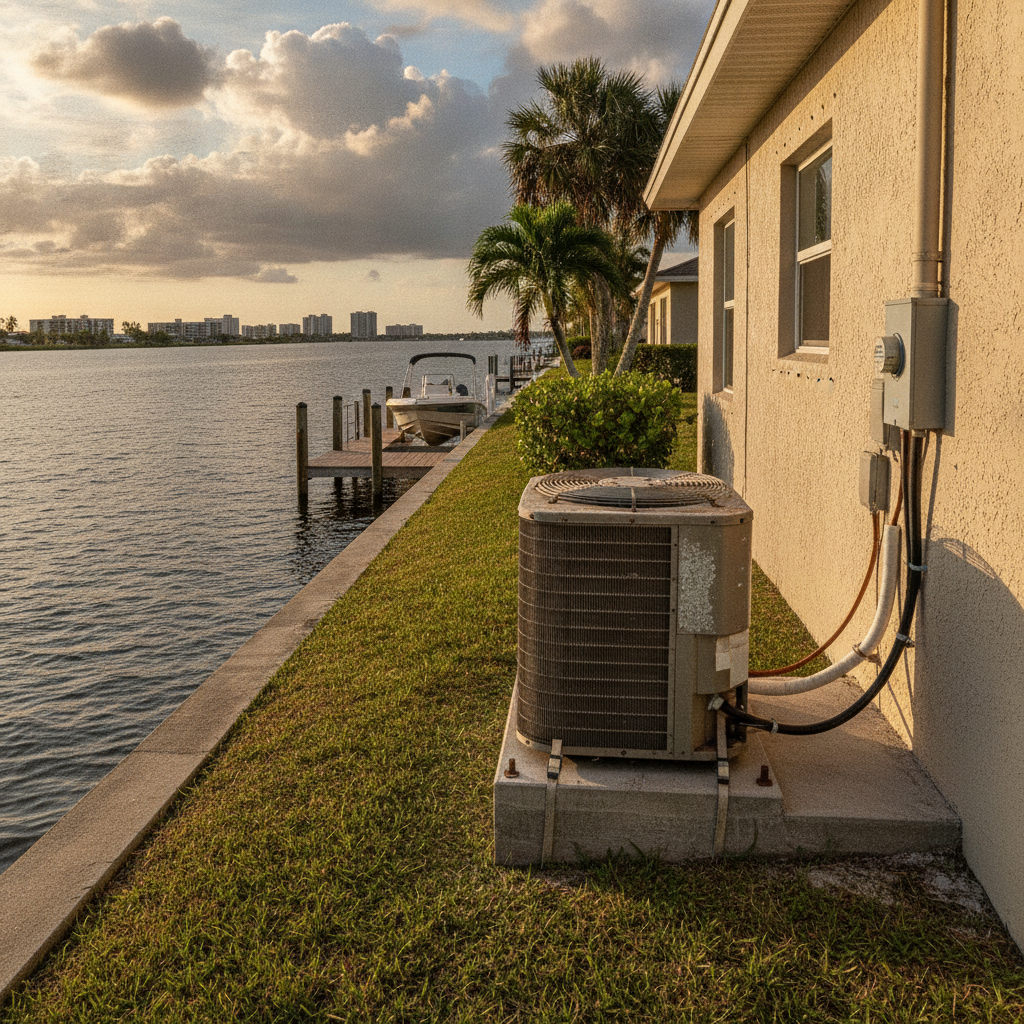
The outdoor unit on a Punta Gorda Isles canal lot sits a few feet from the seawall, and salt crust on the fins is a Tuesday in August, not a mystery. After Hurricane Ian’s Category 4 landfall near Charlotte Harbor in September 2022, a lot of those condensers took wind they were never built for, and some have been limping through every cooling season since. When the air dies in a Harbour Heights ranch or a downtown mid-rise, you need a licensed and insured HVAC contractor at that address, because canal salt, condo boards, and Charlotte County rules do not show up on a generic repair page.
What breaks on a canal-front condenser here
Salt air and a long cooling season eat the outdoor unit first. The fins load up with a white crust, the cabinet pits, and the fan motor works harder every afternoon the breeze comes off Charlotte Harbor. A capacitor that has lost capacitance leaves the compressor straining to start. You hear a hum, a click, then nothing. A clogged condensate drain is the quiet cousin of that failure: the pan fills, the float switch opens, and the system shuts down as if it died for no reason. On a canal-front pad, splash and wind-driven spray make both of those failures more common than they are on a dry inland lot.
Hurricane Ian still sits in the equipment. Some outdoor units in Punta Gorda took a hit in September 2022 and never ran the same afterwards. A bent fan shroud, a coil that took debris, a whip that moved on its disconnect: any of those can look like a sudden no-cool years later, when the real story is a machine that has been compensating. The insurance-driven replacements after Ian are still working through the footprint. A repair on a unit that already took that storm is a different conversation than a repair on a clean, late-model split.
Snowbird houses add a third pattern. A place closed from spring into fall with the thermostat on a setback lets the drain line dry out and grow a plug. The first hot week back, the float switch trips while the new construction across the harbor in North Port runs fine. Rinsing the outdoor coil with a garden hose, changing the filter, swapping thermostat batteries, and resetting a breaker are the honest homeowner-side limits. Adding refrigerant, opening a sealed circuit, or working the high-voltage disconnect is not. EPA Section 608 is the federal rule on who may maintain, service, repair, or dispose of equipment that could release refrigerant.
A diagnostic on this work sits in the $89 to $150 range for this footprint. Most AC repairs, parts and labor after that diagnostic, land between $150 and $650. Those are market ranges, not a quote for your pad. What moves a job toward the high end is access (a condenser on the far side of the house means more copper, more insulation, and more labor to reach it), a salt-eaten coil that will not clean back to useful airflow, and a compressor that has been starting against a weak capacitor all summer. Emergency dispatch and diagnostic work sits at $200 to $450, with after-hours and holidays at the high end of that range.
Condo boards versus a single-family changeout
In a Punta Gorda mid-rise, the association often decides what can be replaced, which equipment is allowed, and when the work can happen. A Harbour Heights or Deep Creek block ranch is the opposite job: you own the pad, the disconnect, and the air handler in the garage or the closet. Same city, same Charlotte County building department, two different decision trees. Downtown and harbor-front condo stock is where a board packet, a reserved elevator, and a roof or mechanical-closet lockout decide the calendar. The licensed contractor we send still does the wrench work. The board decides whether that work is even on the table.
A single-family changeout is a condenser and an air handler sized to the house. Full system replacement in this footprint, condenser and air handler for a single-family home, runs $5,500 to $12,000 installed, with a standard split toward $5,500 to $8,500 and a higher-efficiency variable-speed system toward $9,000 to $12,000. A heat pump is the usual replacement conversation here, because one system carries the cooling load and the occasional cool snap. Those figures are market ranges for this metro, not a promise, and they do not stretch onto a condo plant or a duct rip-out.
A condo is often not that split. The outdoor plant may serve several stacks. The indoor air handler may be the only piece you control. Screening, noise, and a matching-equipment rule can block a one-for-one swap even when the old unit is done. Our condo AC replacement rules walk through that association layer. For Punta Gorda specifically, ask the board what it already approved on your building before anyone prices a pad. A repair that stays inside your air handler is a different approval than a crane day on the roof.
| Situation | Repair still makes sense | Replacement is the conversation |
|---|---|---|
| Canal-front condenser with salt on the fins | Clean and restore airflow if the circuit still holds | Coil or cabinet eaten through, or the compressor failing with it |
| Single-family ranch | Parts and labor on the existing split | Condenser and air handler when the match is gone |
| Mid-rise condo | Indoor work the association already allows on your stack | Board controls the outdoor plant, the make, and the schedule |
A longer line set, a screened pad, or a roof unit the association will not let you touch all push labor up. None of that is a hidden fee. It is the shape of the building.
Charlotte County permits and a licensed contractor
Punta Gorda is Charlotte County, and an AC changeout is mechanical work, so it is permitted work at any price. Florida’s $7,500 permit exemption for small jobs on a single-family dwelling does not apply to electrical, plumbing, structural, mechanical, or gas work. The contractor we send pulls that permit. We match you with the pro. We do not hold a contractor license, and we do not pull permits ourselves.
Charlotte County’s residential mechanical permit covers replacement of heating and air conditioning equipment at a residential location. The county lists who may obtain it: Owner-Builder, Certified HARV Class A, Certified HARV Class B, Certified Mechanical, Registered HARV Class A, Registered HARV Class B, and Registered Mechanical. Florida’s air-conditioning contractor classes live in F.S. 489.105(3). Class A is unlimited on central air-conditioning, refrigeration, heating, and ventilating systems. Class B is limited to 25 tons of cooling and 500,000 Btu of heating in any one system. A mid-rise plant is a different class of job than a ranch split. Confirm the person on your driveway through the Florida DBPR license search by name, city, or license type. The approved phrase on this work is licensed and insured. A license number on this page would not be ours, because this brand is a referral service.
Two other Florida rules show up on bigger tickets. A notice of commencement is required when the direct contract is greater than $5,000, with a carve-out: that filing does not apply to a direct contract to repair or replace an existing heating or air-conditioning system in an amount less than $15,000. Charlotte County’s own mechanical page states the notice of commencement for any improvement whose direct contract price is greater than $15,000, and it must be submitted before the first inspection is scheduled. For a complete mechanical application on an existing single-family dwelling under $15,000, Florida also gives the county a five-business-day decision window. That is a decision deadline, not a promise the permit prints that afternoon. Confirm the current fee with the county building department before you budget. Fees move. A page that invents one does not help you.
A capacitor, a drain, or a contactor on an existing system is a different scope than a changeout. The contractor who opens the unit will tell you if Charlotte County wants a permit for that visit. If the house is hot after dark or on a holiday, emergency HVAC service is how we get a licensed contractor on the diagnosis. The line is answered. We do not promise a clock.
Common repair questions in Punta Gorda
Why did my AC just stop working out of nowhere?
A system that was cooling at lunch and silent by dinner usually failed on a start component, a safety switch, or power, not on a mysterious total collapse. The capacitor can no longer give the compressor the jolt it needs, so you get a hum and a click. The drain line clogs, the pan fills, and the float switch kills the call for cooling to keep water out of the ceiling. A breaker trips and stays out. On a canal lot, salt on the coil can also push head pressure high enough that the machine shuts itself down on a hot afternoon. Filter, thermostat batteries, breaker, and a hose on the outdoor coil are the checks that belong to you. Anything that opens the refrigerant circuit belongs to an EPA Section 608 certified technician working for a licensed contractor.
What is the $5,000 AC rule?
People use that phrase for the notice of commencement, not for a rebate and not for a permit exemption. Florida requires a copy of the notice of commencement before the first inspection when the direct contract is greater than $5,000, and then carves out a direct contract to repair or replace an existing heating or air-conditioning system under $15,000. Charlotte County’s mechanical permit page points at the $15,000 figure for that filing. The $7,500 small-job exemption is a different statute, and it does not reach mechanical work, so a changeout still needs a permit even when the contract is modest. Ask the contractor we send which filing applies to your contract price. Do not budget a fee from memory.
Does a repair qualify for Florida’s A/C rebate?
A repair does not. FPL’s residential A/C rebate is $200 on a new A/C system purchase that includes both indoor and outdoor units, at SEER2 15.2 and above, delivered as a credit on the invoice from FPL’s participating independent contractor. It is not a promise you will receive it, and it is not a utility-wide Florida program. If the diagnosis turns into a replacement, that is the moment to ask the contractor whether they participate. Until then, you are in diagnostic and repair ranges, not rebate paperwork.
When to call us
Call when the house is hot, the outdoor fan is silent, the drain has tripped the float, or a condo board has a packet waiting on a licensed contractor. We match Punta Gorda homeowners with licensed and insured HVAC contractors for diagnosis, repair, and the permit on a changeout. Call us at (941) 292-6250.