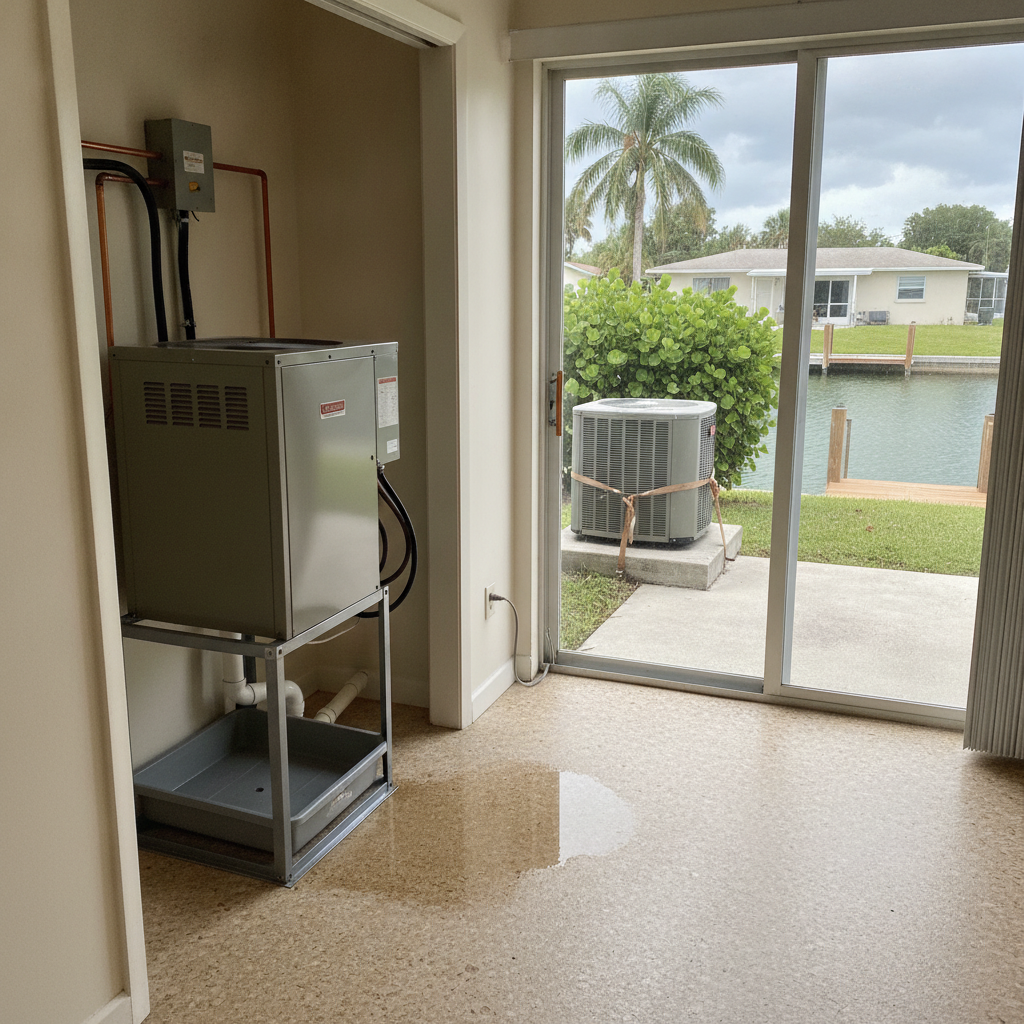
A wet stripe on the terrazzo at the air-handler closet, or a stain on the lanai ceiling of a downtown mid-rise, is the same problem in two different Punta Gorda houses. The indoor coil is wringing humidity out of Gulf air, and that water is not making it outside. The licensed HVAC contractor we send diagnoses the leak. You do not need a plumber for the puddle under the closet, and you should not keep running the system while it dumps water onto the floor.
Water at the air handler is condensate, not a mystery leak
Your air conditioner cools and dries at the same time. Warm indoor air moves across a cold evaporator coil. Water vapor condenses on that coil the way a glass sweats on a Harbour Heights afternoon. The droplets fall into a shallow pan and leave through a PVC drain line that usually exits near the outdoor unit or along a side wall.
That drain runs wet for most of the year here. The National Weather Service page that publishes Punta Gorda climate records sits on a humid Gulf-coast pattern, so a long cooling day makes a lot of condensate. Dust from the return, biofilm, and algae grow in a dark, wet pipe. The trap and the line fill. Water backs up into the pan. The pan overflows at the closet threshold, or it finds a joint in the secondary pan and shows up as a ceiling drip one floor down.
A visible puddle at the air handler is almost always this condensate. It is not liquid refrigerant. Refrigerant stays inside copper as a closed loop. If a sealed-system problem is involved, the usual path is a coil that ices, then dumps meltwater when the ice lets go. That still looks like a water leak. Only a technician with EPA Section 608 certification may open that circuit. Do not add anything to the lines, and do not pull a panel to look for oil or frost.
A dirty filter can start the ice path. Restricted airflow lets the coil get too cold. Ice builds. Later it melts faster than the pan and drain can take. Changing a clogged filter is a fair first move if you can reach it while staying dry. It does not clear a line that is already packed with sludge.
The overflow protection is supposed to stop the mess before it reaches the floor. Many air handlers use a float switch in the pan or a clip-on switch on the drain. When the water rises, the switch opens the control circuit and the system stops making more condensate. That shutdown is why a leak and an AC that is not working in Punta Gorda often show up on the same afternoon. If you found a puddle and the system is still running, that switch did not do its job, or the water is coming from somewhere the switch cannot see: a cracked pan, a disconnected hose, or a sweating, uninsulated suction line.
For the drain-clog pattern across this metro, the pipe and the algae are covered in why an AC drain line clogs. This page is the Punta Gorda version: canal-front ranches, mid-rise lanais, and a pan that sits in salt air.
Canal houses, condos, and a pan that overflows
A canal-front ranch and a downtown condo leak from the same condensate backup, in different places. On a canal lot in Punta Gorda Isles or along the Peace River, the outdoor unit lives in salt air. The indoor air handler often sits in a closet on terrazzo or tile. The primary pan is a shallow metal or plastic tray under the coil. A secondary pan may sit under the whole cabinet. When the PVC clogs, the first water you see is a dark line at the closet door.
Salt air does more than crust the condenser fins outside. A little of that air reaches the closet, and mineral film builds on a float switch that has to move freely to shut the system down. After a few summers the switch can stick closed. The system keeps running. The pan fills. The overflow hits the floor instead of killing the call for cooling. That is a failed safety, not a mystery flood.
Downtown and in the mid-rises, the air handler is often above a ceiling or in a mechanical closet that serves a lanai wall. Water that leaves the pan does not pool at your feet. It stains the drywall, then drips onto furniture or the lanai. An association may require a licensed contractor on the property, and the work window may not be yours to pick. The drain still clogs the same way. Algae does not care about a condo board.
Snowbird houses closed from spring into fall add a second pattern. The system sits, or it runs on a deep setback in a sealed house. Dust settles. The first long run in November or December shoves that dust into a drain that has been sitting wet. The pan overflows on the week you return.
A cracked or rusted pan is a slower leak. Older trays pit. A hairline crack weeps even when the drain is clear. A condensate pump, used when the drain cannot fall by gravity, can fail and dump into the same closet. None of these is a plumbing leak from a supply line. The water is what the coil pulled out of the air.
Turn the thermostat from Cool to Off when you see standing water. If water is around the cabinet and you can reach the breaker without stepping in the puddle, shut that circuit down too. Stay dry. Water and the high-voltage side of an air handler are a bad mix. Then call for AC repair. The contractor we send clears the line, checks the pan, and tests the float. That is the job, not a garden hose through a wall you cannot see.
What the licensed tech checks first
The licensed and insured HVAC contractor we send starts at the water, then works back to the coil. The first look is the drain, the trap, the pan, and the float. A clogged PVC line is the usual find in this humidity. The tech clears it, confirms flow at the outdoor termination, and treats the line so the algae does not rebound in a week.
Next is the pan itself. A warped, rusted, or cracked tray will leak with a clear drain. Replacement of that pan is still air conditioning repair in Punta Gorda, not a full changeout. A disconnected or poorly pitched hose is a simpler mechanical miss: the water never had a downhill path.
The float switch gets a real test, not a tap. Salt air and mineral crust leave a switch that looks fine and no longer opens. If the system kept running while the pan overflowed, that switch is part of the diagnosis. Jumping it so the house cools again leaves the next overflow with no backup.
Airflow is the other half. A packed filter, a blocked return, or a coil matted with dust drops the temperature of the coil and can freeze it. Meltwater then overwhelms the pan. The tech looks for ice, measures temperatures, and decides whether the freeze is a filter and airflow problem or a sealed-system problem. Sealed-system work stays with the EPA-certified technician. You will not be asked to top off anything.
If the air handler is in a ceiling or a tight condo closet, the tech also looks at where the overflow would go. A secondary pan that drains to a visible spot is doing its job when you see water in that pan. A missing or dry-rotted secondary pan is how a small clog becomes a stained ceiling.
Most of this is repair work. A drain clear and a switch replacement stay in that lane. A rusted coil cabinet, a failed pump, or a pan that cannot be sealed may push the conversation toward replacement, and that is a separate decision with its own permit path under Charlotte County’s residential mechanical permit for equipment changeout. A leaking drain on an existing system is usually not that job.
When the house is hot, the leak is active, or water is near electrical parts, that is emergency HVAC territory. We match you with a licensed local contractor. The line is answered. The contractor diagnoses. You should not keep resetting a tripped float so the system can make more water.
Common questions about a leaking AC
What should I do if my AC unit is leaking water
Set the thermostat to Off. Stay out of the water. If you can reach the air-handler breaker with dry feet, switch it off. A filter you can pull without opening the cabinet is worth changing when it is packed. Do not open the sealed system, do not pour chemicals into a line you cannot see, and do not jump the float switch so the house will cool for one more afternoon. Then call so a licensed HVAC contractor can find the clog, the pan, or the switch.
Can I still run my AC if it is leaking water
Indoor puddles, ceiling stains, and water at the closet are a reason to shut the system off. The coil will keep making condensate as long as it is cold and the blower is moving humid air, and that water has nowhere honest to go. A slow drip at the outdoor drain pipe can be normal discharge. That is the system doing its job. Water inside the house is not.
How much does it cost to fix an AC that is leaking water
A clogged drain and a failed float are ordinary repair: the tech restores a path for water that the coil is already making. A rusted pan, a failed condensate pump, or a freeze that points at the sealed system is more labor and more parts. The contractor we send diagnoses first, then explains what the water is doing and what it takes to stop it. Ask for that diagnosis before anyone talks replacement.
What is the $5,000 rule for AC work
It is construction paperwork, not a leak test. Florida requires a notice of commencement on many direct contracts over $5,000, and it carves out a direct contract to repair or replace an existing heating or air-conditioning system under $15,000. Charlotte County asks for that notice on improvements over $15,000 before the first inspection. None of that tells you whether a puddle in the closet is an emergency. Standing water still means the system should be off until a licensed tech restores drainage.
When to call us
Call when water is at the air-handler closet, on a lanai ceiling, or around the outdoor drain in a way that does not look like a normal drip, and you want a licensed HVAC contractor to find the clog, the pan, or the switch. We match Punta Gorda homeowners with licensed and insured local pros for that diagnosis. Call us at (941) 292-6250.