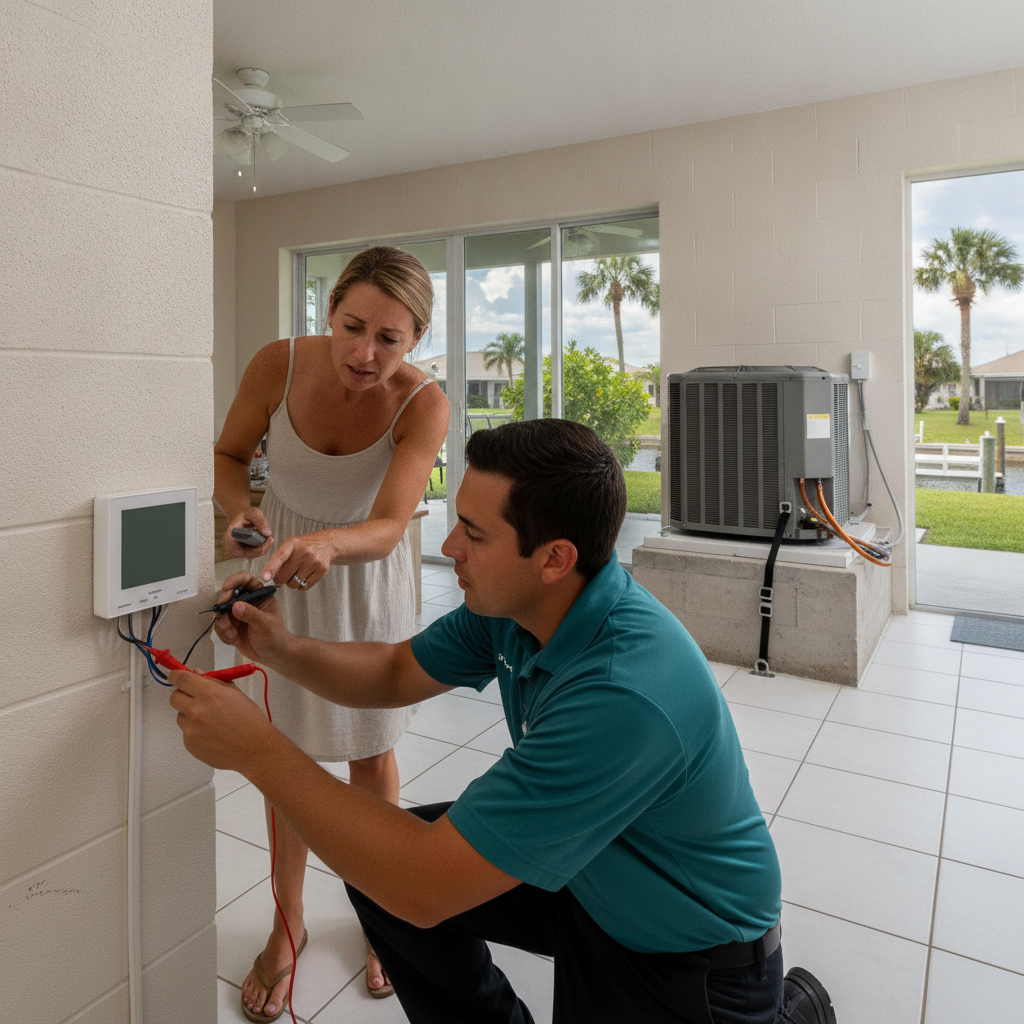
The hallway display is dark, or it still reads 74 while the air handler in the closet never starts. In Englewood that is a thermostat not working, and the first split is simple: the wall unit lost power, or it is calling for cooling into a system that already shut itself down. Batteries, a missing C-wire, and a tripped breaker cover a lot of blank screens. The rest lives at the indoor board, the drain float, or the condenser outside.
Batteries, C-wire, and a breaker that tripped
A blank thermostat almost always means the wall unit is not getting power. Many Englewood homes still use a battery-backed display even when low-voltage wires run back to the air handler, so a set of cells that sat through a Venice snowbird season can take the screen down while the closet unit still has 240 volts. Fresh batteries of the same type, seated the right way, and a minute for the display to boot will tell you if that was the whole story. If the screen was dim or flickering for weeks, that is the same path.
Wired thermostats live on the 24-volt control circuit that comes from a small transformer at the indoor unit. Flip the HVAC breaker fully off, then back on, once. The panel labels in a Port Charlotte ranch are often “AC,” “air handler,” or “heat pump.” A breaker that trips again is not a thermostat problem. Something on that circuit is shorting or overloaded, and the licensed contractor who opens the unit is the person who traces it. Do not keep resetting it. The same rule applies after a Gulf storm when the power comes back and the display stays dead.
The C-wire is the common conductor that completes that 24-volt loop so a bright or Wi-Fi display can stay on without eating batteries. A 1960s cottage near Historic Dearborn Street often has four-conductor cable: R for power, W for heat, Y for cooling, G for the fan. There is no C in the wall. A simple battery thermostat can live on that. A always-on smart display cannot, so it browns out, reboots, or goes blank in the middle of an August afternoon. Pulling a new common through the wall means opening the air handler and landing the wire on the board. That is not a homeowner job.
A few other power cuts look like a dead wall unit and are not. The indoor service switch, the one that looks like a light switch on or near the air handler, may have been bumped to off while someone stored holiday bins in the closet. The faceplate may have popped off the subbase after a cleaning, so the pins are not seated. In this climate a clogged condensate line can trip a float switch and drop the control circuit, which is why a sticky Rotonda West house with water at the drain pan can show a blank or silent thermostat at the same moment. That is a drain problem, not a new wall control. See how a clogged AC drain line shuts a system down before you replace the display.
Safe first facts, not a teardown:
- Dead batteries take the display down even when the air handler still has high-voltage power.
- A tripped HVAC breaker cuts the transformer that feeds many wall units, so the screen goes dark with the indoor unit.
- A Wi-Fi thermostat without a C-wire will brown out because the display draws power the old four-wire run never had to supply.
If the screen comes back and the system still will not cool, stop chasing the wall. That is AC repair at the equipment, starting with a diagnostic that in this market runs $89 to $150.
When the thermostat is fine and the board is not
A lit display that says COOL, with the set point a few degrees below room temperature, is already doing its job. The Y circuit is closed. If the indoor blower never starts and the condenser in the side yard stays quiet, the break is downstream: a blown low-voltage fuse on the control board, a failed transformer, a safety switch that opened, a contactor that will not pull in, or an outdoor unit that took salt and weather on a Placida or Manasota Key lot. You cannot see those from the hallway. You can hear the difference. A working call for cooling should produce a click at the air handler and, a short delay later, the outdoor fan. Silence after a confirmed call means the thermostat is the messenger, not the fault.
Wrong-room temperature is a different tell. Direct sun on a west wall in a Port Charlotte block ranch, a supply register blowing on the sensor, or a kitchen wall that picks up oven heat will make the display lie. The house feels warm while the thermostat thinks it already hit 72, so the system short-cycles or never runs long enough to pull humidity down. Move a cheap room thermometer to the same hallway, out of the sun, and compare. If they disagree by a wide margin after the batteries and the placement are ruled out, the sensor in the wall unit is failing. If they agree and the house is still hot, the equipment is not keeping up, which is how an Ian-damaged condenser or a starved filter mimics a “bad thermostat” all summer.
A click at the wall and no motion at the equipment is the classic board-side failure. The thermostat closed the circuit. The indoor control did not follow through. On older air handlers that fuse is a small automotive-style tap on the board. Replacing it without finding the short that blew it, a nicked outdoor cable, a wet float switch, a stuck relay, puts you right back in the same dark hallway. The breaker that keeps tripping is the high-voltage version of the same warning. One reset is information. A second trip is a stop.
Modern controls also insert a short time delay so the compressor cannot short-cycle. Wait it out before you decide the wall unit is dead. Ten quiet minutes after you drop the set point is normal protection, not a failed call. If the outdoor unit then starts and the supply air is still warm, you have left thermostat diagnosis entirely. That path is refrigerant, airflow, or a failed outdoor component, and EPA Section 608 is what governs who may open a circuit that could release refrigerant. Do not add charge, recover it, or pop the service ports. The pro we send handles that.
A regular HVAC maintenance visit, $89 to $150 in this market, is where a packed filter, a borderline float switch, and a corroded outdoor disconnect get caught before they impersonate a dead thermostat on a Saturday in September. Peak Atlantic hurricane season sits in that window, from mid-August through mid-October, per the National Hurricane Center. Storm outages and the restart after them are when boards, fuses, and batteries fail together.
Programmable vs a simple swap on an older system
A failed mechanical or basic digital thermostat on an older split system is often a like-for-like swap on the same R, W, Y, and G terminals. The air handler does not care that the new face looks different if the calls are the same. That is the honest repair on a Grove City or Englewood Core cottage that only needs on, off, heat, and cool. Push a Wi-Fi unit onto that same four-wire run and you recreate the blank-screen problem you just fixed, because the display wants a C-wire the cable never had.
A programmable or smart control earns its keep in a different house. Venice and Punta Gorda snowbird homes sit closed five to seven months. A schedule that holds a reasonable setback, then returns to occupied settings before the drive down from the north, is the point of the upgrade. Wellen Park new construction already tends to have the extra conductor and a transformer sized for a lit display. The mismatch is the retrofit: old air handler, new glowing screen, no common wire, batteries that die every few weeks until someone lands a C on the board.
| What you have | What usually belongs on the wall | Why |
|---|---|---|
| Older split, four wires, no C | A simple or battery programmable unit | The board already understands R, W, Y, and G, and the display does not need constant 24-volt power |
| Snowbird house empty for months | A programmable schedule, with a C-wire if the screen stays on | Setback is the job, not a brighter display that browns out while the house is shut |
| Lit smart display that keeps dying | Confirm a C-wire at the air handler before another wall unit | The screen is starving, so a second fancy thermostat fails the same way |
Thermostat installation in this footprint, including the install, runs $250 to $500 as a market range, not a quote. The number moves with whether the pro we send can land on existing wires or has to pull a common, replace a failing transformer, or match a heat pump’s O/B reversing wire so cool snaps still heat and August still cools. Heat pumps are the usual replacement system here, one machine for the long cooling season and the occasional cold morning, so the new wall control has to speak that language. A straight-cool thermostat on a heat pump will not.
If the air handler and condenser are already on borrowed time, another wall unit is the wrong spend. A full changeout is AC installation work, and the thermostat comes with the system. Standard split systems in this market install in the $5,500 to $8,500 range; a higher-efficiency variable-speed system sits at $9,000 to $12,000. Those are installed-system ranges for a single-family home, not a thermostat-only job. Confirm the contractor is licensed and insured on Florida’s DBPR license search before anyone pulls the old face off the wall.
Thermostat questions we hear in Englewood
Is there a reset button on a thermostat?
Most wall units do not have a single labeled reset button. Some digital models hide a pinhole on the side or behind the door. The reset that actually works is power: pull the batteries, or switch the HVAC breaker fully off, wait a minute, then restore power and let the display reboot. After a storm outage that is often enough to bring a frozen menu back. If the screen returns with a nonsense schedule, the clock and mode were lost with the power. Set it to cool, drop the set point a few degrees below the room, and wait through the built-in delay. A factory reset, when the manual describes one, wipes schedules. It does not repair a missing C-wire or a board that already dropped the Y call.
How can you tell if a thermostat is bad?
The wall unit is the fault when it stays blank after fresh batteries, a seated faceplate, and one good HVAC breaker, or when the buttons do nothing on a lit screen. It is also the fault when a second thermometer in the same hallway disagrees with the display after you have taken sun and supply-register blast out of the picture. The wall unit is not the fault when it shows COOL, you hear the indoor click, and the condenser never starts, or when the vents blow warm air on a confirmed call. That is equipment. Unresponsive controls, a display that will not hold a set point, and a system that never gets a call while the air handler clearly has power are the cluster that points at replacement, not at another round of battery swaps.
Do I need an electrician to replace a thermostat?
Replacing a thermostat on a central system is HVAC control work, not house wiring. The contractors we send are licensed and insured for that air-conditioning work. The cables are low-voltage, landed on the air-handler board, and they have to match heat-pump reversing, staging, and the C-wire if the new display needs one. An electrician is the wrong first call for a blank Honeywell in a North Port hallway. The exception is the home’s high-voltage circuit itself: a breaker that will not hold, a scorched disconnect, or damaged service wiring at the air handler. Do not open that disconnect. Do not land a C-wire on a live board. The licensed HVAC contractor traces both sides and brings in electrical help only if the 240-volt feed is the actual failure.
My power came back on, but my thermostat isn’t working. What should I do?
After an outage, give the system a minute, then check batteries, the HVAC breaker once, and the mode. Many displays boot to Off or to a default schedule, which is why a Punta Gorda house can sit hot after the lights return even though the equipment is fine. Reseat the faceplate. If the screen stays blank, the 24-volt transformer or the onboard fuse may have taken the surge, and that is a board-side repair. If the breaker trips when the outdoor unit tries to start, stop. Surge-damaged condensers and shorted control wiring show up on this coast after storm weeks, and they are not a thermostat. Most repairs after a diagnostic fall in the $150 to $650 range for parts and labor. After-hours dispatch and diagnostic, when you need that visit, runs $200 to $450 at the high end of this market.
When to call us
If the display stays blank after batteries and one breaker check, or the thermostat is lit and the condenser never starts, you need a licensed HVAC contractor at the air handler, not another wall unit from the hardware aisle. We’ll match you with a licensed and insured pro who can read the board, the float switch, and the thermostat together. Call us at (941) 292-6250.