The five repairs your air conditioner is most likely to need in Englewood are refrigerant leaks, bad capacitors, compressor faults, clogged drain lines, and worn blower motors. A diagnostic visit runs $89 to $150. Most of those repairs then land between $150 and $650. Catch the warning signs early, because they get worse fast. Here’s what each repair actually involves and where it sits in that band.
Englewood Air Pro connects homeowners with the pros we send who handle these repairs and diagnostics across Sarasota and Charlotte counties. Here’s the breakdown.
1. Refrigerant leak (the most common call)
Your AC can’t cool without refrigerant charge. A leak means the system is slowly losing its working fluid, which causes the evaporator coil to freeze over (blocking airflow) or the compressor to overheat and fail.
What it looks like: The air from your vents feels cool but not cold. The system runs constantly without hitting your setpoint. Your electric bill jumps because the unit has to work twice as hard to move warm air out. Sometimes you’ll spot ice on the outdoor condenser or liquid seeping from the copper lines.
What the tech will do: They’ll run a nitrogen pressure test or use an electronic leak detector to find where refrigerant is escaping. Small leaks in soft solder joints or rubber gaskets get a quick braze or reseal. Larger leaks in the coil tubes might require replacing the whole evaporator or condenser.
What it costs: Finding and sealing a leak sits inside most Englewood repairs at $150 to $650 after the $89 to $150 diagnostic. Refrigerant leak repairs run toward the high end of that band. Here’s our full breakdown on AC refrigerant leak repair costs in Englewood.
2. Failed capacitor (sudden and preventable)
Every AC has capacitors: small cylindrical parts that hold electrical charge and trigger the compressor and fan to start. A bad capacitor either won’t start the system at all, or it’ll let the compressor burn out trying to crank without enough electrical force.
What it looks like: Your AC won’t turn on at all, or it kicks on but shuts down after a few seconds. Sometimes the outdoor unit hums but the fan won’t spin. You might smell a burnt plastic or oil odor near the outdoor equipment.
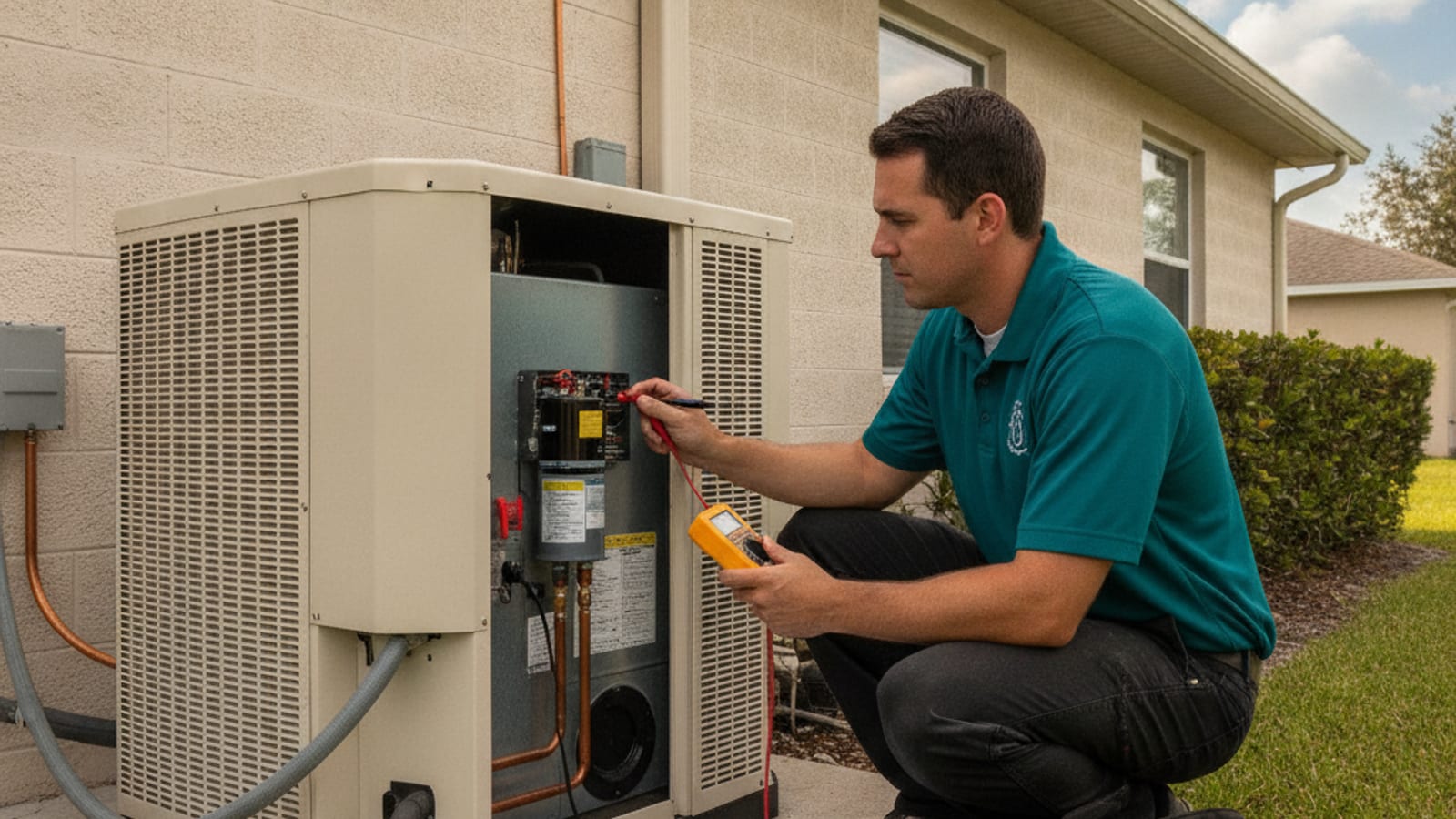
What the tech will do: A multimeter test shows whether the capacitor is holding charge correctly. If it’s failed, they’ll swap it for a new one (a 5-minute job) and check the compressor to make sure it didn’t take damage while trying to start against a weak capacitor.
What it costs: A capacitor swap sits at the low end of the $150 to $650 repair band, after the $89 to $150 diagnostic. If the compressor took damage in the attempt to start, that is a different job. Early maintenance catches a weak capacitor before it kills the compressor.
3. Compressor failure
The compressor is your air conditioner’s heart. It pumps refrigerant through the whole system, and once it fails, you’re either rebuilding it or replacing the outdoor unit. This is the most expensive repair on the list.
What it looks like: The outdoor unit runs but barely any cool air comes from your indoor vents. You might hear a grinding or rattling noise from the compressor, or the system cycles on and off repeatedly without cooling. The breaker might trip or the unit might shut down and refuse to restart.
What the tech will do: A pressure test and amp-draw check will show whether the compressor is still pumping. If it’s failed, replacement is usually the only option because a rebuild costs nearly as much as a new one.
What it costs: Start with the $89 to $150 diagnostic. A compressor job is the point where many Englewood quotes leave the $150 to $650 repair band and the conversation turns to replacing the outdoor unit. Here’s our full guide to HVAC compressor replacement costs in Englewood.
4. Clogged condensate drain
Your AC’s indoor unit produces water as it cools the air. A drain line carries that water outside to a condensate pan. If the line gets blocked by mold, algae, or sediment, the pan overflows and water collects inside your home.
What it looks like: Water pooling around the indoor unit or dripping into a basement or crawlspace. A foul smell (like old socks or vinegar) coming from the air handler closet. Reduced airflow because water is backing up inside the coil housing.
What the tech will do: They’ll blow out the drain line with compressed air or flush it with a special solution, then clean the condensate pan. In older homes, a blockage in the main line might need a wet vacuum or a camera scope to locate.
What it costs: A simple drain clearing sits at the low end of the $150 to $650 repair band after the $89 to $150 diagnostic. Clogged AC drain line repair in Englewood walks through prevention steps.
5. Worn blower motor
The blower motor is a fan that pushes cooled air through your ducts. When the bearings wear out or the motor coil burns, you lose airflow. The system can still run but nothing comes from your vents.
What it looks like: Weak or no air coming from your vents even though the AC is running. The outdoor unit cycles on and off because the indoor coil is backing up with cold air that isn’t being pushed through the house. You might hear a squeaking or grinding noise inside the air handler closet.
What the tech will do: They’ll test whether power is reaching the motor, spin it by hand to check for bearing friction, and use a clamp meter to see if it’s drawing current. A failed motor gets replaced with a new one and the system gets balanced to check airflow.
What it costs: Motor replacements run toward the high end of the $150 to $650 repair band after the $89 to $150 diagnostic.
What makes a repair urgent vs what can wait
Not all repairs are emergencies, but some get expensive fast if you ignore them. A refrigerant leak or compressor problem that you push off for a week can turn into a failed coil. A clogged drain might flood your home. A bad capacitor prevents the whole system from starting.
If your system shows any of these signs, call for a diagnostic visit ($89 to $150): no cooling at all, water pooling indoors, loud noises, constant cycling, or a burnt smell. A technician can rule out simple fixes (thermostat setting, filter clog, breaker trip) and tell you exactly what you’re facing.
Can you prevent the most common repairs
Some repairs you can’t stop, but you can delay them or catch them early.
A spring maintenance visit catches a bad capacitor or weak compressor before it fails hard. Regular filter changes and drain cleanings stop clogs and mold. Keeping weeds and debris away from the outdoor unit prevents coil damage. And for homes near salt water, a post-storm inspection catches corrosion before it eats through the condenser.
Here’s our full guide to why AC maintenance matters in Englewood.
Cost range summary
Here’s a quick reference:
Diagnostic visit: $89 to $150. Most repairs: $150 to $650. Capacitors and drain clearing sit at the low end. Refrigerant leaks and motor replacements run higher. Emergency dispatch and diagnostic: $200 to $450.
If you’re facing a major repair on a system that’s already 12 years old, your tech can walk through the math on replacement versus repair. A full system replacement runs $5,500 to $12,000 for most single-family homes. How much does AC repair cost in Englewood, FL in 2026 covers the full range of costs across system age and damage severity.
Englewood Air Pro connects you with licensed HVAC professionals who diagnose your specific problem and give you honest pricing before any work starts.
Frequently asked questions
How do I know which repair my AC needs?
Call for a diagnostic visit. The technician will run pressure tests, electrical checks, and a system walkthrough to identify the problem. Don’t guess or try to fix it yourself; many of these problems have overlapping symptoms.
Can a bad capacitor damage my compressor?
Yes. A weak capacitor makes the compressor work harder to start. If it keeps trying to crank against a failing capacitor, the motor overheats and burns out. That’s why early replacement matters.
Is a refrigerant leak covered by warranty?
Almost never. Warranty covers defects in the part itself, not leaks from damage, wear, or corrosion. If you’re still under the manufacturer warranty (usually five to 10 years), the tech can check the specific leak site to see whether it’s a factory defect or age-related failure.
Should I replace or repair a 10-year-old AC with a compressor problem?
At that age, a compressor job is worth weighing against a new system at $5,500 to $12,000. Your tech can tell you whether other parts are showing age and whether the outdoor unit is still worth keeping.
How long does a repair usually take?
Most repairs finish in two to three hours once the technician arrives. Capacitor swaps take 30 minutes. Refrigerant recharges and drain clearing take 45 minutes to an hour. Compressor or motor replacement can run four to six hours if the system needs rebalancing after the work.