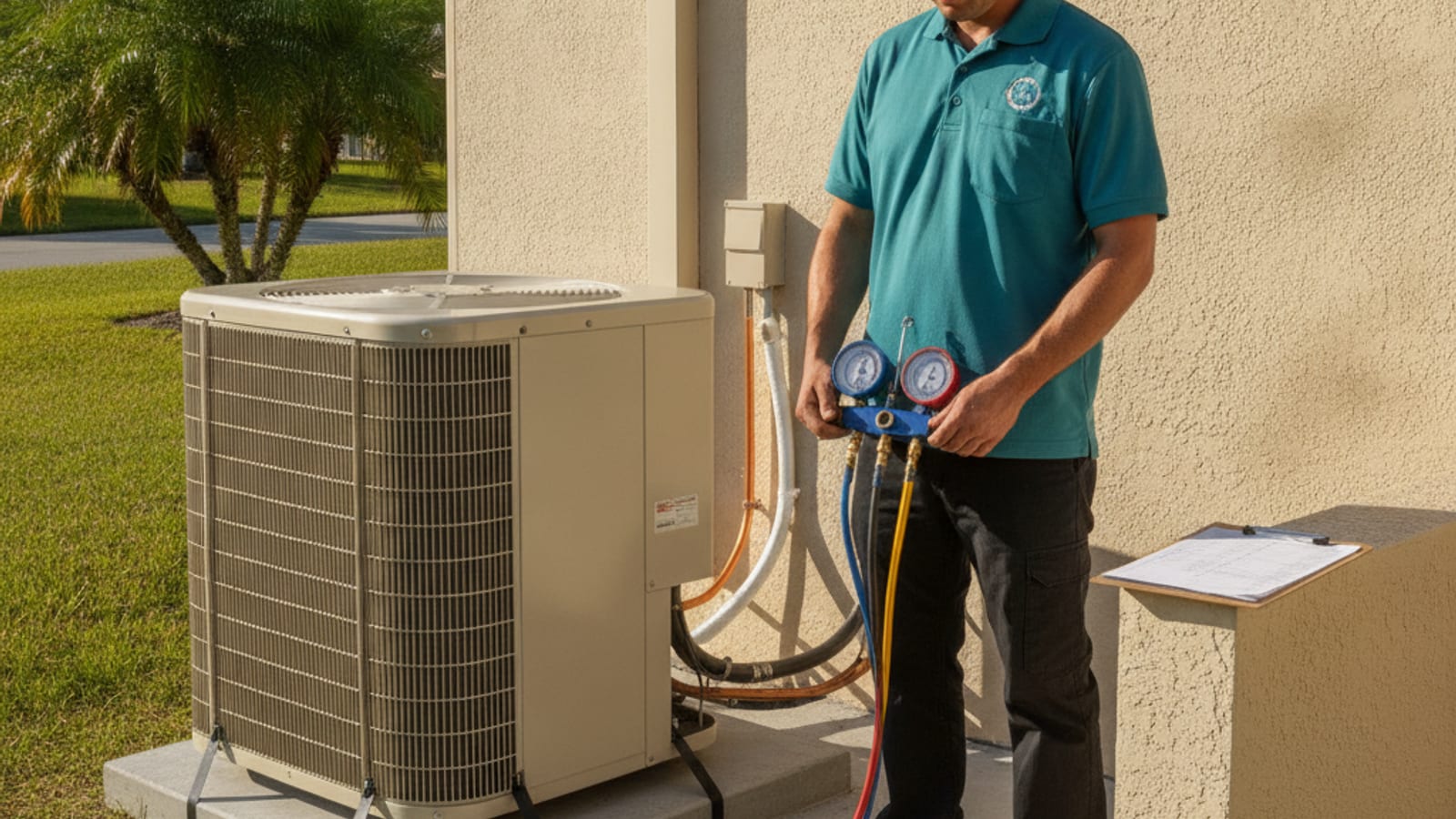
AC maintenance in Englewood costs $89 to $150 per visit, less on an annual plan. A single annual tune-up keeps the system running clean and catches small problems before they turn into no-cool emergencies in July. Most homeowners schedule one in spring and sometimes another in fall, though the Gulf-coast nine-month cooling season means your system gets a harder workout than northern air conditioners.
Englewood Air Pro connects homeowners with the pros we send for AC tune-ups and maintenance across Sarasota and Charlotte counties. The visit price and the capacitor-to-drain checklist live in our AC tune-up cost guide. What you’re signing if you bundle visits is in our maintenance plan post.
What’s included in AC maintenance
A standard tune-up takes an hour to 90 minutes and covers the system head to toe. The technician measures refrigerant charge with a gauge set, cleans the condenser coils on the outdoor unit (salt air or dust can block airflow), checks electrical connections and the compressor amp draw, tests the thermostat for accuracy, evaluates the blower motor and airflow, cleans or replaces the indoor air filter, and looks for any signs of early-stage problems like a capacitor that’s drifting out of specification or refrigerant seeping from a soft solder joint. A written report at the end shows what was found and lists any parts you might want to replace soon before they fail.
Why maintenance matters more in Englewood
The Englewood cooling season runs nine months straight, April through December, which means your air conditioner logs roughly double the runtime compared to a home in Pennsylvania or Ohio. That constant workload wears out capacitors, contactors, and blower motors faster. Add in the Gulf-coast humidity, and coils that stay wet between cooling cycles are more likely to grow mold or algae that blocks airflow.
Homes closer to the coast face a third pressure: salt air. In Manasota Key and Boca Grande, the salt spray corrodes condenser coils, cabinet panels, and electrical connections years faster than homes further inland. Regular maintenance catches that corrosion early, when a cleaning can slow the damage. Skip it and salt air has a longer run at the condenser, the coils, and the electrical connections.
When to schedule maintenance
Spring is the gold-standard time, late March or April, before the daily temperatures hit 90 degrees and everyone’s AC starts running hard. A tune-up before peak season finds problems while the system’s been idle for a few months and parts are easy to replace without rush fees.
Some homeowners schedule a second visit in November, after the heavy summer use, to prepare for the winter transition and catch any signs of wear. That second tune-up is smart if you want to split the wear assessment across the year, though a single spring visit catches most issues.
Storm season matters too. After a hurricane or tropical storm, a quick post-storm check makes sure outdoor equipment wasn’t damaged by debris or water intrusion, and that indoor components weren’t affected by power surges or humidity spikes. Hurricane Ian left us with years of water-damage calls in homes that were flooded or sat unopened for months.
What does maintenance cost in different seasons
Spring maintenance costs the same year-round: $89 to $150 for a standard visit. You’re not paying extra for the season itself, but scheduling during peak season (June through August) might mean waiting longer for an appointment slot. A capacitor that’s drifting toward failure in April is an ordinary appointment. The same part failing in late July competes for slots with emergency no-cool calls, so you might wait a few days.
If you’re paying for a second fall visit, expect the same $89 to $150. An annual maintenance plan is how that second visit usually costs less than booking each one separately.
What problems does maintenance catch before they cost more
A routine tune-up often finds issues that would otherwise land you with a repair call. The diagnostic on a repair visit runs $89 to $150, and most repairs then land between $150 and $650.
Refrigerant charge that’s creeping low might not cause obvious symptoms until the system suddenly can’t keep up on a 95-degree day. A maintenance visit catches it before the indoor coil freezes over mid-summer.
Capacitor readings that are out of spec show that the part is failing, not that it’s already dead. Swapping it during the visit sits at the low end of the repair range and prevents a no-cool emergency when the part dies without warning.
Blower motor bearings that are rough or grinding can be replaced before the motor seizes and leaves you without indoor airflow in a heat wave. Motor replacements run toward the high end of that $150 to $650 band.
Electrical connections that have corroded or loosened can arc if left alone. Cleaning and re-tightening during maintenance is part of the visit.
How long does a tune-up take
A standard maintenance visit runs 60 to 90 minutes once the technician arrives. That’s time for a full system walkthrough with gauges, not a 20-minute glance-over. If the system needs a filter change or coil cleaning on top of the diagnostic, add another 15 to 30 minutes. Most homeowners schedule in the morning and have the house back to normal by early afternoon.
Is maintenance worth the cost
The $89 to $150 visit is cheaper than waiting for a $150 to $650 repair, and cheaper than a $200 to $450 emergency dispatch once the system is already down. It keeps the system running clean through nine months of heavy use. For homes near the coast, it is also when the pro we send inspects salt-air corrosion before it becomes a no-cool call.
For older systems, a maintenance tune-up is less about prevention and more about buying time until replacement makes sense financially. A technician can walk through that comparison honestly during the visit.
What to check before calling for maintenance
You don’t need a reason to call for maintenance, but a few signs suggest you shouldn’t wait:
Your electric bill jumped noticeably with no change in how you use the AC. A system losing refrigerant or fighting blocked airflow runs longer to hit the same setpoint, which shows up as a higher monthly bill before it shows up as uneven cooling.
The air coming from the vents feels weak or cool but not cold. Restricted airflow or low refrigerant often feels like reduced output before the system stops cooling entirely.
The outdoor condenser fan runs but stops and starts frequently, or the compressor cycles on and off more than it used to. These are signs of refrigerant loss or electrical stress.
Water is pooling near the indoor unit, or the condensation drain smells bad. Both point to drainage or biological growth that need attention.
Bring up any of these during your maintenance call, and the technician can focus the diagnostic on likely causes.
Englewood Air Pro connects you with local HVAC professionals for maintenance visits across Sarasota and Charlotte counties. You’ll get a written report at the end, and any parts the technician recommends for near-term replacement come with honest pricing and no pressure to replace today what can wait safely until next season.
For homes with hard water or systems that have been flooded or heavily stressed, our guide to protecting AC equipment from salt air covers what accelerates wear on coastal systems, and our heat pump guide explains how maintenance is slightly different on heat-pump systems that run year-round instead of just through the cooling season.
Frequently asked questions
How often should I maintain my AC in Englewood?
Once yearly in spring is the standard, ideally late March or April before peak cooling season. Some homeowners add a second visit in November after heavy summer use. A system in an older home or near the coast might benefit from twice-yearly maintenance to catch salt-air corrosion and wear faster.
What’s the difference between maintenance and a repair?
Maintenance is scheduled prevention: cleaning, checking readings, replacing wear items like filters, and catching small problems early. A repair is reactive: fixing something that has already failed or stopped working. Maintenance is cheaper than waiting for repairs.
Does maintenance void my warranty?
No, as long as the service is performed by a licensed professional. Florida requires a CAC, air conditioning contractor license, and you can verify any contractor’s license status at myfloridalicense.com. Maintenance by a licensed pro actually protects the warranty.
Will maintenance lower my electric bill?
A clean system with correct refrigerant charge and airflow does not have to work as hard to hold your setpoint.
Can I do maintenance myself?
Filter changes, yes. Everything else requires a licensed contractor. Refrigerant work is illegal without certification, electrical diagnostics need proper tools and training, and a mistake can turn a maintenance visit into a repair or void your warranty.
What’s included in a $89-$150 tune-up?
Refrigerant charge check, condenser coil cleaning, electrical connection inspection, thermostat test, blower motor and airflow evaluation, indoor filter check or replacement, and a written report on any parts showing wear. See AC tune-up cost in Englewood for the visit itself.
If your AC needs maintenance, call (941) 292-6250 and we’ll connect you with a local HVAC pro who schedules quickly and gets the job done with a full system check.