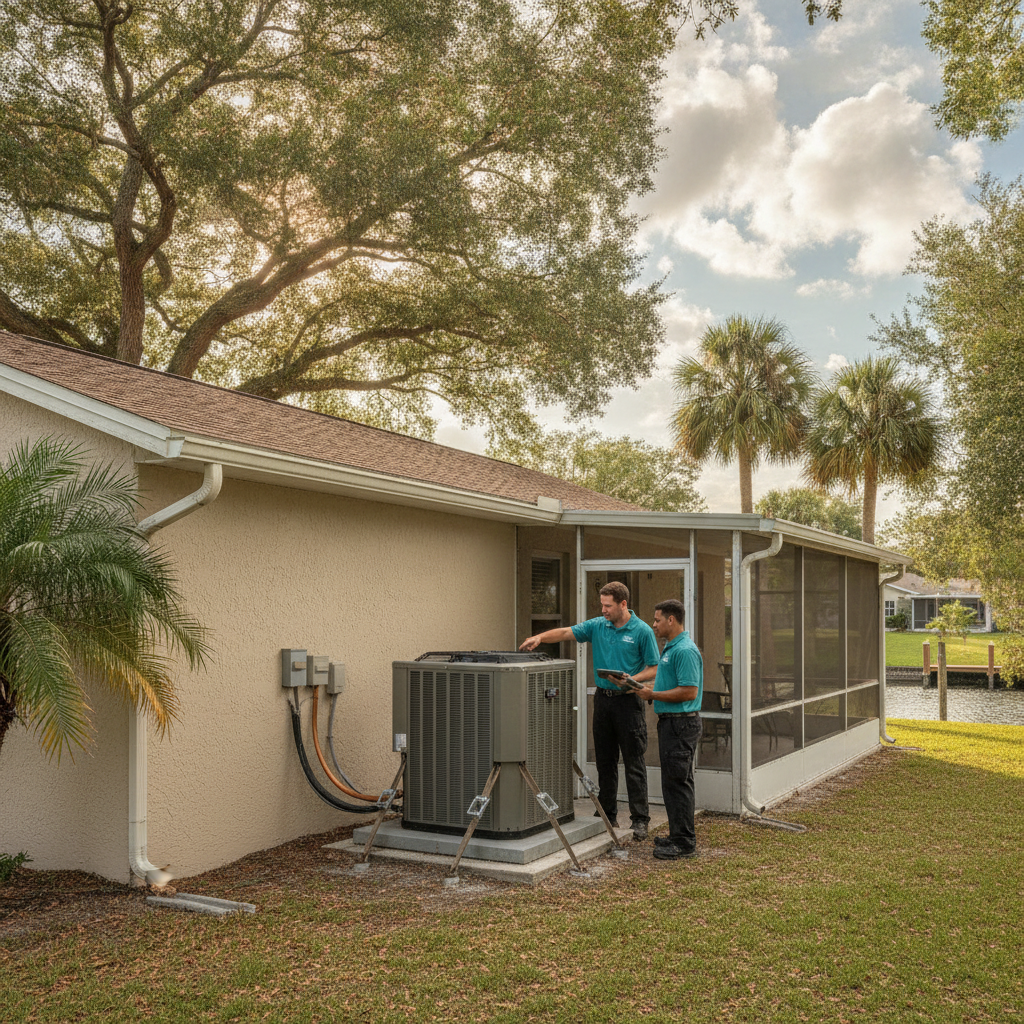
The air handler in a Laurel ranch can run all afternoon and still leave the hallway sticky. Registers blow, the outdoor fan spins, and the indoor temperature keeps climbing. That is an AC repair call, and it belongs to a licensed HVAC contractor. We match Laurel homeowners with licensed and insured pros who already work this Sarasota County stretch between Osprey and Nokomis.
A Laurel house that will not cool in Sarasota County
Laurel sits in Sarasota County, in the Venice and North part of our footprint, along Laurel Road and Tamiami Trail. Most of the stock is 1980s single-story stucco with a condenser on a concrete pad beside a screened lanai. Live oaks throw shade on the west wall and drop pollen on the fins. When that pad unit stops rejecting heat, the house climbs in an hour. Gulf humidity does the rest.
Warm rooms here usually trace to a short list of failures. A capacitor that has lost capacitance leaves the compressor humming and straining to start while the fan already spins. A clogged return filter or a matted evaporator starves the coil of air, the coil ices, and the supply air goes from cool to weak. A condensate line that sat dry for months in a closed snowbird house grows a blockage, the pan fills, and the float switch cuts power on a hot August afternoon. Low refrigerant does the same thing from the other direction: the system runs, the air feels tired, and the coil may frost. Opening that circuit belongs to a certified technician.
EPA Section 608 requires certification for anyone who maintains, services, repairs, or disposes of equipment that could release refrigerant. The contractor we send holds that work. Our job is to get that licensed pro to your house.
A diagnostic visit in this market runs $89 to $150. Most repairs after the diagnosis, parts and labor, fall between $150 and $650. Those figures are market ranges for this footprint. A capacitor, a contactor, or a cleared drain sits toward the low end. A compressor or a leaking coil is a different conversation, and that conversation often turns to replacement.
Laurel is a Sarasota County address. If the repair becomes a changeout, Florida treats an AC replacement as mechanical work, so it is permitted work at any price. The small-job exemption under F.S. 553.79 does not cover mechanical work on a single-family dwelling. The contractor we send pulls that permit. Inspection and permit fees are set by the Sarasota County building department, so confirm the current amount before you budget. Neighborhood coverage for this corridor lives on our Laurel HVAC service page.
How Laurel stock differs from Osprey and Nokomis
Laurel is the suburban middle of this corridor. Osprey mixes older bay-side houses with later infill, and the repair pattern there is its own story in our notes on air conditioning repair in Osprey. Nokomis sits closer to Casey Key and the Intracoastal, where salt crusts the fins sooner. Laurel’s 1980s ranches sit inland of that spray, under live oaks, with original flex duct in hot attics and outdoor units that have already been replaced once, sometimes twice.
Seasonal occupancy is the other split. Venice and North carries the heaviest snowbird share in the footprint, and Laurel feels it. A house on Laurel Road can sit closed from April to November with the thermostat on a setback and the outdoor disconnect off. The drain line dries. The trap crusts. The blower wheel loads with dust. In May the owner returns, flips the breaker, and the first long run of the season trips the float switch or ices the coil. A year-round house farther south, the kind we describe in air conditioning repair in Venice, has been cycling every afternoon since March. That is why HVAC maintenance before you leave, and again when you come back, is the difference between a quiet startup and a holiday weekend with no cooling.
Ductwork in these ranches is often the original 1980s flex, baked in an unconditioned attic. Leaky returns pull hot attic air into the system, so the equipment runs and the house still feels damp. An oversized replacement from a prior owner short-cycles: the air goes cold for a few minutes, the thermostat satisfies, the compressor stops, and humidity never leaves. The rooms feel clammy even when the display says 74. That is a runtime problem hiding behind a working thermostat.
When a repair quote climbs toward a new system, heat pumps are the usual replacement in this metro because one piece of equipment handles the long cooling season and the occasional cool snap. A full condenser and air handler for a single-family home in this market runs $5,500 to $12,000 installed. A standard split system is often $5,500 to $8,500. A higher-efficiency variable-speed system is often $9,000 to $12,000. A heat pump system is $6,000 to $14,000. Florida Power & Light publishes a $200 instant rebate on a new residential A/C with both indoor and outdoor units at SEER2 15.2 or above, credited on the invoice from a participating contractor. That program is FPL’s. The participating contractor is the one who delivers it. Year-round comfort on the next town over is a different occupancy mix, which is why heating and cooling in Osprey reads like a neighbor with the system running all summer.
Atlantic hurricane season runs from June 1 to November 30, with most activity between mid-August and mid-October. A weak capacitor in September on a Laurel ranch is a bad time to keep resetting the breaker and hoping. Get the licensed contractor on the pad before a long outage turns a repair into a soaked house.
What a licensed tech checks on the first visit
The first visit is a diagnosis. The licensed HVAC contractor we send starts at the thermostat and the filter, then moves to the disconnect, the outdoor cabinet, and the air handler. A homeowner can swap a thermostat battery, reset a breaker, and rinse grass clippings off the condenser with a garden hose. Past that, the cabinet stays closed.
On a Laurel ranch the pro is looking for the failures this stock actually produces:
- A weak capacitor lets the fan spin while the compressor only hums, then the overload opens and the house warms back up.
- A burned contactor or a tripped float switch explains a system that is dead even though the breaker looks fine.
- A drain line blocked after a long vacancy dumps water into the pan until the safety switch shuts the equipment down.
- A dirty evaporator or a packed filter drops airflow, the coil ices, and supply air turns weak and wet.
- Low charge or a restriction in the refrigerant circuit is read with gauges, and only an EPA Section 608 certified technician may open that circuit.
Amp draw on the compressor tells the tech whether the motor is working against a mechanical failure or starving for a start assist. Superheat and subcooling tell whether the charge is short or the metering device is not feeding. None of that is visible from the living room.
Give the compressor a few minutes after a shutdown before you call for another start. That pause, often called the three-minute rule, lets high-side and low-side pressures equalize. Restarting against leftover head pressure can stall the compressor and trip a breaker. Many thermostats already build in a short delay. If yours does not, wait before you flip the mode switch again.
If the diagnosis points past a repair, the same licensed contractor can talk through AC installation options for the house. Confirm the company on Florida’s DBPR license search by name, city, or license type before work starts. Florida’s Class A air-conditioning contractor class is unlimited on central air-conditioning, refrigeration, heating, and ventilating systems. Class B is limited to 25 tons of cooling and 500,000 Btu of heating in any one system. Either class, working as licensed and insured, is the person who should be in your yard.
How much does it cost to fix an AC unit?
A diagnostic visit in this market is $89 to $150. Most repairs after that, parts and labor, run $150 to $650. Emergency dispatch and diagnostic work runs $200 to $450, with after-hours and holidays at the high end of that range. A full system replacement, condenser and air handler, for a single-family home is $5,500 to $12,000 installed. Line length, attic access, and whether the air handler has to come out through a tight Laurel ranch closet all move the number. Ask the contractor we send to show you what failed before you approve the repair.
What is the most common problem with an air conditioner here?
On Laurel’s 1980s ranches, the pattern is a failed start capacitor, a clogged condensate drain after a long vacancy, or a dirty coil that ices under August load. The outdoor fan running while the compressor sits silent is the capacitor story. Water under the air handler, or a system that was running and then went dead, is often the drain and the float switch. Those three cover most first-visit findings before anyone talks about compressors or coils.
What is an AC repairer called in Florida?
The person who should open your system is a licensed air-conditioning contractor, Class A or Class B under Florida law, working as licensed and insured. Refrigerant work also requires EPA Section 608 technician certification. Search the contractor on the state licensing portal before anyone cuts a lock on the disconnect.
What is the three-minute rule for air conditioners?
After the compressor stops, pressures in the lines need a short time to equalize. Restarting in that window makes the compressor push against leftover high-side pressure, which can trip an overload or a breaker. Wait a few minutes, then try again. If it still will not start, stop cycling it and get a licensed HVAC contractor on site.
When to call us
Call when a Laurel house will not cool, when the outdoor unit hums without starting, when the air handler leaks, or when a snowbird startup ices the coil on the first hot day back. We match you with a licensed and insured HVAC contractor for that visit. Call us at (941) 292-6250.