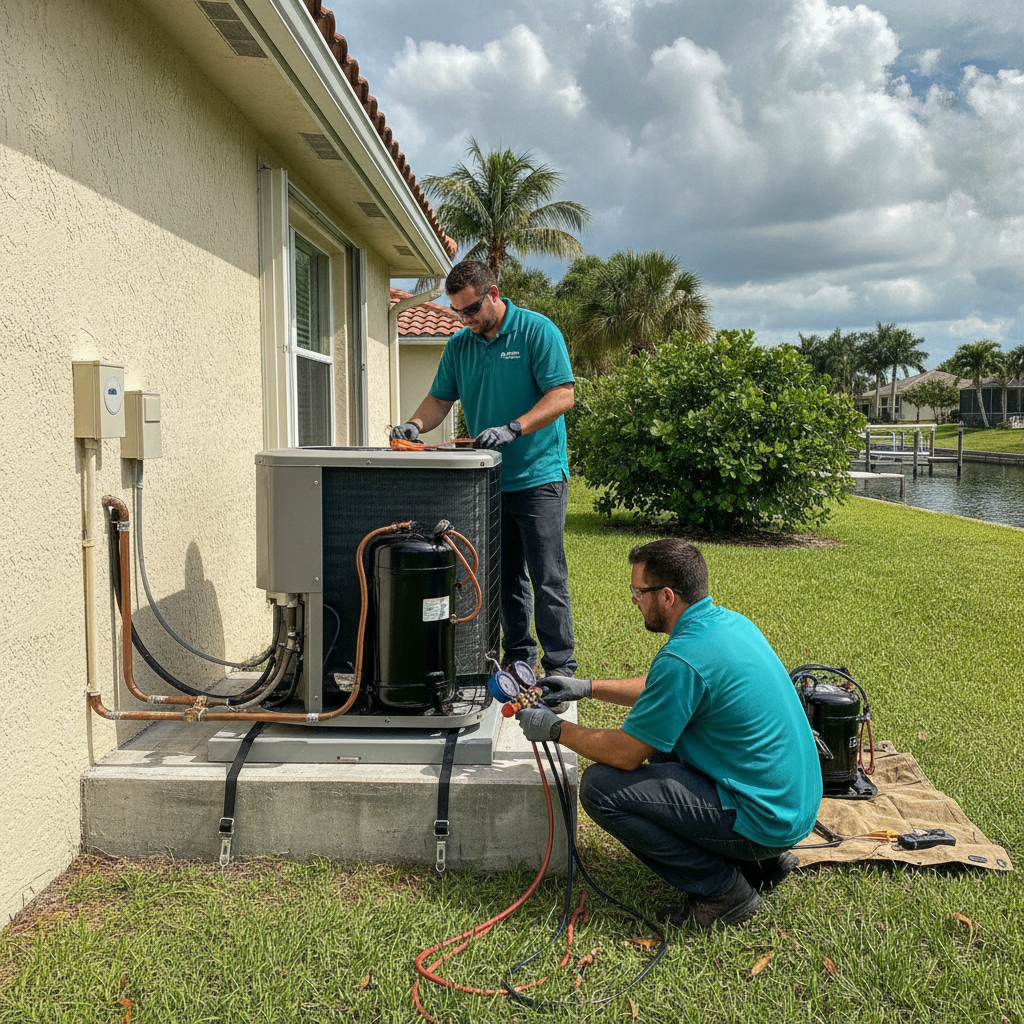
The indoor fan can run all afternoon and the house still will not drop. On a canal-front lot in Placida that feels like a box fan aimed at a wet towel: moving air, no real cooling, humidity climbing with every hour. The blower and the refrigeration cycle are different jobs, and only one of them is working.
Fan on, no cold air
Warm air from a running system means the indoor fan is circulating while the cooling cycle is not. The air handler can do its job all day and the house still sits sticky, because heat only leaves when refrigerant is compressed, condensed, and evaporated on purpose. A running blower is not proof the outdoor unit is pumping.
The thermostat is the one control that can fake this without a broken part. Fan mode runs the blower and never starts the compressor. Fan set to On, instead of Auto, keeps pushing room air through the ducts between cycles, so the grille feels tepid even after a real cooling run. Cool, Auto, and a setpoint below the room are the settings that actually call for cold air. A blank display is often dead batteries, not a dead condenser. Swap them and wait through a cycle before you assume the equipment failed. A thermostat that will not call for cooling at all is a different fault from one that is calling and getting ignored.
Heat pumps are the usual replacement choice in this metro, because one system carries the long cooling season and the occasional cool snap. If the reversing valve sticks, the indoor fan still runs and the air can feel warm even though you asked for Cool. Venice and Punta Gorda snowbird houses that sat closed from spring into fall are a common place for that first-start surprise. The outdoor unit may hum. The air at the register still is not cold.
The electrical split matters on older Englewood and Port Charlotte panels. Many homes have one breaker for the indoor air handler and another for the outdoor condenser. The indoor fan can run on a live indoor circuit while the outdoor breaker sits tripped after a storm, a voltage dip, or a compressor that tried to start and failed. A reset that holds can bring the outdoor unit back. A breaker that trips again is a stop sign. Do not keep throwing it. That is how a shorted winding or a failed capacitor turns into a worse fault. Leave the disconnect, the capacitor, and the compressor wiring to a licensed HVAC contractor.
Look at the cabinet from the yard. If the fan on top is still while the indoor blower is loud, heat has no path out. Grass clippings, hedge trimmings, and salt crust on a Manasota Key or Cape Haze condenser all choke the coil the same way. The system runs. The house does not cool. Clearing debris around the cabinet and a gentle garden-hose rinse of the fins is the honest homeowner limit. AC repair is what comes next when the outdoor fan still will not spin, the compressor clicks and dies, or the air never turns cold after those checks.
One hot room with a cool hallway is usually air, not charge. A sofa over a return, a closed supply in a Port Charlotte ranch, or leaky original ductwork in a 1960s cottage near Historic Dearborn Street dumps cooled air into a hot attic and leaves that bedroom stagnant. Whole-house warm air with a strong blower points back at the cycle: outdoor unit, coil, charge, or compressor.
Filter, coil, and charge
A dirty filter, a fouled coil, or a starved refrigerant circuit will all leave you with a running fan and air that is not cold. They fail in different places, but they share one result: the indoor coil never gets cold enough, or air never moves across it, so heat stays in the house.
The filter is the simple one. Gulf pollen, drywall dust from a Wellen Park build, and pet dander load a filter until the air handler is gasping. Restricted airflow starves the evaporator. The coil temperature drops, moisture in the return air freezes on the fins, and a sheet of ice blocks the rest of the heat transfer. You still hear the blower. You get a trickle of room-temperature air. That is the same pattern as a frozen evaporator coil, and running the system through it is how liquid refrigerant slugs back toward the compressor. Switch the system off and let the ice melt. If it ices again after a clean filter, the cause is still in the machine.
The outdoor coil has the opposite job. It has to dump the heat the indoor coil just pulled out of the living room. A condenser packed with lawn clippings behind a Rotonda West hedge, or white salt on the fins after two summers on Lemon Bay, cannot reject that heat. Head pressure climbs. Cooling collapses. The indoor fan keeps circulating whatever air it has. A hose rinse of the fins is fair. Bending those fins with a pressure washer is not.
Refrigerant is not fuel. The system does not use it up over a season. If the charge is low, there is a leak in a coil, a fitting, or a line set. The tell is a pattern, not a guess: long run times that never catch up, frost on the suction line, a hiss at a joint, and air that starts slightly cool and then goes lukewarm. Only a technician certified under EPA Section 608 may open that circuit, find the leak, and put the charge back where it belongs. Do not add refrigerant. Do not recover it. Do not crack a service port. A refrigerant leak that keeps returning on a salt-pitted coil is often the fork between a repair and a changeout, not a top-off.
The compressor is the pump in that loop. When it fails, the indoor blower can still sound healthy while the outdoor unit sits there making heat instead of moving it. A hard-start click, a hot cabinet, an outdoor fan spinning over a compressor that is not pumping, or a unit that ran poorly after Hurricane Ian’s September 2022 landfall near Charlotte Harbor and never recovered, all point at that failure. Capacitors and contactors fail first and are ordinary AC repairs. A dead compressor on an aging split is the larger decision.
Humidity makes every one of these worse here. The system is not only dropping temperature. It is wringing moisture out of Gulf air. A clogged condensate line in August will trip a float switch and shut the cooling call down while the fan still feels alive, which is the same miserable afternoon in Rotonda West that a new build at Wellen Park never sees. That is a drain problem, not a charge problem, and it still leaves the house hot.
| What you notice | What is usually failing | Why the air stays warm | | Indoor fan strong, air at room temperature | Thermostat in fan mode, outdoor breaker off, or a compressor that is not pumping | Air is moving, but heat is not leaving the house | | Weak air at the registers, frost on the copper | Clogged filter, dirty indoor coil, or a leak that starves the coil | The indoor coil cannot absorb heat if air or refrigerant is missing | | Outdoor fan still, cabinet roasting in the sun | Capacitor, fan motor, or a condenser packed with grass and salt | Heat pulled indoors has nowhere to go |
What a visit includes
A licensed HVAC contractor starts with a diagnostic, not a guess from the driveway. On this footprint that visit is typically $89 to $150. Most repairs after that, parts and labor, land between $150 and $650. After-hours and holiday dispatch and diagnostic work runs $200 to $450, at the high end of that range. Those are market ranges, not a quote for your house.
The pro you get sent will confirm the call at the thermostat, measure airflow, look at the filter and both coils, and test the electrical parts that start the outdoor fan and the compressor. If the refrigeration circuit is in play, that same person has to hold Section 608 certification to put gauges on the system. Charge is a measurement, not a hunch. A capacitor swap, a drain clear, a contactor, or a fan motor is ordinary service. A leaking coil or a failed compressor is the point where repair and replacement split.
When the job becomes a changeout, the installed range for a condenser and air handler on a single-family home is $5,500 to $12,000. A standard split often sits at $5,500 to $8,500. A higher-efficiency variable-speed system is $9,000 to $12,000. A heat pump, which is the default replacement in this metro, is $6,000 to $14,000 installed. If FPL serves the house, that utility’s residential program advertises a $200 instant rebate on a new A/C with indoor and outdoor units, at SEER2 15.2 and above, credited on the participating contractor’s invoice. It is not a promise this brand can make, and it does not apply to a repair.
An AC changeout is mechanical work. Florida’s $7,500 building-permit exemption does not cover mechanical work on a single-family dwelling, so the replacement is permitted at any price. Englewood straddles the line: ZIP 34223 is Sarasota County and ZIP 34224 is Charlotte County, and the permit goes to a different building department on each side of that line. Charlotte County’s residential mechanical permit is written for replacement of heating and air-conditioning equipment at a residential location. Boca Grande and Palm Island are reached through Charlotte County but they are not Charlotte County addresses. They sit in Lee County, so that Charlotte page does not govern them. The contractor we send pulls the permit. This brand does not.
Florida law treats the bid itself as contracting. The people who do this work hold Class A or Class B air-conditioning credentials under F.S. 489.105(3), or another qualification the county lists on the mechanical permit. You can confirm a licence on the Florida DBPR License Search. The contractors we send are licensed and insured. A maintenance visit at $89 to $150 is how a dirty coil and a weak capacitor get caught before the next August afternoon turns into this same call.
Ducts belong in the same conversation on the oldest stock. Original trunk lines in a Dearborn Street cottage, or canal-front runs that were never sealed, can leak enough cooled air that the equipment is running hard and the rooms still feel warm. Duct repair or replacement in this market is $1,500 to $6,000 depending on scope. That is a different job from a charge problem, and it is why a running system with weak registers is not always a refrigerant leak.
How do I reset my central AC not blowing cold air?
A reset is a thermostat and breaker check, not a repair. Set Cool and Auto, put the setpoint below the room, replace blank-display batteries, and see whether the outdoor unit starts. If the outdoor breaker is tripped, one restore is reasonable. If it trips again, stop. Power the system down and let a frozen coil thaw before you turn it back on. Repeated resets on a shorted compressor or a failed capacitor make the failure more expensive.
Why is my air conditioner blowing air but not cold?
The blower is a fan. Cold air is the refrigeration cycle. Fan-only thermostat settings, a tripped outdoor breaker, a dirty filter that froze the coil, a salt-fouled condenser, a refrigerant leak, a stuck heat-pump reversing valve, or a compressor that is no longer pumping will all move air that is not cold. Strong air at every register with no temperature drop points at the outdoor unit or the charge. Weak air in one bedroom of an older Englewood cottage points at ducts or a blocked return.
How to tell if an AC is low on refrigerant?
Low charge is a leak, not a tank that ran empty. Long run times that never catch the setpoint, frost on the suction line, a hiss at a coil or fitting, and air that starts faintly cool then goes lukewarm are the pattern. Only a Section 608 certified technician should confirm it with gauges. Adding refrigerant on top of a leak returns you to the same hot house in a week, and it is not a homeowner job.
When to call us
Call when the fan is running, the air is not cold, and a filter, thermostat, and outdoor-breaker check did not change it, or when the coil is icing, the outdoor fan is dead, or you can hear the compressor click and die. That is licensed HVAC work, including anything that opens the refrigerant circuit. We’ll match you with a licensed local contractor. Call us at (941) 292-6250.