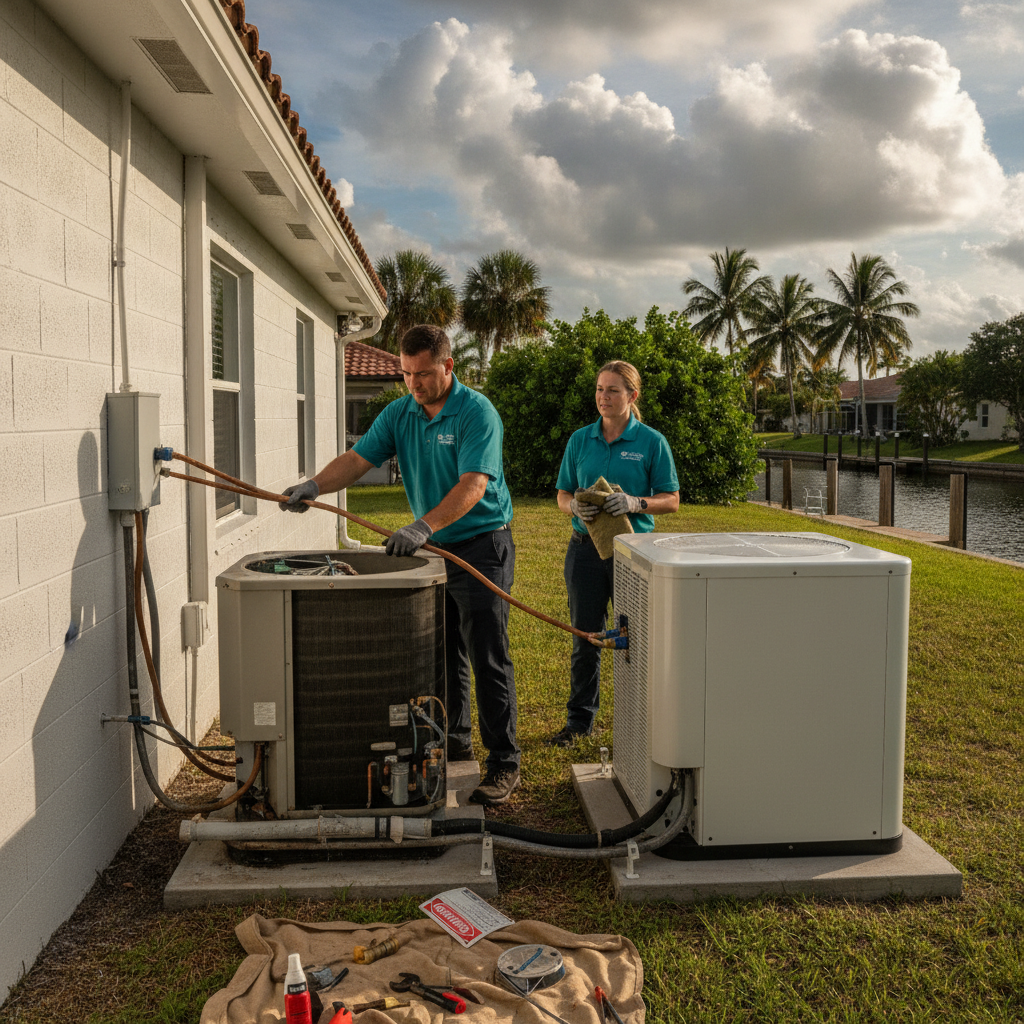
The condenser on a canal-front lot in Placida can look fine from the driveway and still be done. Salt crust sits on the fins, the compressor labors on every start, and a second repair in the same rainy season is usually a delay, not a fix. The licensed contractors we send treat that moment as a matched-system decision: indoor unit, outdoor unit, and the line set between them, sized for a Gulf-coast house that cools almost every day of the year.
Age, SEER2, and a coil that has lived in salt air
Repair stops making sense when the outdoor coil has lived in Gulf salt air long enough that the next failure is the expensive one: a compressor that will not start, a coil that will not hold a charge, or a cabinet so eaten that the fins no longer move air.
Salt aerosol and a long cooling season are hard on outdoor coils, fins, and cabinets. A unit on Manasota Key, Cape Haze, or the Placida waterfront works in humid air almost year-round. It does not get a true off-season. A Venice snowbird house closed from spring into fall sits with the thermostat on a setback, then gets asked to dry and cool a sealed cottage in November. Neither pattern is gentle on a tired circuit.
The housing stock here makes the age question local. Original ductwork still runs through the attic of a 1960s cottage near Historic Dearborn Street. Block ranches in Port Charlotte took wind damage in Hurricane Ian, a Category 4 landfall near Charlotte Harbor in September 2022, and some outdoor units never ran the same afterwards. Wellen Park in North Port is often on a second or third system already. Boca Grande and Palm Island take the worst salt in the footprint, with causeway or ferry access, and they are Lee County addresses, not Charlotte County ones. A page that treated those jobs as the same job would be guessing.
SEER2 is the rating language on equipment sold new. It is not a reason to scrap a working system. It is the yardstick on the quote when you are already buying a changeout. Heat pumps are the usual replacement recommendation in this metro because one system carries the cooling load and the occasional cool snap. That is the case we already make in why heat pumps are the default system in Englewood. Near the water, the contractors we send still look for coated or marine-grade condenser coils. That is a coastal habit, not a numbered promise about how long a cabinet will last.
A younger system with one failed part is a different job. A capacitor, a contactor, or a clogged drain is AC repair, and heat pump repairs in this market commonly land between $150 and $650 in parts and labor after the visit. Pouring that same money into a salt-worn coil two summers in a row is how people buy a replacement in pieces. HVAC maintenance on a system you mean to keep is the other fork: clean coils, a clear drain, and a unit that starts without straining.
An oversized leftover from a previous changeout can fool you too. It short-cycles, the coil never runs long enough to wring humidity, and the house feels cold and clammy instead of cool and dry. That is a sizing and runtime problem, not a filter problem. If the indoor air never dries on a still August afternoon in Rotonda West, you are not looking at another seasonal tune-up. You are looking at whether the matched system still belongs in that house.
What a changeout involves on a slab cottage
On a slab cottage near Historic Dearborn Street, a changeout is a pad, a closet air handler, copper through the wall, and a condensate line that already has a history of clogging in August and tripping the float switch.
The licensed HVAC contractor we send recovers the old refrigerant. That is EPA Section 608 work, not a homeowner job. Never add refrigerant, recover it, or open a sealed system yourself. The new outdoor unit has to match the indoor coil and air handler. A mismatch is how a house ends up loud, short-cycling, and still sticky at 4 p.m. The thermostat can read cool while the furniture still feels damp.
Old Florida cottages often keep their original ducts. If those trunks leak in a hot attic, or the returns were never sized for a heat pump’s longer run times, the changeout can pull in ductwork repair. Whole-home duct repair or replacement in this market runs $1,500 to $6,000 depending on scope. That is a separate range from the equipment. A longer line set from a condenser parked on the far side of the house means more copper, more insulation, and more labor to run it. Rotonda West deed restrictions can decide what equipment may be seen from the street or the golf course, which can mean screening or a different pad location. A Punta Gorda condo adds an association’s rules on when a unit may be swapped and what may sit on the balcony.
Boca Grande is not that slab-cottage day. Access, salt, and Lee County permitting change the work even when the indoor unit looks familiar. A Wellen Park house in North Port is closer to a clean pad and a recent electrical disconnect. Same search, different house.
AC installation and replacement is the service path for a full changeout. A heat pump system, installed, runs $6,000 to $14,000 in this market. That is a range, not a quote and not a promise. What moves a job toward the high end is line-set length, duct repairs, electrical, a coastal coil, and a tighter lot. A standard split-system changeout and a higher-efficiency variable-speed system sit in different bands on the AC side of the same decision. The heat pump range is the one that belongs on this job.
| Path | What you pay for | What you still live with |
|---|---|---|
| Keep repairing | A typical heat pump repair here runs $150 to $650 in parts and labor | The same outdoor coil, cabinet, and refrigerant circuit that already failed |
| Replace the system | A heat pump system, installed, runs $6,000 to $14,000 in this market | New matched indoor and outdoor equipment, pulled as a permitted changeout |
The repair column is the right column when one part failed on a system you still trust. The replace column is the right column when the coil, the compressor, and the cabinet have all had a turn.
Permits and the A2L refrigerant rules
A heat pump changeout is mechanical work. Florida’s exemption for work valued under $7,500 on a single-family dwelling does not apply to mechanical work, so the job is permitted at any price. The licensed contractor we send pulls that permit. We do not.
Which building department you answer to depends on the address. Englewood sits on the county line: ZIP 34223 is Sarasota County and ZIP 34224 is Charlotte County. Same town in conversation, different counter. Charlotte County publishes a residential mechanical permit whose scope is the replacement of heating and air conditioning equipment at a residential location. Their page lists who may obtain it: Owner-Builder, Certified HARV Class A, Certified HARV Class B, Certified Mechanical, Registered HARV Class A, Registered HARV Class B, and Registered Mechanical. Do not treat a Sarasota County job as a Charlotte County form.
Florida law also sets a decision window, not a promise the permit prints that afternoon. For an existing single-family home, a mechanical permit, a complete and sufficient application, and work valued under $15,000, the local government has five business days to decide when the applicant is using a local plans reviewer. Inspection fees, by state law, may not be based on the total cost of a project and may not exceed the actual inspection costs. We do not publish a fee. The county that issues the permit sets it.
Notice of commencement is a separate paper. State law has the issuing authority require a copy before the first inspection when the direct contract is greater than $5,000, with a carve-out: that requirement does not apply to a direct contract to repair or replace an existing heating or air-conditioning system in an amount less than $15,000. Charlotte County’s own mechanical page states a notice of commencement for any improvement whose direct contract price is greater than $15,000, submitted before the first inspection is scheduled. Confirm which paper your address actually needs.
The people who may bid and install this work are air-conditioning contractors under Florida law. A Class A air-conditioning contractor’s services are unlimited on central air-conditioning, refrigeration, heating, and ventilating systems. A Class B air-conditioning contractor is limited to 25 tons of cooling and 500,000 Btu of heating in any one system. A residential heat pump sits well inside Class B’s ceiling. Contracting includes the attempted sale and the negotiation or bid, which is why the quote itself belongs to a licensee. You can confirm a name on Florida’s DBPR License Search. The contractors we send are licensed and insured. We are the referral line, not the licensee.
New equipment is also a refrigerant story. Under 40 CFR 84.54, as of January 1, 2025, new residential and light commercial air-conditioning or heat pump systems may not use a regulated substance, or a blend containing one, with a global warming potential of 700 or greater. Pre-2025 R-410A equipment may still be installed where every specified component was manufactured or imported before that date. Availability, not a ban on what you already own, is the practical limit. An existing R-410A system does not have to come out because of that rule. The Florida Building Code in force is the 8th Edition (2023), effective December 31, 2023. The local walkthrough is in A2L refrigerant rules in Englewood.
How much does heat pump replacement cost in Englewood?
A heat pump system, installed, runs $6,000 to $14,000 in this market. That is a range for this footprint, not what any one house will pay. Line-set length, duct repairs, electrical, a coastal coil, and a tighter lot all push a job up. A typical heat pump repair, by contrast, runs $150 to $650 in parts and labor after the visit.
Does replacing a heat pump need a permit in Englewood?
Yes. A changeout is mechanical work, so it is permitted work at any price. ZIP 34223 goes to Sarasota County and ZIP 34224 goes to Charlotte County. Boca Grande and Palm Island are reached through the Charlotte County mainland but are not Charlotte County addresses. The pro we send pulls the permit.
Can I keep servicing an older R-410A heat pump?
Yes. The 2025 rule changed what may be installed new. It did not make it illegal to own or service an existing R-410A system. Only an EPA Section 608 certified technician may open that refrigerant circuit.
When to call us
A heat pump changeout is licensed contracting: refrigerant recovery, a mechanical permit, and matched indoor and outdoor equipment. If the outdoor unit is failing, the house will not dry, or a repair is chasing last summer’s repair, we’ll get a licensed HVAC contractor out to you. Call us at (941) 292-6250.