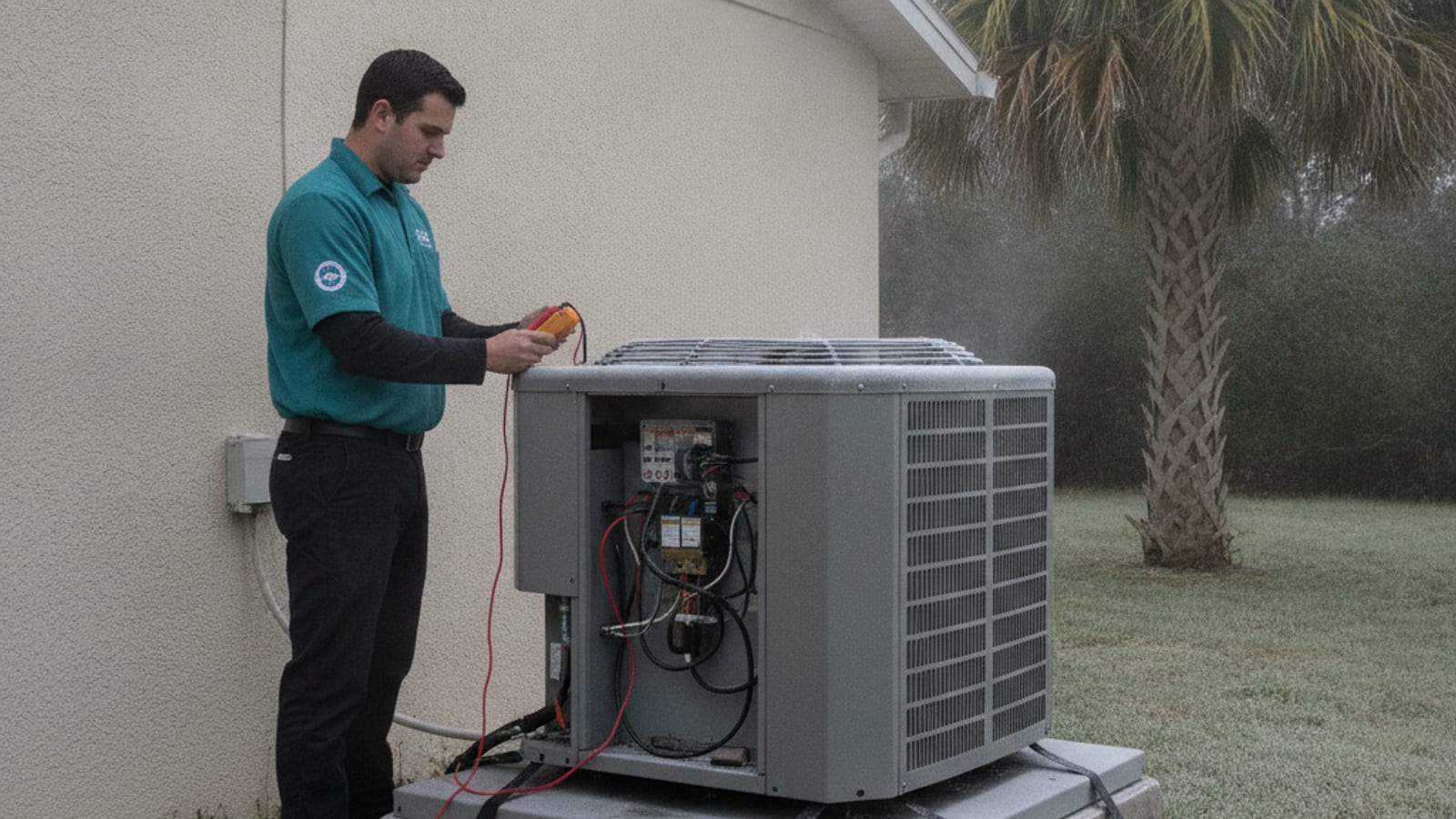
If you’re searching for furnace repair near Englewood, you might not have a furnace at all. Most homes on the Gulf coast run heat pumps for both cooling and heating. When your heating stops on a rare cold January morning, a heat pump malfunction is what you’re actually dealing with. Here’s what a heating emergency looks like and what the repair will cost.
Englewood Air Pro connects homeowners with HVAC professionals who handle emergency heating repairs across Sarasota and Charlotte counties when your heat pump stops working. Unlike inland furnace repairs, heating failures here happen fast and unexpectedly because so few days actually require heat.
Do most Englewood homes have a heat pump?
Yes. Most Englewood homes heat and cool with a heat pump, not a gas furnace. Florida doesn’t need furnaces. A traditional furnace burns fuel to generate heat, which wastes energy when you only need it forty to sixty days a year. A heat pump runs year-round and flips its cycle in winter, pulling heat from the outside air (even when it’s cold) and pumping it inside. In heating mode, the outdoor unit becomes the evaporator and the indoor coil becomes the condenser. When outdoor temperatures drop below about 35 degrees, the system switches to defrost cycle or kicks in a backup electric heat strip to avoid frost on the outdoor coil.
Most Englewood homes built in the last twenty years have heat pumps. Older homes might have small electric resistance heating or a heat pump added during an AC retrofit. Gas furnaces are rare here, and that changes what a heating repair actually looks like.
When heating fails in Englewood
Heating calls spike in mid-January on the rare days when overnight lows hit the 30s or when a system that’s been idle since April suddenly has to run. You’ll notice it fast because people expect their heat to work instantly, unlike air conditioning which builds up gradually.
A heating failure usually shows up as no warm air coming from the vents, or an unusual sound from the outdoor unit. Sometimes the system runs but only blows cool air. On some days, owners mistake the defrost cycle (a normal automatic operation that pulls indoor heat outside to defrost the outdoor coil) for a breakdown. That cycle runs 10 to 15 minutes and then resumes normal heating. If it cycles more frequently than that, the reversing valve is probably failing.
What a heat pump heating repair involves
The first step is a diagnostic call. An HVAC tech will check:
The outdoor unit’s operation in heating mode. They listen for the compressor running and the fan moving air. A silent condenser means the compressor isn’t cycling.
The thermostat setting. Many heating no-cools happen because the thermostat got bumped to off, or the heat pump mode switched to cool or emergency heat without the owner noticing.
The reversing valve. This solenoid switch flips the refrigerant flow between heating and cooling cycles. A stuck or failed valve lets cold refrigerant flow the wrong direction, so the indoor coil can’t gather warmth from the outside air.
Refrigerant pressure. Low charge prevents the system from extracting heat. A pressure test identifies leaks or undercharge conditions.
The electric heat strip. If the outdoor temperature is below the heat pump’s efficiency point (usually 35 to 40 degrees), the backup strip should kick in. A failed strip means the system can only warm the house to 50 or 55 degrees on its own.
Common heating repairs and costs
Most heat pump heating repairs run $150 to $650. A diagnostic visit runs $89 to $150. That covers the parts that fail most often: capacitors, contactors, and defrost-board issues. A reversing valve or strip-heat failure can sit higher than a capacitor swap. The licensed HVAC pros we send diagnose the actual failure and quote it in writing before any work starts.
A reversing valve that sticks can leave the system locked in cooling mode on a winter day, blowing cold air. Heat-strip failure shows up as a house that warms a little but cannot reach setpoint on a 35-degree morning. Low refrigerant often hides through the cooling season, then the system cannot pull enough heat in January. A failed defrost board either never defrosts the outdoor coil or cycles defrost continuously. An older thermostat stuck on cool will blow cold air on a cold day; a programmable thermostat locks the setting electronically.
Emergency heating repair timeline
January heating volume is lower than July cooling volume. The licensed HVAC pros we send set their own availability. Do not count on a same-day swap.
If your system is completely dead on a 30-degree night (no compressor sound, no fan, no heat strip), a replacement compressor or heat pump unit takes longer than one visit. Ask about portable electric heaters or temporary heat until the part arrives.
Preventing heating failures
Spring maintenance catches problems before winter. During a spring tune-up (April or May), the tech checks the reversing valve by running the system in heating mode, confirms the heat strip works, and tests the defrost board. Any weak components show up during that service, not when it’s 32 degrees outside and you need heat now.
A yearly heating-mode check is part of a published tune-up visit at $89 to $150. On the Gulf coast, that visit is cheap insurance because a heating failure on the few days a year you actually need heat is maddening.
Also keep your thermostat in heat mode during winter, not in auto mode. Auto switches between heating and cooling based on room temperature, which sometimes causes the system to bounce between modes if outdoor temperature is right at the switching threshold. Lock it to heat mode from December through February.
When to replace instead of repair
If your heat pump is more than 10 to 15 years old and the repair is a major component, replacement is worth comparing. Heat pumps lose heating efficiency over time the same way they lose cooling efficiency. A system that struggles to reach 70 degrees on a 35-degree day probably needs replacement anyway. Compare the one-time $6,000 to $14,000 installed replacement cost against repeated $150 to $650 repairs over the next few winters.
Englewood Air Pro connects you with licensed HVAC pros for heating repairs or spring maintenance checks across Englewood, Venice, Port Charlotte, and North Port. A tech will diagnose the problem, explain what’s broken and why, and give you honest pricing for repair or replacement.
For more on heating systems in Southwest Florida, see our guide to heat pumps as the default system in Englewood and heat pump vs air conditioner comparisons.
Frequently asked questions
Do most Englewood homes have a heat pump?
Yes. Most Englewood homes heat and cool with a heat pump, not a gas furnace. If you searched furnace repair near me, you are usually looking at a heat pump that will not switch into heat.
Do I have a furnace or a heat pump?
If your home was built after 2000 and you live on the Gulf coast, you almost certainly have a heat pump. Go outside and look at your outdoor AC unit. If it’s a square condenser box with one fan, it’s a heat pump. If you hear a gas ignition sound when the system starts, or you have a metal flue vent on the roof, you have a furnace or a gas unit. In Englewood proper, furnaces are very rare. Call your HVAC contractor if you’re unsure.
What temperature triggers the emergency heat?
Most systems auto-switch to emergency heat (the electric heat strip) when outdoor temperature drops below 35 to 40 degrees, or when the indoor temperature drops more than two degrees below your setpoint. On days above 40 degrees, the heat pump alone should handle heating. Below that, the strip kicks in to boost warmth. If it doesn’t, the strip is probably failed and needs service.
How often should I have heating maintenance?
Once yearly in spring (April or May) is ideal. One tune-up catches weak components, checks refrigerant charge, confirms the reversing valve works, tests the heat strip, and prevents emergency calls in January. Fall checks are optional unless your system had problems the prior winter.
Is heating repair more expensive than cooling repair?
Usually about the same. Both involve diagnostics, component replacement (valves, contactors, boards cost the same), and refrigerant work. Emergency pricing for heating calls can be higher because fewer companies staff for January emergencies and service windows fill fast. Book maintenance in spring to avoid emergency rates.