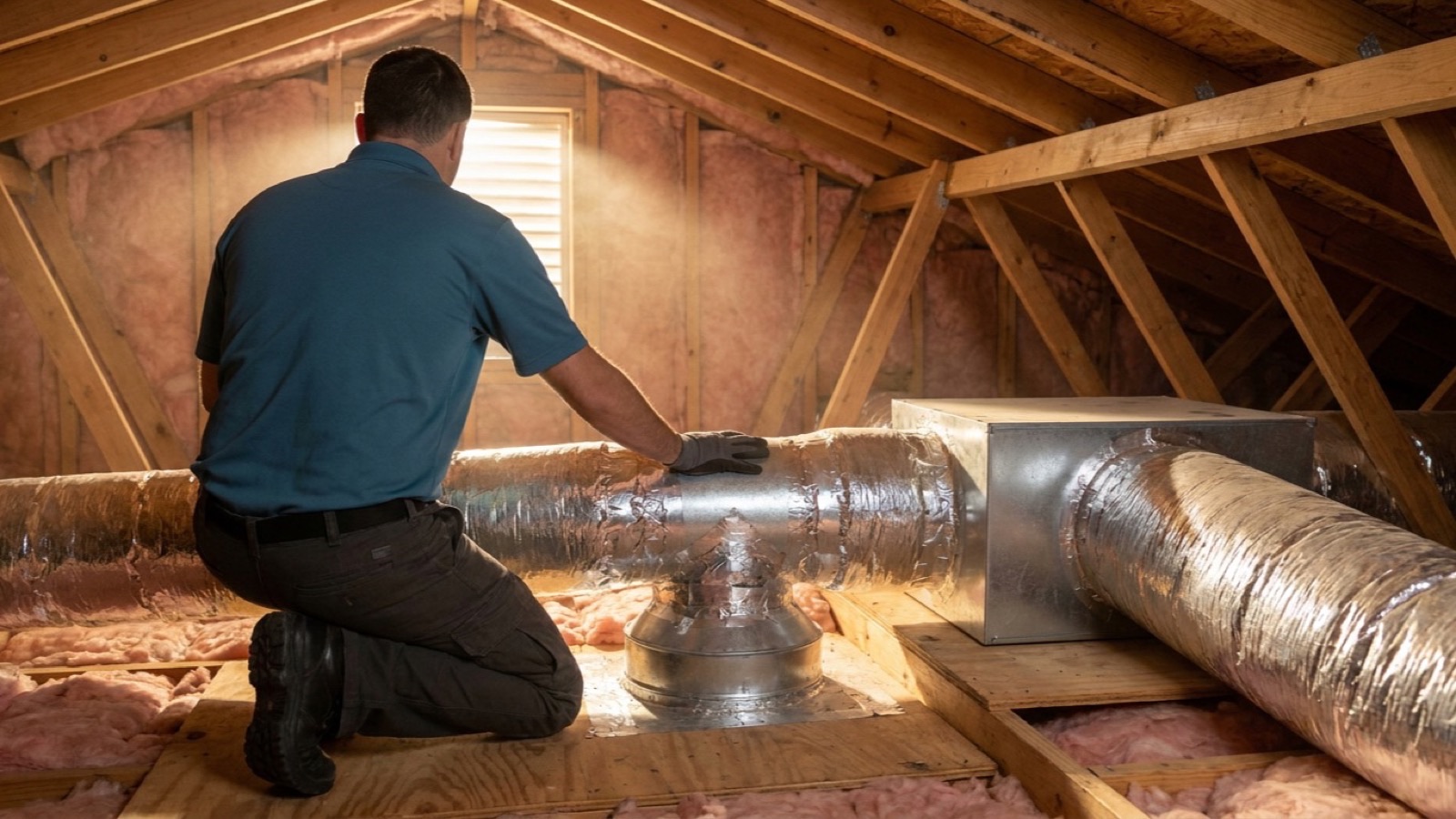
A duct leakage test measures how much conditioned air escapes from a duct system instead of reaching your rooms. Where Florida’s energy code calls for a postconstruction test, total leakage has to stay at or below 4 cfm25 for every 100 square feet of conditioned floor space. Florida goes further than most states here. It names who’s allowed to run the test, what report has to follow it, and the situations where the test isn’t required at all.
What does a duct leakage test measure?
It measures air escaping from the whole duct system, not one bad joint. That means supply ducts, return ducts, every connection, and the air handler enclosure.
During a postconstruction test, every register gets taped or sealed shut. The tester then pushes a controlled pressure across the whole system. Whatever still escapes is the total leakage number that goes on the compliance report.
Section R403.3.3 describes the procedure directly:
“Postconstruction test: Total leakage shall be measured with a pressure differential of 0.1 inch w.g. (25 Pa) across the entire system, including the manufacturer’s air handler enclosure. Registers shall be taped or otherwise sealed during the test.”
That’s why you’ll see the result written as cfm25. It’s the measured airflow at a pressure difference of 25 pascals. The system gets tested as one connected assembly, not piece by piece.
The air handler isn’t left out of that assembly, and it carries its own spec. Section R403.3.2.1 requires air handlers to have a manufacturer’s designation for air leakage of no more than 2 percent of the design airflow rate when tested in accordance with ASHRAE 193.
A duct leakage test isn’t the same thing as a blower door test. The duct test looks only at the HVAC distribution system. It won’t tell you anything about air leaking through the walls, windows, or roof.
That distinction matters more here than it does in a dry climate. Typical Englewood-area homes with unsealed ductwork lose 20 to 30 percent of conditioned air before it ever reaches a vent.
Those losses usually trace back to disconnected joints, crushed sections, or connections that were never sealed properly. Testing tells you the system is leaking, and ductwork repair is what fixes the physical problem behind the number.
What number do your ducts have to hit in Florida?
The postconstruction limit is 4 cfm25 per 100 square feet of conditioned floor area. That’s the prescriptive threshold in Florida’s current energy code, and it’s the number a passing result has to beat.
Section R403.3.4 writes it this way:
“Postconstruction test: Total leakage shall be less than or equal to 4 cubic feet per minute (113.3 L/min) per 100 square feet (9.29 m²) of conditioned floor area.”
The code in force is the Florida Building Code, Energy Conservation, 8th Edition (2023). The Florida Building Commission publishes December 31, 2023, as its effective date.
You’ll also run into a 3 cfm figure, and it trips people up. It belongs to the other test in the same section, the rough-in test, which happens before the house is finished. The same R403.3.4 sets it out:
“Rough-in test: The total leakage shall be less than or equal to 4 cubic feet per minute (113.3 L/min) per 100 square feet (9.29 m²) of conditioned floor area where the air handler is installed at the time of the test. Where the air handler is not installed at the time of the test, the total leakage shall be less than or equal to 3 cubic feet per minute (85 L/min) per 100 square feet (9.29 m²) of conditioned floor area.”
So the tighter 3 cfm number only applies when the air handler isn’t in place yet. These are testing conditions, not two standards a contractor gets to pick between.
| Item | Florida requirement |
|---|---|
| Test pressure | 0.1 inch w.g., or 25 Pa |
| Postconstruction limit | 4 cfm25 per 100 square feet |
| Rough-in, air handler installed | 4 cfm25 per 100 square feet |
| Rough-in, air handler not installed | 3 cfm25 per 100 square feet |
| Air handler leakage spec | No more than 2 percent of design airflow |
| Final document | Signed written report for the code official |
A result over the limit doesn’t tell you where the leaks are. It only tells you the system as a whole missed the threshold. Finding the leaks is the next visit, and that’s when a contractor works out which sections need sealing, repair, or replacement.
That work is a different job from duct cleaning, and the two get confused constantly. Cleaning pulls buildup out of ducts that are structurally fine. It won’t reconnect a separated duct or seal a leaking joint.
Is a duct leakage test required?
Florida lets a licensed Class A air-conditioning contractor run the test, and it is not required on every AC job. The code’s alteration section is what puts duct testing on the table for existing homes. Whether it lands on your job depends on what’s being installed.
Section R503.1.2 covers alterations, and it applies Section R403.3, the duct section, to “New heating, cooling and duct systems that are part of the alteration”.
Read that phrase closely. It reaches new duct systems installed as part of the work. It does not say that swapping a condenser and an air handler onto ducts you’re keeping is itself a new duct system.
So a job where the ductwork gets replaced or newly run sits much closer to the rule than a straight equipment changeout does. That’s the distinction to raise with your contractor and, if it’s unclear, with the building department reviewing the permit.
Two written carve-outs sit alongside it, and the official Appendix RD form for the 2023 code states them together:
“The total leakage test is not required for ducts and air handlers located entirely within the building thermal envelope, and for additions where ducts from an existing heating and cooling system extended to the addition through unconditioned space are less than 40 linear ft.”
Notice what the 40-foot carve-out is written for. It’s additions, not any alteration, so don’t read it as a general pass on a replacement.
The energy code itself states the first carve-out as an exception under Section R403.3.3:
“A duct air leakage test shall not be required where the ducts and air handlers are located entirely within the building thermal envelope.”
The word doing the work is “entirely”. Both the ducts and the air handler have to sit inside the thermal envelope. A duct run crossing an unconditioned attic doesn’t.
That’s why the exception matters so much on a Gulf coast house. When the run goes through the attic, it’s surrounded by hot attic air rather than conditioned air. The exception comes down to how your own system was installed, not what town you live in.
There’s a second exception in the same place:
“Duct testing is not mandatory for buildings complying by Section R405 of this code.”
That one turns on the compliance method chosen for the building. It isn’t a blanket pass for existing homes, for replacements, or for any particular county.
For the changeout process itself, read the Englewood AC replacement permit guide. It walks the permit side without treating a duct test as automatic.
Who can perform a duct leakage test in Florida?
Florida lets two groups run it: certain qualified individuals named in statute, and licensed air-conditioning contractors. So you’re not automatically stuck hiring a separate energy rater on top of your HVAC contractor.
Section R403.3.2 names both routes in one sentence:
“Duct tightness shall be verified by testing in accordance with ANSI/RESNET/ICC 380 by either individuals as defined in Section 553.993(5) or (7), Florida Statutes, or individuals licensed as set forth in Section 489.105(3)(f), (g) or (i), Florida Statutes, to be “substantially leak free” in accordance with Section R403.3.3.”
Florida Statutes Section 489.105(3)(f) makes the HVAC route clear:
“A Class A air-conditioning contractor may test and evaluate central air-conditioning, refrigeration, heating, and ventilating systems, including duct work; however, a mandatory licensing requirement is not established for the performance of these specific services.”
Hold those two sentences together, because neither one says much on its own. The energy code names licensed air-conditioning contractors as a permitted class of tester, and the statute confirms that testing and evaluating duct work sits inside a Class A contractor’s scope. Put plainly: in Florida the person who works on your ducts can also be the person who tests them. That’s the answer the national pages on this topic never give you, because in plenty of other states it isn’t true.
You may still run into a rater rather than a contractor, and that’s fine. Both routes are written into the code. Whoever shows up should be able to tell you which one they’re qualifying under.
Englewood Air Pro is a referral service, not the contractor performing the test. We connect homeowners with licensed and insured HVAC contractors serving Sarasota and Charlotte counties.
The pro we send sets their own availability, pricing, and terms. Ask who’s actually conducting the test before you accept a quote. You can check a Florida CAC license yourself at myfloridalicense.com before any work starts.
If a new system is going in, raise testing before the install date gets locked. We can route an AC installation request to a licensed local pro who’ll answer that up front.
What happens to the report after the test?
The person who ran the test signs a written report and hands it to the code official. That report is the record of the number your system hit.
Section R403.3.3 states:
“A written report of the results of the test shall be signed by the party conducting the test and provided to the code official.”
This isn’t a courtesy printout for your files. It’s a signed code document tied to a measured result.
Charlotte County makes that step unusually easy to see. Its Community Development Department publishes its own form, titled “DUCT LEAKAGE TEST REPORT”.
The form is scoped to “Residential Prescriptive, Performance or ERI Method Compliance”, and it names the 2023 Florida Building Code, Energy Conservation, 8th Edition. The copy on file carries a 06/2026 revision stamp, so it’s current paperwork rather than a leftover.
That matters because Englewood crosses a county line. ZIP 34224 and Grove City sit on the Charlotte County side, and ZIP 34223 sits on the Sarasota County side.
Charlotte County is the only building department quoted here. Ask your contractor which county’s process applies to your address before anything gets scheduled.
The same goes for Port Charlotte and El Jobean nearby. Homeowners there can start with HVAC service in Port Charlotte.
Keep the finished report with the rest of your HVAC paperwork. The next contractor who opens your attic gets the measured result and the testing condition instead of a guess.
How much does a duct leakage test cost?
Florida lets a licensed Class A air-conditioning contractor run the test, and there is no published dollar price for the test itself. Whoever performs it sets that number, so ask for it directly before you schedule.
The figure actually worth budgeting for is the repair that follows a failed result. Published ductwork repair costs run $1,500 to $6,000 depending on scope.
Spot sealing at accessible joints sits near the bottom. Replacing crushed or collapsed flex duct pushes further up. Re-insulating damaged runs stretches it again.
A full duct-system replacement sits at the top of the range. A spot repair is usually half a day, and a full replacement can take up to two.
Read the Englewood ductwork repair cost guide before you compare two repair quotes. It explains what moves a job inside that band.
A diagnostic visit runs $89 to $150. That’s often the right first call when rooms won’t hold temperature and you’re not sure ducts are the reason.
Whole-home duct cleaning runs $400 to $900. It solves a different problem than sealing does.
The duct cleaning cost guide covers when cleaning is the right call. Don’t let it stand in for repairing a duct that’s come apart.
Use the test result to choose the next step:
| Test outcome | Practical next step |
|---|---|
| Result meets the applicable limit | Keep the signed report with project records |
| Result misses the limit at accessible joints | Ask for a sealing and repair scope |
| Result points to damaged duct sections | Compare section replacement with broader repair |
| Existing ducts need major reconstruction | Coordinate ductwork with the HVAC project |
| Test condition or exception is unclear | Ask the provider to identify the applicable code path |
A failed result doesn’t mean the whole system comes out. The number establishes that the system leaks. What gets replaced depends on where the defects turn up.
Routine visits catch duct and drainage problems between the big projects. We connect homeowners with local pros for HVAC maintenance on that schedule.
Englewood Air Pro serves Englewood, Placida, Cape Haze, Rotonda West, and the communities around them, with emergency dispatch available around the clock across Sarasota and Charlotte counties. Call (941) 292-6250 and we’ll connect you with a licensed, insured local HVAC contractor.
Frequently asked questions
What is a duct leakage test?
It measures air escaping from your HVAC distribution system under controlled pressure. Registers get sealed first, and the air handler enclosure counts as part of the system being tested.
What is a passing duct leakage test result in Florida?
On the prescriptive postconstruction test, total leakage has to stay at or below 4 cubic feet per minute per 100 square feet of conditioned floor area. Ducts and air handlers sitting entirely inside the building thermal envelope are exempt from the total leakage test.
Who can perform duct leakage testing in Florida?
Qualified individuals named in Florida law can test ducts, and so can specified licensed air-conditioning contractors. That means you don’t always need to bring in a separate energy rater.
Is a duct leakage test required for every AC replacement?
No. The alteration section applies the duct rules to new heating, cooling and duct systems that are part of the work, which reads very differently for a duct replacement than for an equipment swap on existing ducts. Ask your contractor and the permit reviewer how it lands on your job.
Why do I see both a 4 cfm and a 3 cfm limit?
Because they’re different testing conditions. The 3 cfm figure belongs to the rough-in test with the air handler not yet installed. The postconstruction test uses 4 cfm.
How much does a duct leakage test cost in Englewood?
Whoever performs the test sets that price, so ask for it before scheduling. The repair that follows a failed result is the bigger number, and published ductwork repair runs $1,500 to $6,000 by scope.
What happens after a duct leakage test fails?
The tester writes the result into a signed report. From there a contractor can track down the problem areas and recommend sealing, section replacement, insulation work, or a broader rebuild.