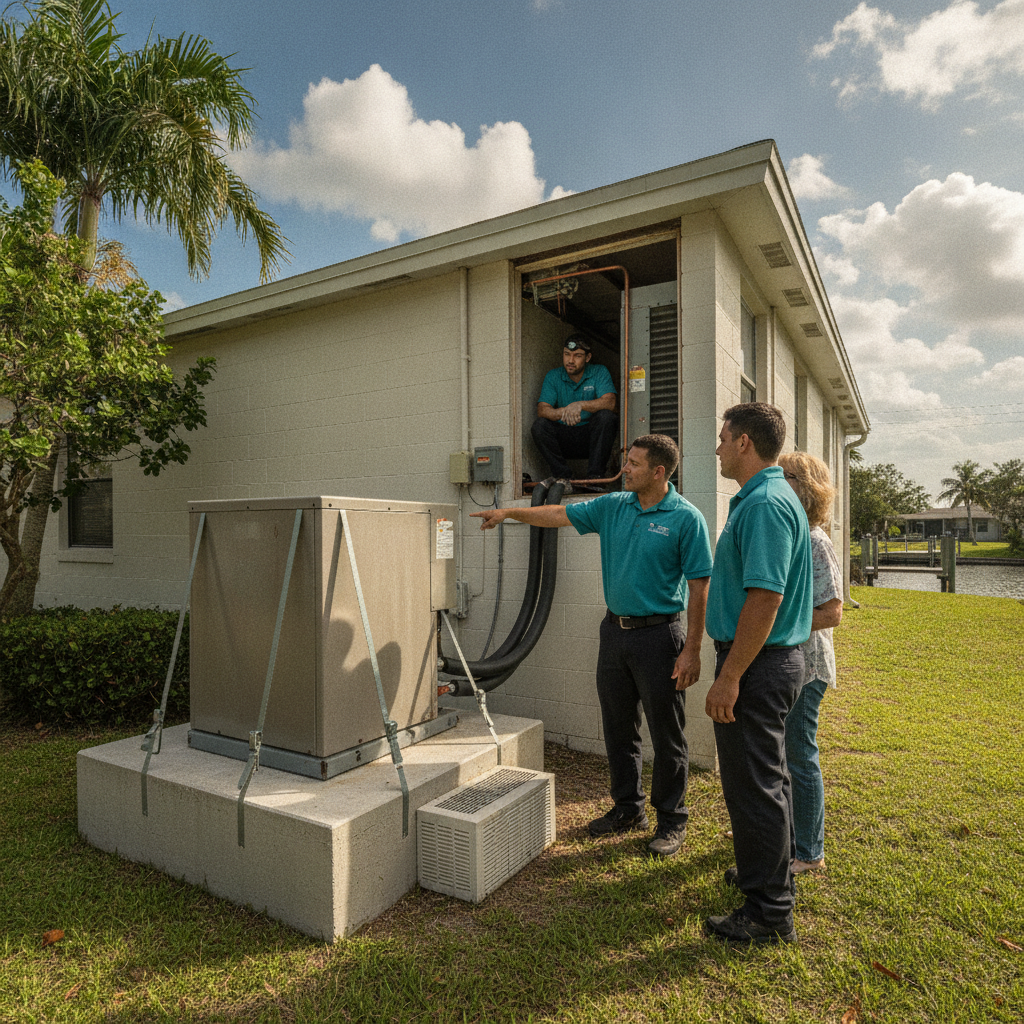
Walk a Port Charlotte ranch and the yard usually tells you the layout. A wide metal cabinet on a slab, with two fat ducts punching the wall, is a package unit. A smaller condenser out back and a coil sweating in the attic is a split system. That is the choice on this Gulf coast: where the parts live, and what a slab ranch plus salt air does to them.
What each system is
A package unit is one weather cabinet that holds the compressor, the condenser coil, the evaporator coil, and the blower. The whole machine sits outside, on a concrete pad or on a roof curb. Supply and return ducts run from the house to that box. There is no indoor air handler and no copper line set crossing the attic. Heat, if the cabinet includes it, lives in the same box: electric strips, a heat-pump circuit, or a gas section on some older packs.
A split system splits those jobs. The outdoor unit holds the compressor and the condenser. The indoor unit holds the evaporator coil and the blower. On a lot of Englewood ranches that indoor piece sits on a platform in a hot attic over a slab. A copper line set and a condensate drain connect the two halves. Cool air then moves through the same kind of ductwork the package unit uses, just starting from inside the house instead of from the yard.
Most houses here were built for one layout, not as a coin flip. 1960s and 70s cottages near Historic Dearborn Street often still run original attic ducts to a split. Port Charlotte and Punta Gorda block-ranch streets still show pad-mounted packs from years when a builder wanted cooling without stealing a closet. Wellen Park in North Port leans split, because those houses were framed with an air-handler platform. Rotonda West deed restrictions care what you can see from the street or the golf course, so a bulky package cabinet can be a problem even when the mechanicals work.
Both can cool. Both can heat. On this metro a heat pump is the usual replacement path, because one system carries the long cooling season and the occasional cool snap. The difference is space, service access, and which parts you leave in Gulf weather.
| Package unit | Split system | |
|---|---|---|
| Where the parts live | One outdoor cabinet holds the compressor, both coils, and the blower | Outdoor cabinet for compressor and condenser; indoor air handler and coil, usually in the attic on a ranch |
| How air moves | Supply and return ducts punch a wall or roof to the cabinet | The indoor blower pushes air through the house ducts from the attic or a closet |
| Indoor space | No indoor mechanical closet | Needs attic, garage, or closet room for the air handler |
| Salt and weather | Every coil sits in Gulf air | Only the outdoor coil takes the salt; the evaporator stays inside |
| Typical fit here | Slab ranch with no attic room, some manufactured homes, some low commercial pads | Dearborn cottages, Venice suburbs, Wellen Park new builds, snowbird houses with an existing attic unit |
A ductless mini-split is a third layout, not another name for a split. It skips ducts and puts a wall cassette in the room. Older Englewood cottages with tired original trunks sometimes go that way. National writeups often mash those three machines together. They are not the same job.
Salt air and a roof package unit
Lemon Bay salt, Placida canal lots, Manasota Key, Cape Haze, and Boca Grande put outdoor metal in aerosol. A split still parks a condenser in that air, but the evaporator, the blower, and most of the controls stay in the attic. A package unit puts every one of those parts in the same weather. The evaporator a split would hide indoors sits in the cabinet, inches from the condenser, breathing the same salt.
That is the standing disadvantage of a packaged air conditioner on this coast. Rain, sun, and lawn irrigation hit the whole machine. After two summers a condenser on a canal-front lot in Placida can show salt crust on the fins. On a package unit those fins are not the only coil taking that beating. Roof-mounted packs add wind and heat on top. They sit in full sun, and after Hurricane Ian’s Category 4 landfall near Charlotte Harbor in September 2022 a lot of rooftop cabinets in the Port Charlotte and Punta Gorda impact zone never ran the same. The Atlantic hurricane season runs from June 1 to November 30, with the peak on September 10, so a roof unit spends those months as a sail.
Ground pads are not automatically safer. A slab ranch near Charlotte Harbor, the Peace, or the Myakka can put that cabinet in splash and standing water. Near the water, this site already points people toward coated or marine-grade condenser coils. On a package unit, that coating conversation has to cover the cabinet that actually sits in the spray, not only the condenser face. Barrier-island stock on Boca Grande and Palm Island is the worst salt exposure in the footprint, with causeway and ferry access on top, and those addresses sit in Lee County, not Charlotte County.
Service is simpler in one way and harder in another. One cabinet means one place for a licensed tech to open during HVAC maintenance. Filters, coils, and electrical all live there. The same cabinet also means every repair happens in the weather, and a failed blower or evaporator is an outdoor job. AC repair on a split often starts in the attic: a clogged drain, a float switch, a dirty indoor coil. On a pack, that drain and that coil are outside. Anyone who opens the refrigerant circuit on either layout needs EPA Section 608 technician certification. That is federal, and it is about refrigerant, not the Florida contractor licence.
Quiet is the other split advantage people feel. The blower on a package unit sits in the yard. On a split, the compressor is outside and the air handler is in the attic. A Venice snowbird house closed from spring to fall still has that attic unit sitting in heat, which is its own wear, and an August clog in a Rotonda West attic drain can trip the float switch while the pack next door is failing from salt on the pad. Neither layout is maintenance-free. They fail in different rooms.
Replacement paths
Like-for-like is the usual path because the ducts already know where to go. A package unit’s supply and return already punch the wall or the roof. A split’s line set already runs to the attic platform. Changing types means building the missing half.
Going from a pack to a split means finding indoor space for an air handler, running a line set, a condensate line, and a disconnect, and tying the new indoor unit into ducts that were aimed at an exterior cabinet. Going from a split to a pack means abandoning the attic coil, sealing that space, and cutting wall or roof openings for two large ducts. On a ranch with a tight attic, that missing indoor space is exactly why the house got a pack in the first place. Port Charlotte ranch ductwork often lives in a hot attic either way, so a layout swap does not magically fix leaky trunks. If the ducts are the real problem, ductwork repair sits on its own range of $1,500 to $6,000 depending on scope.
An AC changeout is mechanical work. Florida’s $7,500 building-permit exemption does not cover electrical, plumbing, structural, mechanical, or gas work on a single-family dwelling, so the job is permitted at any price. The contractor we send pulls that permit. On the Charlotte County side, including ZIP 34224 in Englewood, a residential mechanical permit covers replacement of heating and air conditioning equipment. The qualifications the county lists include Certified and Registered HARV Class A and Class B, Certified and Registered Mechanical, and owner-builder. Englewood ZIP 34223 sits in Sarasota County, so the same street grid can answer to a different building department. Confirm the address before anyone files.
People ask about a $5,000 HVAC rule. That is a notice of commencement rule, not a price cap and not a permit fee. Florida law tells the permit office to collect a copy of the notice of commencement before the first inspection when the direct contract is greater than $5,000, with a carve-out: that requirement does not apply to a direct contract to repair or replace an existing heating or air-conditioning system in an amount less than $15,000. Charlotte County’s own mechanical page uses the $15,000 figure for when the notice must be in before the first inspection.
Market ranges on this site for a full system replacement on a single-family home run $5,500 to $12,000 installed. A standard split system, installed, is published at $5,500 to $8,500. A higher-efficiency variable-speed system is $9,000 to $12,000. A heat pump system is $6,000 to $14,000. Those are footprint ranges, not a bid, and a long line set, a roof curb, or a duct rewrite moves the number up because of copper, labor, and access. If the indoor and outdoor halves of a new split both go in, FPL’s residential A/C rebate is $200 as a credit on the participating contractor’s invoice for a SEER2 15.2 rated unit and above. That program is written for a new A/C system purchase including both indoor and outdoor units, so it maps to a split changeout, not to every single cabinet in the yard.
Look up the contractor on the Florida DBPR Licensing Portal before you sign. Brand lists on the internet will not tell you whether the cabinet fits a Rotonda setback or a Dearborn attic. AC installation on this coast is a layout decision first.
What is the $5,000 rule for HVAC systems?
It is a notice of commencement trigger in Florida construction law, not a rule that a system under that number skips a permit. An air-conditioning changeout is mechanical work at any price. For a repair or replacement of an existing heating or air-conditioning system under $15,000, that notice rule has a written carve-out, and Charlotte County’s mechanical page repeats the $15,000 line for when the notice is due before the first inspection.
What are the disadvantages of a packaged air conditioner?
Every coil and the blower sit outdoors, so Gulf salt, sun, irrigation, and storm wind reach parts a split would keep in the attic. The cabinet also takes a larger yard footprint, which can clash with Rotonda West screening rules, and a roof pack takes hurricane-season wind that a ground condenser does not. Service is in the weather, including evaporator and blower work.
Are package units worth it?
They are worth it when the house has no honest indoor space for an air handler: a tight ranch attic, a manufactured home, a slab with ducts already aimed at a wall cap. They are a poor trade on Manasota Key, Placida, or Boca Grande if you have attic room for a split, because you are volunteering both coils to salt. Match the machine to the shell you already have, then let a licensed and insured contractor size the replacement.
When to call us
A failed pack on a pad, an attic coil that has given up, or a package-to-split swap is licensed HVAC work, not a weekend project. We match you with licensed and insured contractors, and the pro we send pulls the mechanical permit for the changeout. Call us at (941) 292-6250.