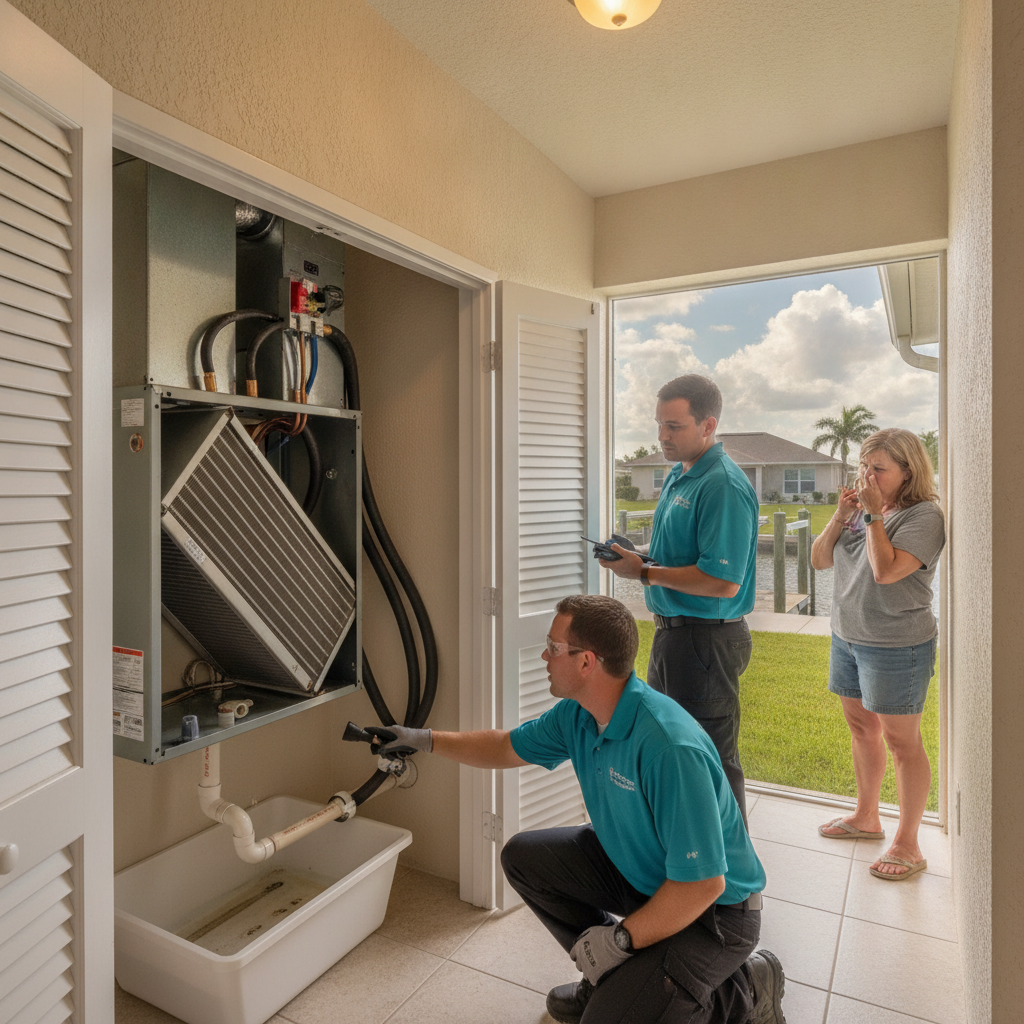
You walk into a Venice house that sat closed from April to November, flip the cooling on, and the first blast from the vents smells like a damp gym bag. That odor is moisture that never left the system. On this coast the evaporator coil sweats every cycle, and when that water sits on the fins, in the drain pan, or in the closet around the air handler, the blower sends the smell through every register.
Musty vs burning vs sewer
A musty smell from the AC is damp and earthy. People call it mildew, dirty socks, or a wet towel. It usually hits when the blower starts, eases a little as air moves, then comes back on the next cycle. That pattern is water sitting on a surface the air still touches: the coil, the pan, a clogged condensate line, a packed filter, or the closet around the indoor unit.
It is not a fire. It is not sewage. Mixing those three up is how a homeowner either ignores a wet closet or keeps running a system that should be off.
A burning smell is electrical. Hot plastic, overheated dust on a heat strip, or wiring that is cooking belongs in a different bucket. Shut the system off at the thermostat and the breaker. Do not wait to see if it clears. We already wrote the electrical version in what a burning smell from the AC means in Englewood.
A sewer or stagnant-drain smell usually means the condensate is not leaving, or a trap on that line has dried so the pipe can pull odor back toward the air handler. A garbage smell can mean an animal in a return, a flex run, or the outdoor cabinet after a storm. That is less common than a wet coil. A new filter will not fix it.
| What you smell | Where it usually starts | What it is telling you |
|---|---|---|
| Musty, mildew, dirty socks | Evaporator coil, drain pan, closet around the air handler | Water is sitting where supply air still moves |
| Hot plastic or burning | Blower motor, wiring, or dust on a heat strip | Stop the system and treat it as electrical |
| Sewer or stagnant drain | Condensate line, trap, or a pan that overflowed | The water path is blocked, or dry in the wrong place |
Gulf humidity makes the musty column the default here. The National Weather Service Tampa Bay area office publishes the Punta Gorda and Sarasota-Bradenton climate records behind that load. A Port Charlotte ranch that runs from late morning through evening in August puts far more water on the coil than a short spring afternoon inland. The coil is doing its job. The drain has to keep up.
The one homeowner-side move that actually belongs to you is the filter. A packed filter starves the coil of air, so the coil runs colder and stays wet longer. Swap it before a tech arrives. That will not wash a slimy coil. It does let air move again so water can sheet into the pan instead of hanging on the fins.
A brief musty puff the first time a snowbird house starts after months shut is leftover moisture and dust on a cold coil. A smell that is still in the hallway on day three is not “just the season.” Something is still wet.
A wet coil in an Englewood closet
Most indoor equipment in this footprint does not live in a spacious garage. It lives in a hall closet.
On a 1960s cottage near Historic Dearborn Street, the air handler is often stuffed behind louvered doors with original ductwork still leaving through the attic. The coil sits in a dark box. Every cooling cycle wrings humidity out of the return air. That water is supposed to sheet off the fins, drop into the pan, and leave through a PVC condensate line. In a closet with almost no air around the cabinet, the pan stays wet, the cabinet insulation stays damp, and the closet itself starts to smell like the system.
A clogged filter makes that worse. Less air across the coil means more time wet. The blower then strips the film on the fins and sends it down the hall. You get the same physics in a Rotonda West house where the air handler is tucked off the lanai, and in a canal-front Placida ranch where salt is already chewing the outdoor coil while the indoor coil quietly grows a film no one sees.
Snowbird houses add a second version. A Venice or Punta Gorda home closed from spring into fall still sits in Gulf humidity, even with the thermostat on a deep setback. When the family returns and slams cooling on, the first hour of airflow is the still, wet air that lived on the coil. If the drain line crusted shut over summer, that first run can also trip the float switch and leave a wet closet for the people who just drove down.
Oversizing does the same thing in a different costume. A system that is too large for the house short-cycles: it hits the thermostat before it has run long enough to wring the house dry. You get a cold, clammy living room and a coil that never really dries. Wellen Park new construction can still get this if the equipment was picked for speed instead of latent load. The 1980s North Port house next door gets it when a bigger condenser went in after Hurricane Ian’s September 2022 landfall near Charlotte Harbor and the old leaky ductwork stayed in the attic.
Barrier-island stock is the wettest indoor version of the same problem. Boca Grande and Palm Island are reached through Charlotte County but sit in Lee County for permitting, so they are not Charlotte County addresses. The closet still holds the smell. Salt is the outdoor story. Humidity is the indoor one.
Return leaks feed the closet too. Attic air on this coast is a wet sponge. If the return plenum or the old flex above a Grove City cottage is pulled apart, the air handler is drinking attic humidity and wringing it onto the coil all afternoon. Cleaning the coil without sealing that leak brings the smell back.
If water is on the closet floor, or the float switch has already killed the system, stop resetting it. The pan is full. Running it anyway soaks the closet, the return, and sometimes the ceiling of the room below. That is no longer just an odor. It is a water problem in a tight indoor space.
What a tech cleans
A licensed HVAC contractor is looking for where the water stopped moving.
They start at the filter slot and the return. Then they open the air handler enough to see the evaporator coil, the drain pan, and the start of the condensate line. What they clean is the wet side of the indoor unit: the coil face, the pan, and the line that should carry condensate outside or to a pump. If that line is blocked, water has been sitting, and that is the classic musty source. The clog itself is the same job we describe in what a clogged AC drain line does in Englewood.
They should not leave you a scented filter and call it done. Perfume does not remove the film on the fins. Coil cleaning is part of a real tune-up, and it is also the core of an AC repair call when the smell is the complaint. An AC tune-up and coil cleaning visit is the scheduled version of the same work.
If the pan is rusted through, the coil is packed past washing, or the air handler cabinet is rotting from years of overflow, cleaning is not the whole job. Then the conversation turns to replacing the indoor unit or the system. That is installation work, and it is permitted mechanical work. Florida’s exemption for some jobs under $7,500 does not reach mechanical work on a single-family house, so an air-handler or full changeout is permitted at any price. Englewood straddles the line: ZIP 34223 goes to Sarasota County and ZIP 34224 goes to Charlotte County. On the Charlotte side, the county publishes a residential mechanical permit for replacement of heating and air conditioning equipment.
Do not open the refrigerant circuit yourself. EPA Section 608 is the federal rule for technicians who maintain, service, repair, or dispose of equipment that could release refrigerant. Rinsing an outdoor coil with a garden hose is on your side of the line. Pulling the indoor coil or adding charge is not.
Ducts can hold the odor after the coil is clean, especially leaky original runs in those Dearborn Street attics. Whole-home duct cleaning in this market runs $400 to $900, and duct repair or replacement runs $1,500 to $6,000 depending on scope. Those are market ranges, not a quote. If the house stays humid after the coil is clean, a whole-home dehumidifier is the humidity tool, typically $1,800 to $3,500 installed, through indoor air quality work.
A diagnostic visit for AC repair is $89 to $150. Most repairs after that, parts and labor, land between $150 and $650. A maintenance visit is $89 to $150, less on an annual plan. None of those figures is a promise of what you will pay. They tell you which bucket you are in: a cleaning and a drain, or a new indoor unit.
The HVAC contractors we send are licensed and insured. Ask to see the licence class before anyone opens the closet. Florida’s air-conditioning contractor classes are Class A and Class B. Confirm the name on the state’s licensing portal, not on a door magnet.
How do I get my AC to stop smelling musty?
Swap a packed filter first, then have a licensed HVAC contractor clean the evaporator coil, the drain pan, and the condensate line. The smell stops when the wet surface is gone, not when the vents are sprayed. If the pan is rusted or the coil will not come clean, the indoor unit itself is the next conversation, not another bottle of scent.
What does a moldy AC smell like?
It smells like a damp gym bag, wet cardboard, or dirty socks, strongest in the first minute after the blower starts. That is the odor of a wet coil or pan, not a burning wire and not a sewer line. A tech confirms what is growing by looking at the coil and the pan. The smell alone is the clue to look there.
Can I still use my AC if it has mold?
If the only symptom is odor and the closet is dry, the system will still cool, but you are circulating air that just passed over a wet, dirty coil. If the pan is overflowing, the float switch is tripping, or water is on the closet floor, shut the system off so you do not soak the return and the ceiling below. Cooling can wait. Standing water in a closet cannot.
Is it bad to breathe in a musty smell from the vents?
You are breathing air that crossed a wet coil, a dirty pan, or damp closet insulation. People with asthma or allergies often feel that first: scratchy throat, heavier breathing, a house that never quite smells clean. Clearing the moisture source is the fix. Masking the odor leaves the wet surface in the air stream.
When to call us
When the smell lasts past a filter change, when the closet is wet, or when the system keeps cutting out on the float switch, you need a licensed HVAC contractor on the indoor unit, not another scented spray. We’ll match you with someone licensed and insured who can clean the coil and the drain, or tell you when the air handler is past cleaning. Call us at (941) 292-6250.