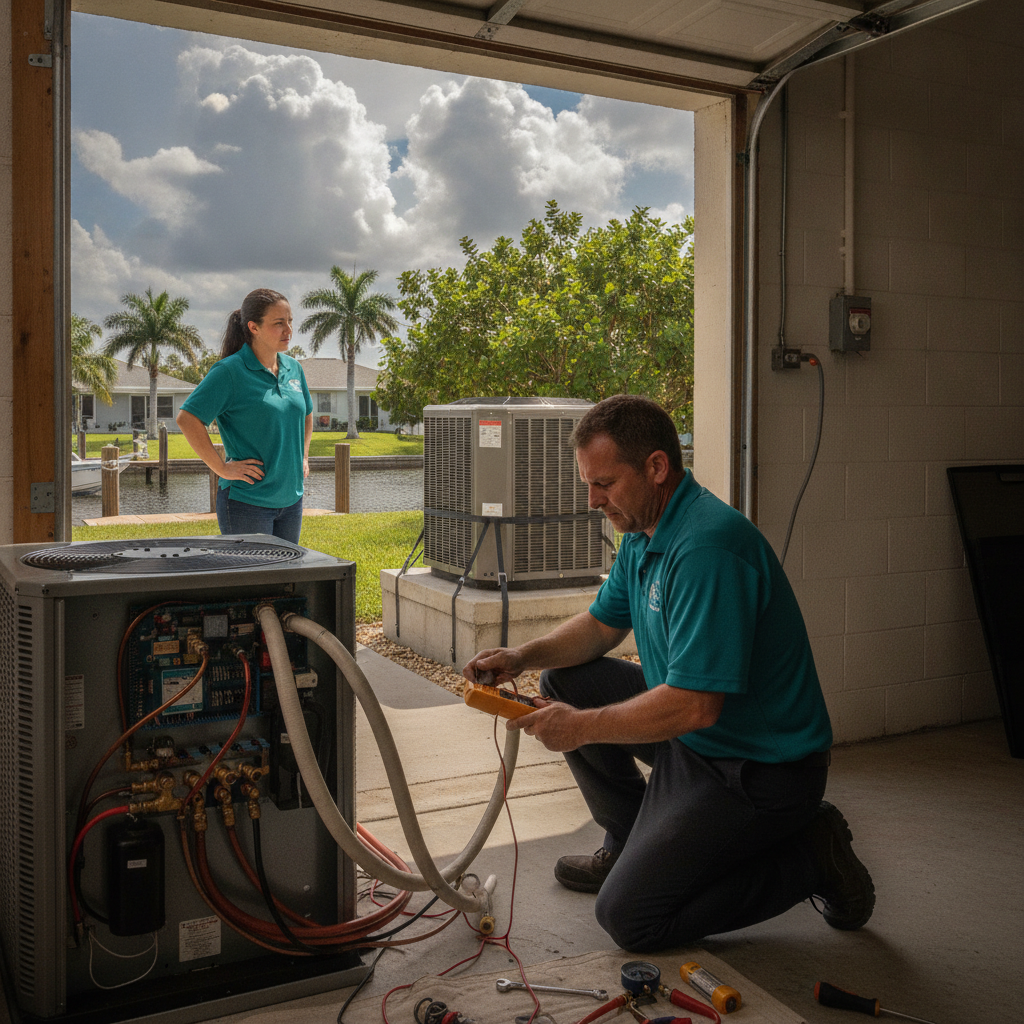
The condenser behind a Rotonda West lanai kicks on, runs a short burst, and dies. Then it does it again. That pattern is AC short cycling: the system never stays on long enough to finish a cooling cycle, so the house never really dries out and the compressor takes a beating it was not built for. On an August afternoon along Lemon Bay, you feel it as a cool blast, then sticky air. The thermostat may look fine. The rooms do not.
What short cycling does to a compressor
A compressor wants a start, a real run, and a rest. The hard part is the start. Starting shoves a locked motor into motion and has to get oil and refrigerant moving from a standstill. A healthy cycle lets that motor settle in and hold a coil temperature that wrings water out of indoor air. A short cycle cuts the run off while the machine is still in the expensive part of the job. Oil rides with the refrigerant, so a burst that lasts only a moment can leave oil hanging in the line set on a Port Charlotte ranch where the condenser sits across the house. Repeat that all afternoon and the compressor runs drier than it should.
Humidity is the comfort casualty. On a standard split system, moisture leaves the air only while a cold coil sits in a long, steady airflow. Short bursts give you slightly cooler air and the same wet feeling you walked into. A Venice snowbird house can hit the number on the wall and still feel clammy in the hall. Mild weather can mean a brief runtime because the house is already close to setpoint. A stutter that leaves the air wet in August is not that.
Protective switches pile on. High pressure from a salt-crusted condenser in Placida or a packed filter will drop the unit out to save the compressor. Low suction from a leak does the same from the other side. You hear start, stop, start because the compressor is being yanked off the line so it does not destroy itself.
That is why AC repair belongs on the calendar as soon as the stutter shows up, not after the compressor has been clicking for a month. A diagnostic visit in this market runs $89 to $150. Most repairs after that, parts and labor, land between $150 and $650. Those are ranges for this footprint, not a quote. If the compressor is already damaged, the conversation shifts toward replacement, and a full system changeout on a single-family home here is $5,500 to $12,000 installed.
Don’t add refrigerant, recover it, or open the sealed system yourself. EPA Section 608 requires certification for technicians who maintain, service, repair, or dispose of equipment that could release refrigerant. The pros we send are licensed and insured, and they handle that circuit. You can change a filter. You can’t charge a system.
Oversized units, dirty coils, and a bad thermostat
The three causes you actually see around Englewood are a system that is too big for the house, airflow that cannot get through dirty filters and coils, and a thermostat that lies about the room.
Oversized equipment cools the air at the thermostat too fast. The rest of the house, and the moisture in the air, never catch up. The unit satisfies, shuts off, and the humidity creeps back. Then it starts again. After Hurricane Ian’s Category 4 landfall near Charlotte Harbor in September 2022, a lot of Port Charlotte and Punta Gorda houses got a new condenser because insurance wrote a check. Matching the old nameplate, or bumping size to be safe, is how a brand-new system short cycles from day one. The lasting fix is a correctly sized AC installation based on the house as it is now, ducts included, not the carton the last unit came in. An oversized AC is a sizing problem, not a filter problem. Heat pumps are the usual replacement in this metro because one system carries the cooling load and the occasional cool snap.
Restricted airflow is the maintenance version of the same stutter. A packed filter makes the indoor coil run too cold or the whole cabinet run too hot. The safety opens, the unit rests, the switch resets, and the loop repeats. On a canal-front lot the outdoor coil also grows a salt crust that acts like a blanket on the fins. Grass clippings from a tight side yard in Grove City do the same. Ice on the evaporator is the cousin: low airflow or a leak drops coil temperature, the coil ices, airflow falls further, the system shuts down, the ice melts, and it starts again. That freeze-and-thaw loop is what a frozen AC coil looks like from the living room, and it can look like cycling in seconds once a pressure switch is bouncing.
A bad thermostat will short cycle a healthy system. Dying batteries, a misread sensor, or a control mounted where afternoon sun hits a Venice west wall will call for cooling in a pattern that has nothing to do with the bedrooms. A supply register dumping on the thermostat is the same lie from the other direction. Thermostat installation here, including install, runs $250 to $500. Moving one off a sun-soaked wall is often the whole repair. A weak capacitor leaves the compressor straining to start. A failing contactor chatters and drops the circuit. Those are licensed-contractor diagnoses. Stay off the high-voltage disconnect.
A few checks are honestly yours:
- A filter that is grey and packed will choke return air and can shut the system down on a high-temperature or high-pressure trip.
- A thermostat in direct sun or under a supply vent will call for cooling in a pattern that ignores the rest of the house.
- An outdoor coil you can rinse with a garden hose may be so caked with salt and grass that the condenser cannot reject heat.
If those three still leave you with a stutter, the next step is an HVAC maintenance visit, which runs $89 to $150, or a repair diagnostic in the range above. Regular AC maintenance in Englewood is how a dirty coil gets caught before it starts clicking the compressor off. Low refrigerant is not a normal operating condition. It means a leak, and the pressure switches then short cycle the compressor to keep it alive.
Why Englewood cottages see it after a cheap changeout
The cottages near Historic Dearborn Street still push air through original 1960s and 70s ductwork. Flex that old leaks, kinks, and sits in a hot attic all summer. A cheap changeout swaps the box outside, leaves the ducts alone, and often copies the old tonnage or goes larger so the new unit can keep up. The new equipment is strong. The ducts cannot deliver the air. The hall thermostat drops fast. Short cycling starts on the first real heat wave.
That is a different failure from a Wellen Park house in North Port, where the system and the ducts were built together. Treat those two houses as the same job and you will size one of them wrong. Grove City and the older Englewood core are where the mismatch shows up.
The county line rides along with the work. ZIP 34223 is Sarasota County. ZIP 34224 is Charlotte County. The permit goes to a different building department depending on the address, even when the cottages look identical. An AC changeout is mechanical work. Florida’s exemption for small building jobs does not reach electrical, plumbing, structural, mechanical, or gas work on a single-family dwelling, so the changeout is permitted work at any price. On the Charlotte County side, a residential mechanical permit covers replacement of heating and air conditioning equipment at a house. Charlotte County lists owner-builder, Certified HARV Class A, Certified HARV Class B, Certified Mechanical, Registered HARV Class A, Registered HARV Class B, and Registered Mechanical among the qualifications that may obtain that permit. Boca Grande and Palm Island are reached through the Charlotte County mainland, but they are not Charlotte County addresses. They sit in Lee County, so that permit page is not theirs.
Rotonda West adds a local twist. Deed restrictions on what equipment can be seen from the street or the golf course push condensers behind screens and lattice. A tight enclosure plus Gulf humidity is a recipe for high head pressure and a unit that trips, rests, and trips again. Manasota Key, Placida, and Cape Haze add salt aerosol on top of that. Coated or marine-grade condenser coils are the usual recommendation near the water.
Snowbird houses in Venice and Punta Gorda sit closed five to seven months. A thermostat left on a deep setback, a filter nobody changed in April, and a coil that sat damp will misbehave the week everyone flies back. That first week of short cycling is often a neglected system, not a dead compressor.
If the ducts are the real constraint, ductwork repair or replacement in this market runs $1,500 to $6,000 depending on scope. A standard split system, installed, is $5,500 to $8,500. A higher-efficiency variable-speed system is $9,000 to $12,000 installed. Variable-speed equipment can run longer at a lower speed, which is the opposite of a short cycle and the reason it pulls humidity instead of blasting and quitting. Heat pump systems, installed, run $6,000 to $14,000. The climate records published for Punta Gorda and Sarasota-Bradenton are a reminder of why that long, steady run matters here: the load is heat and moisture together, for months.
Common questions about short cycling
How do I stop my AC from short cycling?
You stop it by fixing the cause, not by tapping the thermostat. Change a packed filter, get the thermostat off a sun-soaked wall, and rinse obvious junk off the outdoor coil with a garden hose. If the unit still starts and dies, a licensed HVAC contractor has to find whether the problem is a control, a dirty indoor coil, a leak, or a system that was never the right size. There is no homeowner setting that makes an oversized condenser run a full cycle.
What would cause an AC compressor to short cycle?
The compressor short cycles when something tells it to stop before the house is actually cooled. That something is usually a pressure or temperature safety, a thermostat that is satisfied too early, or a motor that cannot finish a start because a capacitor has weakened. Low refrigerant from a leak drops suction pressure. A dirty outdoor coil or a boxed-in condenser in Rotonda West raises head pressure. Either switch will cut the compressor out, let it rest, and let it try again. Oversizing does the same thing without a safety trip: the room sensor hits setpoint and the contactor opens.
Why is my air conditioner short cycling in seconds?
Cycling in seconds is almost always a protection device bouncing, not a thermostat hunting. A locked-rotor start, a capacitor that has lost capacitance, a chattering contactor, or a pressure switch that opens the moment the compressor loads will drop the unit in a blink. Ice that has closed off the indoor coil can do it too, once airflow is gone. Turn the system off at the thermostat and let a frozen coil thaw before you try again. If it repeats, stop. That is not a filter day. That is a licensed diagnosis.
Will a bad thermostat cause short cycling AC?
Yes. A thermostat that misreads, loses batteries, or sits in a draft will short cycle a system that is otherwise fine. Sun on a west-facing wall in a closed-up Venice house is a classic liar. A register blowing on the sensor is the other. If the outdoor unit’s behavior tracks the sun moving across that wall, start with the control, not the compressor. A replacement thermostat, installed, is $250 to $500 in this market.
When to call us
When the unit starts and stops without finishing a cycle, a licensed HVAC contractor needs to find the cause, whether that is a control, a coil, a charge, or a system that was never the right size. We’ll get a licensed and insured contractor out to you. Call us at (941) 292-6250.