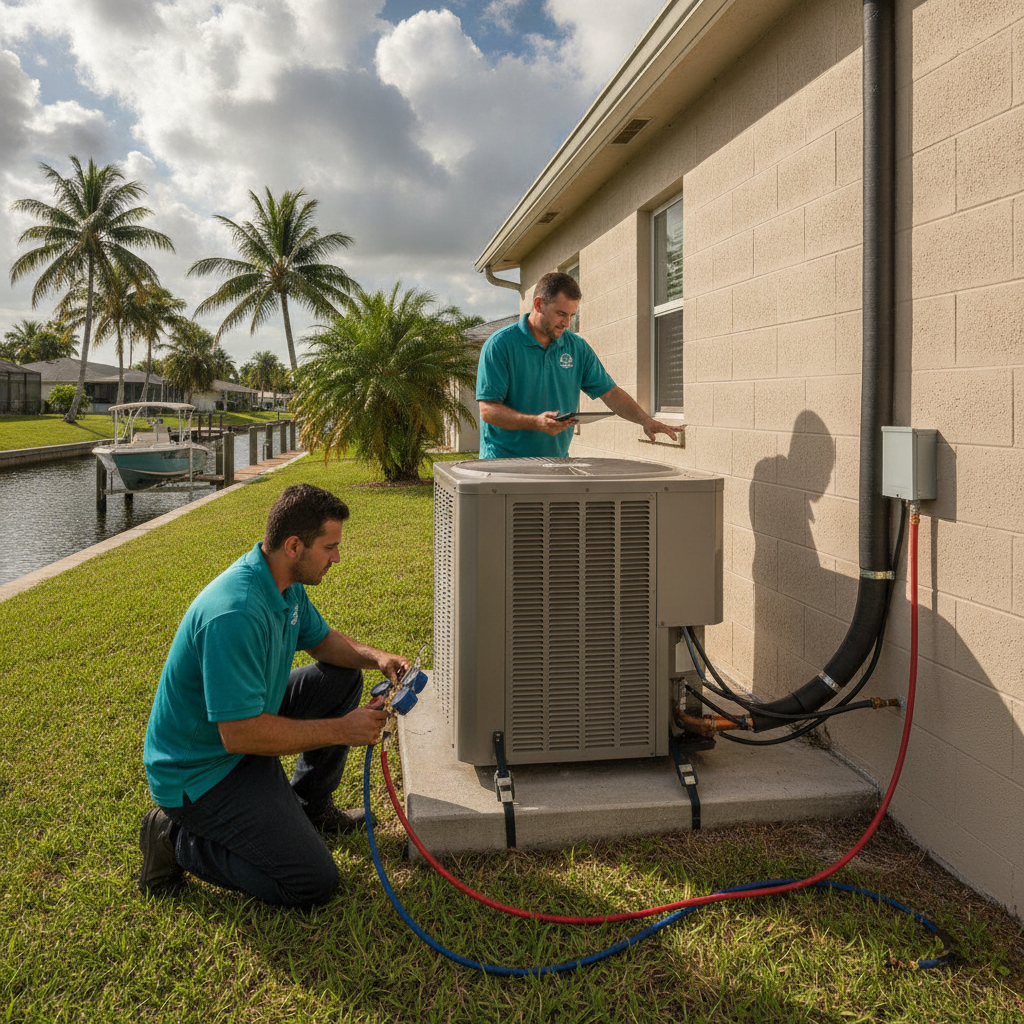
The outdoor fan on a Placida canal lot can spin all afternoon and still leave the house sticky. A heat pump that has lost a capacitor, a reversing valve, or a coil’s ability to move air through salt crust will look busy and do almost nothing. That is the usual Englewood failure, not a compressor that died on the first hot day.
The same outdoor unit and air handler cool the house through a long Gulf summer and heat it on the handful of cool nights. One stuck part takes both jobs with it.
What fails on a coastal heat pump
Capacitors, contactors, outdoor fan motors, and salt-fouled coils are the parts that actually fail on heat pumps from Englewood through Venice and Port Charlotte. The compressor is the expensive story people fear. It is not the first thing that usually goes.
A run capacitor that has lost capacitance leaves the compressor straining to start. You hear a hum, a click, and then nothing. The contactor, the relay that sends power to the outdoor unit, pits and welds after years of Gulf-coast cycling. An outdoor fan motor that has taken salt spray seizes, and the coil then cooks because air is not moving across it. None of that is mysterious. It is wear on a machine that runs most of the year.
The indoor side fails on its own schedule. A clogged condensate drain line backs up until the float switch cuts power, a common August afternoon in Rotonda West. A dirty filter starves the air handler and ices the indoor coil in cooling. Original ductwork in a 1960s cottage near Historic Dearborn Street still dumps supply air into a hot attic, so the heat pump runs and the rooms stay damp. The outdoor unit is not always the patient.
Salt air is the local multiplier. A condenser on Manasota Key, Cape Haze, or a canal lot in Placida picks up salt aerosol on the fins. The crust narrows the gaps. Airflow drops. Head pressure climbs. The compressor works harder for the same cooling. Coated or marine-grade condenser coils are the usual recommendation near the water. That is a material choice, not a count of extra years.
After Hurricane Ian’s Category 4 landfall near Charlotte Harbor in September 2022, a lot of Port Charlotte and Punta Gorda cabinets took wind and rain they never fully recovered from. A bent fan guard, a shifted coil, a control board that sat wet: those units can still run and never perform the way they did. A repair on a cabinet already rusted through is a short chapter.
When the system will not start, will not switch modes, or is cooling poorly, AC repair and diagnostics is the right first call. We match you with a licensed and insured HVAC contractor who diagnoses the unit. Heat pump repairs after that visit, parts and labor, run $150 to $650 in this footprint. That range is a market figure, not a quote for your house.
Defrost, reversing valve, and a coil full of salt air
A heat pump is an air conditioner with a reversing valve, and that valve is the part that makes one machine do both jobs. A solenoid shifts a slide inside the valve body and swaps which coil rejects heat and which coil absorbs it. When the slide sticks mid-stroke, the house gets lukewarm air in cooling, or it keeps dumping heat when you asked for cold. Venice snowbird houses that sit closed from spring to fall see this on the first cool night back: the thermostat calls for heat, the outdoor unit runs, and the supply air never warms up.
Defrost is the other heat-pump-only circuit. In heating, the outdoor coil is the cold coil. On a cool, damp January morning in Englewood it can frost. A defrost board and sensors are supposed to reverse the system briefly, thaw the coil, then return to heat. A failed sensor or a dead board leaves frost sitting on the fins, or it parks the unit in defrost so long that the house gets cooler instead of warmer. That is a control problem on a machine running backwards through a wet night, not a freeze that belongs somewhere else.
The coil itself is the slow failure. Salt crust on a Boca Grande or Palm Island condenser is the worst exposure in this footprint. Those barrier-island addresses are reached through the Charlotte County mainland, but they are not Charlotte County addresses, and the outdoor unit lives in salt spray every day. Rinsing the outdoor coil with a garden hose is the honest homeowner-side limit. Opening the refrigerant circuit is not. EPA Section 608 certification is what governs who may maintain, service, repair, or dispose of equipment that could release refrigerant. Never add refrigerant, recover it, or crack a service port yourself. Salt-air protection on the barrier islands is the longer version of why those coils crust over so fast.
HVAC maintenance and tune-ups exist for this climate because the coil and drain do not stay clean on their own. A tune-up visit in this market runs $89 to $150, less on an annual plan. The contractor we send rinses the coil properly, checks the electrical parts that actually fail, and looks at the reversing valve and defrost board before they strand a house on a holiday weekend. That visit will not stop salt air. It does catch a capacitor and a packed coil while they are still cheap problems.
The Atlantic hurricane season runs from June 1 to November 30, and the seasonal peak is September 10. Outdoor cabinets, electrical whips, and disconnects take that weather. After a storm, the job is inspection and repair by a licensed HVAC contractor, not a reset at the thermostat and a hope. If the refrigerant circuit is open, the person on the ladder needs the federal credential, not a helpful neighbor.
Repair vs replacement on an older Englewood unit
Repair is the right move when one part failed and the rest of the system still holds pressure and still moves air. Replacement is the right move when the compressor, both coils, or the cabinet are the problem, or when the indoor ductwork is the real reason the house never dries out.
Heat pump repairs in this footprint run $150 to $650 after diagnosis. A heat pump system, installed, is a $6,000 to $14,000 job for a single-family home in this market. Those figures are published ranges, not what you will pay on your lot. A longer line set, a condenser placed on the far side of a Rotonda West house to satisfy a deed restriction on what can be seen from the street or the golf course, and matching a new outdoor unit to an older air handler all move the number up. Swapping a failed capacitor does not.
North Port makes the split obvious. A 1980s house on its second or third system is often a repair until the compressor or both coils give out. A new build at Wellen Park is a different machine, still under a different kind of wear. In Punta Gorda, a condo or mid-rise unit answers to the association as much as to the equipment: what can be replaced, and when, is their call before a contractor ever sets a condenser.
| What you are looking at | Usual path | Why |
|---|---|---|
| One failed electrical part, coil still clean enough to pass air | Repair | The compressor and the refrigerant circuit are still doing their jobs |
| Reversing valve or defrost board stuck, system otherwise sound | Repair | Those are discrete controls, not a reason to scrap the pair |
| Compressor failed, both coils crusted, or the cabinet rusted through | Replace condenser and air handler together | A new outdoor unit on a tired indoor coil is a mismatch waiting for a second bill |
| Original 1960s ductwork dumping air into a hot attic | Fix the ducts, then decide on the equipment | A new heat pump on leaking trunks still leaves rooms clammy |
A changeout is mechanical work. Florida’s exemption for work valued under $7,500 does not apply to mechanical work on a single-family dwelling, so a heat pump replacement is permitted work at any contract price. Englewood straddles the county line: ZIP 34223 is Sarasota County and ZIP 34224 is Charlotte County, and the permit goes to a different building department either way. On the Charlotte County side, the residential mechanical permit covers replacement of heating and air conditioning equipment. Charlotte County lists Certified HARV Class A, Certified HARV Class B, Certified Mechanical, the registered versions of those classes, and Owner-Builder among the qualifications that may obtain it. The Charlotte County residential mechanical permit page is the county’s own description. Boca Grande and Palm Island sit in Lee County, so do not treat them as Charlotte paperwork.
The contractor we send pulls that permit. You can confirm the person is a licensed air-conditioning contractor through the Florida DBPR license search. Englewood Air Pro matches you with licensed and insured HVAC contractors. It is not the licensee and does not pull the permit itself.
New equipment is a different refrigerant conversation than a repair. Effective January 1, 2025, new residential heat pump systems using a regulated refrigerant with a global warming potential of 700 or greater face a federal install limit, with an allowance for equipment whose specified components were manufactured or imported before that date. An existing R-410A system in a North Port ranch is still legal to own and still legal to service. The rule changed what may be installed new. It did not condemn the unit in your yard.
If both the indoor and outdoor units are coming out, Florida Power & Light publishes a $200 instant rebate on a new residential A/C system at SEER2 15.2 and above, delivered as a credit on the participating contractor’s invoice. That is FPL’s program and FPL’s threshold, not a promise this brand can make on a given house.
This metro’s default replacement is a heat pump, because one system carries the cooling load and the occasional cool snap. That case is laid out in why heat pumps are the default system here. AC installation and replacement is the path when the pair is done. For the heat-pump-specific version of that job, the contractors we send handle heat pump repair and installation the same way: licensed work, permitted when the equipment is coming out, diagnosed when it is still a part.
How much does heat pump repair cost in Englewood?
Heat pump repairs here run $150 to $650 for parts and labor. A failed capacitor sits at the low end of that range. A reversing valve, a fan motor, or a control board sits higher because the part costs more and the labor takes longer. A full heat pump system, installed, is a different job at $6,000 to $14,000. None of those figures is a quote. Line-set length, coil condition, and whether the indoor unit has to come out with the outdoor unit are what move a real number.
Can a homeowner add refrigerant to a heat pump?
No. Adding or recovering refrigerant means opening a sealed system, and that work belongs to a technician with EPA Section 608 certification. A low charge is a leak until a licensed HVAC contractor finds it. Putting refrigerant in without fixing the leak is a short delay, not a repair. Filter changes, a thermostat battery, a breaker reset, and a gentle hose rinse of the outdoor coil are the homeowner-side limits.
Why is a heat pump blowing warm air in cooling mode?
A reversing valve stuck in heating, or stuck between positions, will send lukewarm air when the thermostat is calling for cool. A packed outdoor coil can produce the same comfort complaint because the unit cannot reject heat through salt-crusted fins. Both are licensed HVAC contractor diagnoses. Neither is a DIY refrigerant top-off.
When to call us
Call when the heat pump will not switch between cool and heat, when the outdoor fan runs and the house stays warm, or when the coil is crusted and the house never dries out. That is licensed HVAC contractor work, and we will get one of those contractors out to you. Call us at (941) 292-6250.