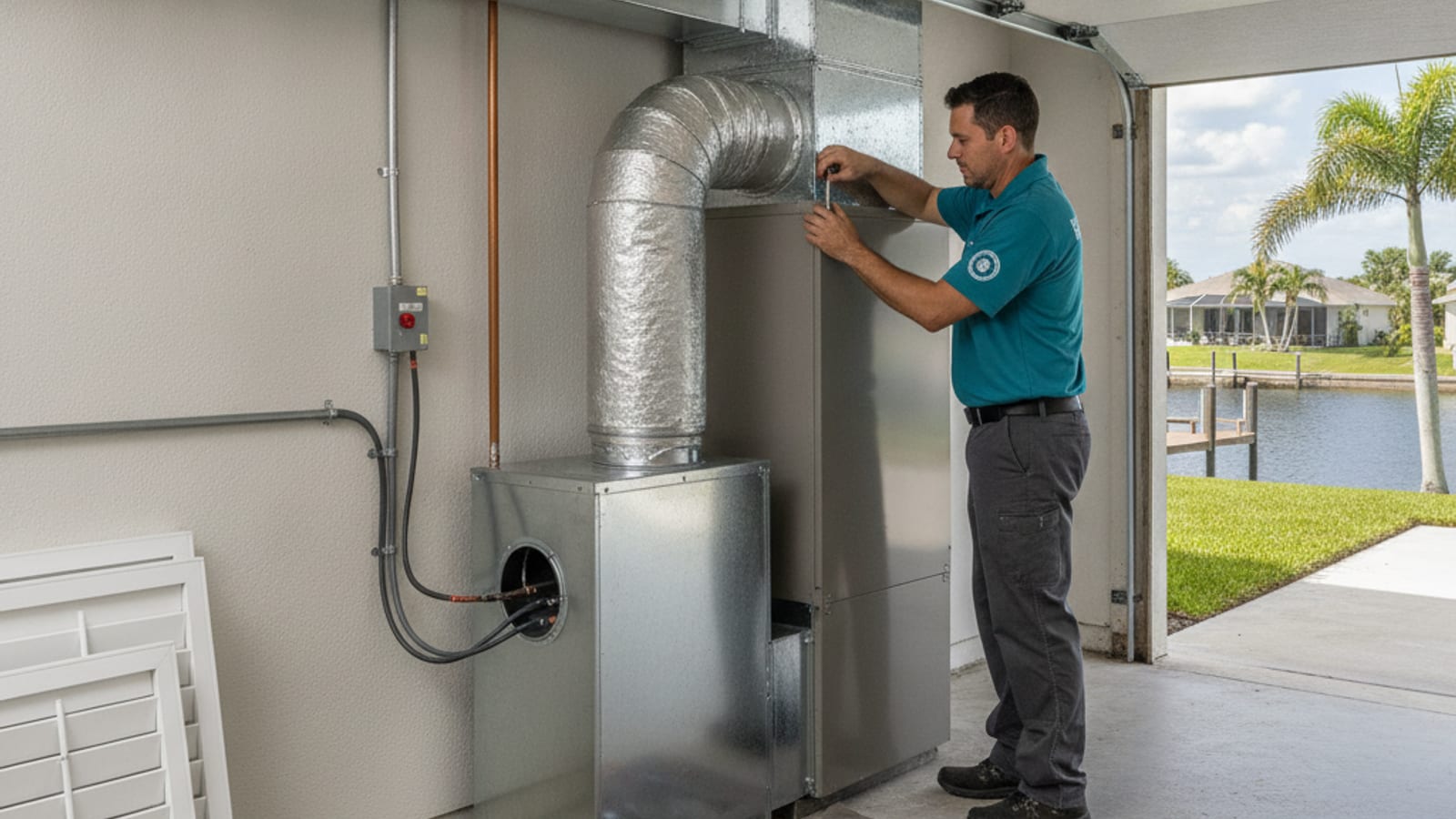
Port Charlotte sits inland from the barrier islands but still wraps around Charlotte Harbor and a wide grid of dredged canals, and that mix of standing water, year-round humidity, and Gulf coast heat makes indoor air quality a bigger project here than a simple filter swap. A lot of the housing stock is also boom-era construction from the late 1970s through the early 1990s, built before airtight envelopes and mechanical ventilation were standard practice. Add in a metro where a real share of homes took on wind or flood damage during Hurricane Ian, and Port Charlotte families end up dealing with air quality problems they never had to think about somewhere drier. Our indoor air quality work across Charlotte County usually starts with the same question: is this a humidity problem, a filtration problem, or something the storm left behind.
Why is Port Charlotte’s air harder to keep clean than most of Florida?
Humidity is the root of almost every indoor air complaint we see out here, and it isn’t seasonal the way it is farther north. A Port Charlotte home fights moisture nine months a year, and an oversized or aging AC system can cool a room fast without ever running long enough to actually pull that moisture out. That leaves a house that feels cool on the thermostat but still muggy against your skin, which is exactly the environment dust mites and mold spores need to multiply. Canal-front lots in the Port Charlotte grid, Deep Creek, and Harbour Heights add another layer, since brackish water sitting close to grade keeps the crawlspace and slab edges more humid than an inland lot a mile away.
Did Hurricane Ian leave lasting air quality problems in Port Charlotte homes?
For a lot of homes, yes, even years later. Hurricane Ian’s Category 4 landfall on Charlotte Harbor in September 2022 pushed storm surge into low-lying streets across Port Charlotte and Punta Gorda, and homes that took on even a few inches of water often had drywall, insulation, or subflooring that never fully dried before repairs closed the walls back up. Mold growing behind a repaired wall doesn’t announce itself the way visible flood damage does. It shows up later as a musty smell when the AC kicks on, or as someone in the house developing allergy symptoms that never used to bother them. If your home flooded during Ian and the air has never quite smelled right since, that’s worth a real inspection rather than another candle.
What indoor humidity level should a Port Charlotte home actually target?
Most HVAC professionals aim for 40 to 50 percent relative humidity indoors. Above 60 percent, mold and dust mites start thriving, and a surprising number of Gulf coast homes sit above that line more often than the owner realizes, especially in rooms farthest from a return vent. A cheap hygrometer from a hardware store is enough to check your own numbers room by room. If the reading climbs into the 60s even with the AC running on a normal schedule, that’s a sign the system is either oversized, short-cycling, or simply not enough on its own to handle a Charlotte County summer.
Does a whole-home dehumidifier make sense for a Port Charlotte house?
Often, yes, particularly in a canal-front home or one with any history of flood exposure. A whole-home dehumidifier ties into the existing ductwork and pulls moisture out directly instead of asking the AC to do double duty, which most systems in this climate genuinely can’t manage on their own. Installed cost usually lands between $1,800 and $3,500 depending on the unit size and how accessible the ductwork is, and it’s a one-time install rather than a recurring expense. For a house that always feels a little damp no matter how low the thermostat is set, a dehumidifier addresses the actual cause instead of just running the AC repair call back a few months later for a coil or drain issue caused by chronic excess moisture.
What filter rating actually helps with dust and allergies here?
MERV 11 filtration catches meaningful fine particulate, and MERV 13 is a strong step up for allergens and general air quality, but only inside a filter cabinet sized to handle that rating. Jamming a high-MERV filter into a standard one-inch slot restricts airflow enough to strain the blower motor and can actually make things worse. Homes near US-41 and the busier stretches of Port Charlotte pick up more road dust and pollen through open garages and screened lanais than a quieter inland street, which is one more reason filtration matters more here than the national average.
Do UV lights on the coil really cut down on musty smell?
For controlling mold and biological growth directly on the evaporator coil, yes, that use case is well established, and it matters more in a climate where coils stay damp for months at a stretch. A UV-C light mounted to shine directly on the coil keeps organic growth from building up in a spot that’s otherwise hard to inspect or clean regularly. As a whole-house air sterilizer covering every room, the evidence is much weaker, so it’s worth treating UV as a coil-specific fix rather than a cure for every air quality complaint in the house.
How does canal-front living change the air quality picture?
A dock, a seawall, and brackish water twenty feet from the back door bring a level of ambient humidity that inland Murdock or Deep Creek homes don’t deal with in the same way. Condensate drain lines clog faster with algae growth near the water, and a clogged drain that backs up doesn’t just risk water damage, it also means standing moisture sitting inside the air handler cabinet longer than it should. Routine HVAC maintenance that flushes the condensate line on a set schedule matters more for a canal lot than it does for a house a mile inland, since the margin for a small clog turning into a real problem is thinner out here.
Systems that took on surge or wind damage during a storm sometimes show air quality symptoms without any obvious sign of harm to the equipment itself. Our post on emergency AC service after a storm walks through how to tell routine wear from storm-related damage if your system has never quite run right since Ian.
Frequently asked questions
What’s a healthy indoor humidity range for a Port Charlotte home?
Between 40 and 50 percent relative humidity is the target most HVAC professionals recommend. Once a home climbs above 60 percent on a regular basis, mold and dust mites become a real risk, and that threshold gets crossed more often in Port Charlotte’s canal-adjacent neighborhoods than most homeowners assume.
Can mold from Hurricane Ian flooding still be a hidden problem years later?
Yes, if drywall, insulation, or subflooring didn’t fully dry before a repair sealed it back up. A musty smell that only shows up when the AC runs, or allergy symptoms that started after the storm and never went away, are both worth a real inspection rather than assuming it’s just normal Florida humidity.
Is a whole-home dehumidifier worth it if I already run AC constantly?
Often, yes. Running the AC harder doesn’t necessarily pull more humidity out of the air, especially if the system is correctly sized or slightly oversized for the space. A dehumidifier targets moisture directly, which is usually the more reliable fix for a house that feels damp even with the thermostat set low.
What MERV filter rating should I use in a Port Charlotte home?
MERV 11 handles most fine particulate well, and MERV 13 is a solid choice for allergy-sensitive households, but only inside a properly sized filter cabinet. A high-MERV filter forced into a standard slot restricts airflow enough to hurt the system rather than help the air.
Do UV lights actually help with air quality?
They’re well proven for controlling mold growth directly on the evaporator coil, which matters in a climate where coils stay damp for most of the year. As a whole-home air sterilizer, the evidence is weaker, so UV works best as a targeted coil fix rather than a general air quality solution.
How do I confirm an HVAC technician is properly licensed in Florida?
Check the technician’s Florida CAC (air conditioning contractor) license directly at myfloridalicense.com before any work begins. We connect Port Charlotte homeowners with experienced, insured local HVAC pros, and verifying that license only takes a couple of minutes.
If your Port Charlotte home always feels muggy or the air hasn’t smelled right since a storm, call (941) 292-6250 and we’ll connect you with a local HVAC pro to figure out what’s actually going on.