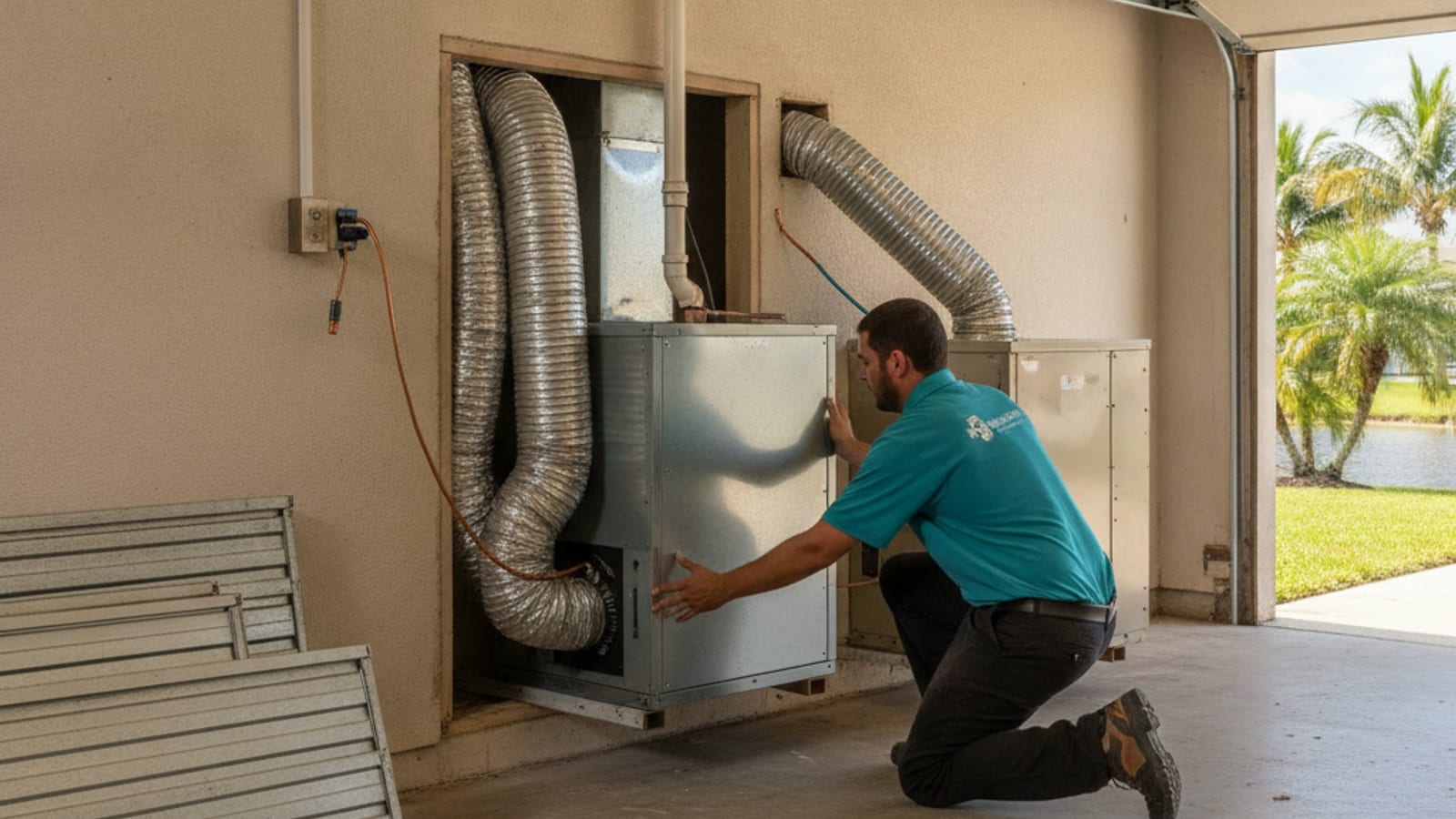
Air handler replacement in Englewood is almost always priced as part of a full matched system replacement, $5,500 to $12,000 installed, rather than as a standalone swap. That’s not an upsell. Pairing a new air handler with an outdoor condenser that isn’t matched to it hurts efficiency and can void the manufacturer’s warranty, which is why most reputable installers won’t quote the two separately.
Englewood Air Pro connects Sarasota and Charlotte county homeowners with local HVAC pros for AC installation, with a free quote once a real assessment of your specific equipment determines whether a standalone air handler swap is even the right call.
Why isn’t there a simple standalone price for air handler replacement?
Because in most cases, replacing just the air handler while keeping an older outdoor condenser isn’t the honest recommendation. Manufacturers rate indoor and outdoor units as a matched pair for a specific efficiency level, and mismatching a new air handler with an aging condenser, or the reverse, typically reduces the system’s actual cooling capacity and can void the warranty on the new component. When both parts genuinely need replacing, which is common once a system passes 12 to 15 years old, the honest quote is for the full matched system: $5,500 to $12,000 installed, the same range that applies to a standard AC installation.
Is there ever a case where just the air handler gets replaced?
Occasionally, yes, when the outdoor condenser is relatively new and a technician confirms the specific replacement air handler is compatible with it, matching refrigerant type, capacity, and manufacturer specifications closely enough to preserve both performance and warranty coverage. That’s a narrower, less common scenario than a full system swap, and it genuinely requires an in-person assessment of your existing equipment before anyone can give you an honest number. We won’t quote a standalone air handler price sight unseen, since doing so risks either overpromising a mismatch or underquoting a job that turns out to need the outdoor unit too.
What actually determines the cost of the work?
Tonnage and equipment tier are the main drivers, the same factors that set the price for any full AC installation. Ductwork condition matters too, since a lot of Englewood-area attic air handlers sit next to ductwork that’s original to the home. If the ducts connected to the unit are leaking, undersized, or damaged, ductwork repair gets scoped alongside the air handler work rather than discovered as a surprise after the fact. Access also plays a role: an attic-mounted air handler in tight quarters, common in older ranch homes across Port Charlotte, sometimes takes more labor to remove and replace than a closet-mounted unit with clear access. Our post on ductwork in a 1970s Port Charlotte ranch home covers what that same attic environment does to the ducts running alongside the air handler.
Does a failing air handler show different symptoms than a failing condenser?
Yes, and it’s worth knowing the difference before you call. A failing air handler often shows up as weak airflow from the vents, a blower motor that’s loud or won’t start, water pooling near the indoor unit from a clogged condensate line, or musty air circulating through the house. A failing condenser more often shows up as warm air despite the system running, or a compressor that hums but won’t start. Either set of symptoms is worth a real AC repair diagnostic before assuming a full replacement is necessary, since some air handler issues, like a clogged drain or a failing blower capacitor, are straightforward repairs rather than a replacement.
Should I replace the air handler before it fully fails?
If a technician finds it’s failing and your outdoor condenser is also aging past 12 years, replacing both together during the same visit is usually more cost-effective than doing one now and the other in a year or two, since a lot of the labor overlaps. If the condenser is newer and in good shape, ask directly whether a compatible standalone replacement is realistic for your specific equipment rather than assuming either answer.
Does Englewood’s humidity make air handler failure more common?
Yes. The air handler houses the evaporator coil and blower, and both sit directly in the path of whatever humidity is riding through the return air, which in this climate is a lot. A neglected air filter or a coil that’s never been cleaned lets that moisture build into real corrosion and mold risk over time, especially in an attic-mounted unit where visual checks happen less often than for equipment in a hallway closet. Routine HVAC maintenance that includes an evaporator coil check is one of the more effective ways to catch early wear before it becomes a full air handler failure, since replacing a failing blower motor or a corroded coil early is a far smaller expense than a full unit swap.
Is a new air handler alone eligible for any rebates?
Generally not on its own. FPL’s efficiency programs, when available, are typically tied to whole-system efficiency ratings rather than a single component, so a standalone air handler replacement usually doesn’t qualify the way a full matched-system upgrade might. The federal tax credit for qualifying HVAC equipment also expired for installs after December 31, 2025, so it isn’t a factor for a 2026 project either way. Confirm current program details directly with FPL or your contractor rather than assuming a specific number applies to your situation.
Frequently asked questions
How much does it cost to replace just the air handler?
There’s no honest flat number for a standalone air handler swap without seeing your specific outdoor unit first, since compatibility determines whether that’s even the right approach. When a full matched system replacement is needed, which is the more common outcome, it runs $5,500 to $12,000 installed.
Why won’t a contractor just quote the air handler alone over the phone?
Because mismatching a new air handler with an existing condenser can reduce system performance and void the new component’s warranty. A responsible quote requires confirming your outdoor unit’s age, refrigerant type, and capacity in person first.
Is air handler replacement covered by a home warranty?
That depends entirely on your specific policy and its equipment-age limits, so check directly with your provider. We can still send a technician to diagnose the problem and provide a written quote regardless of what a warranty ultimately covers.
What are the signs my air handler needs replacing rather than repairing?
Persistent weak airflow across multiple rooms, a blower motor that’s failed more than once, or visible rust and water damage inside the unit’s cabinet all point toward replacement being the more sensible long-term choice over another repair.
Does replacing an air handler affect my home’s ductwork?
It can. If the attic ductwork connected to the unit is undersized or leaking, addressing that during the same visit improves how well the new air handler actually performs, so it’s worth having both evaluated together rather than treating them as unrelated projects.
How do I verify a contractor’s license before an air handler replacement?
Florida requires a CAC (air conditioning and refrigeration contractor) license for this work, and you can verify a contractor’s license status for free at myfloridalicense.com before signing anything. We connect Englewood homeowners with experienced, insured local HVAC pros, and we’d rather you check than take anyone’s word for it.
If your air handler is showing problems, call (941) 292-6250 and we’ll connect you with a local pro who can assess your actual equipment before recommending repair or replacement.