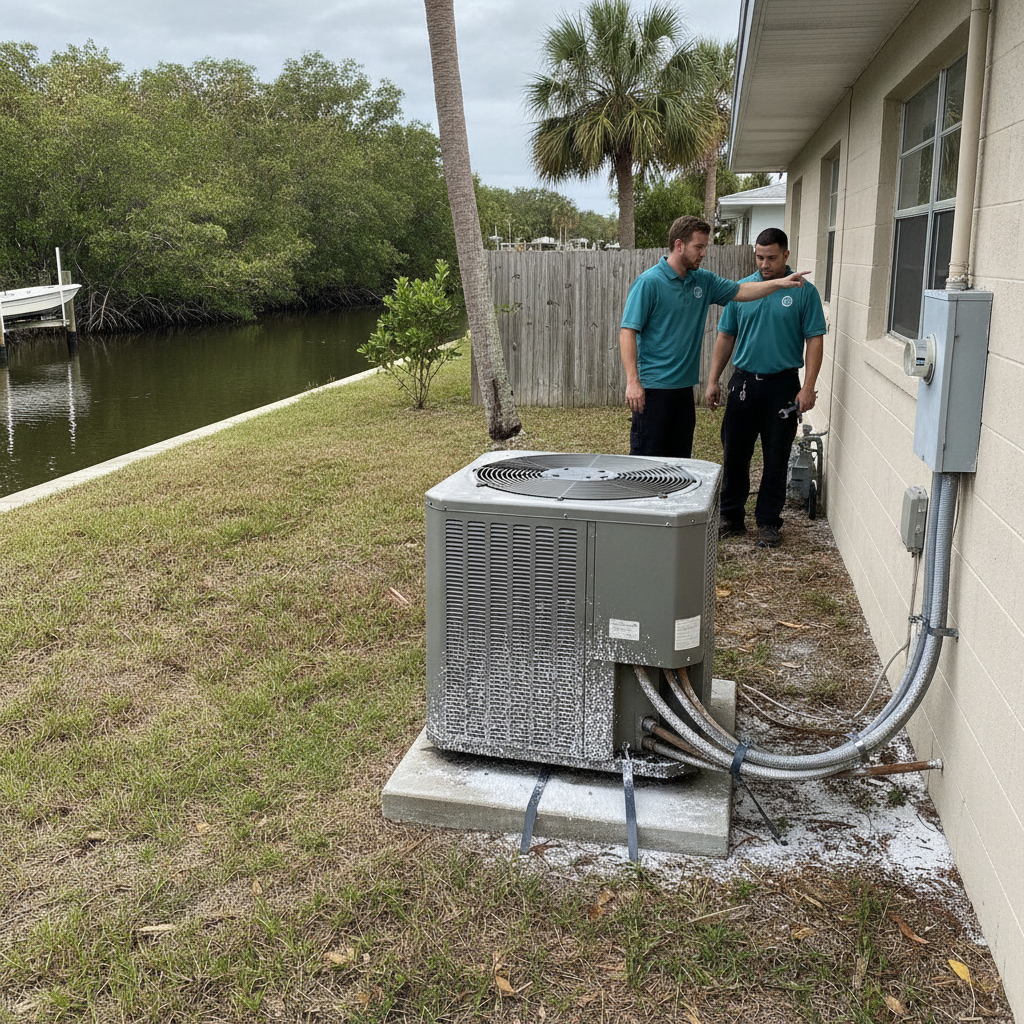
The condenser on a canal-front ranch in Charlotte Harbor has been sitting in salt spray since Hurricane Ian made landfall nearby in September 2022. Plenty of those machines still run. They just rattle, blow lukewarm air, or quit when a float switch opens in the closet. Asking for AC repair on this water is asking a licensed HVAC contractor to read that unit, the pad it sits on, and the drain it dumps into.
A condenser that has lived on the harbor since Ian
Charlotte Harbor sits at the mouth of the Peace River, where the storm that still shapes this county came ashore. The Atlantic hurricane season runs from June 1 to November 30, and the peak is September 10. Ian landed in September as a Category 4 near this harbor. Insurance-driven replacements have been working through the county ever since. The wider Charlotte and Sarasota storm picture lives on our emergency AC after a storm page. This page stays on the harbor address.
Walk a slab ranch off Harborview, or along the basins toward Punta Gorda, and you still see original pads with a unit that was stood back up, rinsed, and switched on. The fan cage is a little oval. The windward fins are packed with white salt crust. The disconnect box has been wet. The system cools on a mild morning and falls behind by mid-afternoon.
That pattern is mechanical. A bent fan blade throws the motor out of balance, so the outdoor unit shakes and the bearings wear. Salt on the coil fins closes the gaps the air is supposed to pass through, so the refrigerant cannot reject heat the way the factory designed. The compressor runs longer. Head pressure climbs. The house never quite dries out.
Indoor air tells on the outdoor unit. A closet air handler that sat in humid air after the storm often grew a film on the coil and in the drain pan. Supply air picks up that smell and the humidity the coil is no longer wringing out. If the house feels heavy even when the thermostat is satisfied, the pairing is usually a stressed condenser and a dirty indoor coil, the same pairing we see in indoor air quality work in Port Charlotte.
None of that is a reason to open the refrigerant circuit yourself. EPA Section 608 requires a certified technician to maintain, service, repair, or dispose of equipment that could release refrigerant. Rinsing the outdoor coil from the outside with a garden hose, changing the filter, and swapping thermostat batteries are the honest homeowner limits. The sealed system, the high-voltage disconnect, and any brazing belong to the licensed contractor we send.
AC repair services in Charlotte Harbor start with that outdoor machine. A capacitor, a contactor, a fan motor, or a drain can bring a harbor unit back. A cabinet that has rusted through at the base, a compressor that has been sitting in water, or a coil that will not hold a charge is a different conversation, and it still belongs to the same licensed pro.
Salt, surge, and a slab ranch on a canal
Charlotte Harbor’s housing stock is mostly block-ranch and canal-front, the same pattern as Port Charlotte and the older streets in Punta Gorda. Slab on grade. Air handler in a closet or a garage. Condenser on a pad a few feet from the seawall. After surge, that pad is often no longer level. The unit sits in a puddle every time it rains. The crankcase and the electrical compartment stay damp.
A flooded pad does a few specific things. Water wicked into the control board corrodes traces until a call for cooling does nothing. A contactor that sat wet welds itself closed, so the compressor hums after the thermostat is satisfied, or it pits until it will not pull in at all. Insulation on the line set wicks water. Then the suction line sweats into the wall chase, and the closet smells like a boat bilge.
Salt is slower and more certain. Aerosol off the harbor settles on the aluminum fins and the steel cabinet. The fins oxidize and close. The cabinet rusts at the base, then at the fastener holes. Coated or marine-grade condenser coils are the recommendation this far into the salt, because a bare coil on a canal lot works in a harsher bath than a unit two miles inland in Deep Creek. We cannot honestly pin a year-count on a coastal unit. We can say the harbor unit works harder, for more of the year, in worse air.
Humidity is the other half of AC service in Charlotte Harbor. A canal house in August is a moisture load as much as a heat load. If the system short-cycles because the outdoor coil is choked, it never runs long enough to dehumidify. Rooms feel cold and clammy instead of cool and dry. A clogged condensate line makes it worse. Algae and dust build in the PVC, the pan fills, and the float switch opens. The indoor unit stops on a safety. The house climbs through the 80s while the thermostat still shows the set point.
Snowbird houses along the harbor add a seasonal twist. Closed from April to November, thermostat on a setback, indoor coil sitting wet. The first cool-down in November often trips the float or blows musty air until a licensed tech clears the drain and cleans the coil. That is not a mystery failure. That is what happens when a Gulf-coast system sits idle through the wet months and then gets asked to pull a closed-up house down in one afternoon.
Harbor lots also share their air with the water. Mangrove debris, grass clippings, and fine salt all land on the same coil face. A unit screened by a fence still breathes that mix. If the grass crew blows clippings at the condenser every week, the fins load from the bottom up and the fan starts dragging. The licensed tech who knows this water looks there first.
What a licensed tech checks on the first visit
The contractors we send are licensed and insured. Florida lets a homeowner confirm that on the DBPR license search by name, city, or license type. Class A and Class B air-conditioning contractors are the residential classes in F.S. 489.105(3). We match you with one of those pros. We do not pull the permit, we do not own the truck, and we do not open your system.
On a Charlotte Harbor first visit, the licensed tech starts outside, because that is where Ian and the salt live. They look at the pad and the cabinet. A unit sitting crooked stresses the compressor mounts and can oil-log a corner of the crankcase. A rusted base means the next hard rain puts standing water on electrical parts that were never meant to sit wet. They look at the fan. A cage bent in 2022 still throws the blade. A blade that wobbles takes out the motor. A motor that hums and will not spin often traces to a capacitor that has lost its ability to give the compressor and fan a starting kick. That is a common, bounded repair. It is also a part that fails more often on a unit that has been heat-soaked and salt-sprayed for years.
They look at the coil fins and the airflow path. If the windward face is a solid white crust, no amount of thermostat tapping will make the house dry. A careful rinse from the outside can help a homeowner between visits. A tech with the right comb and cleaner can open fins that a hose will not. They look at the electrical. Burn marks at the disconnect, a whip with cracked insulation, a contactor face that is pitted: those are harbor signatures. Indoors they check the drain, the float switch, the filter, the blower wheel, and the evaporator coil. A tripped float is why a lot of afternoon “the AC died” calls on this water are actually a drain, not a compressor.
If the diagnosis points past a part and toward a changeout, that work is mechanical. Florida’s small-project building-permit exemption does not apply to electrical, plumbing, structural, mechanical, or gas work, so a replacement is permitted at any price. In Charlotte County, a residential mechanical permit covers replacement of heating and air conditioning equipment at a residential location. The qualifications the county lists for that permit include Certified HARV Class A, Certified HARV Class B, Certified Mechanical, Registered HARV Class A, Registered HARV Class B, Registered Mechanical, and Owner-Builder. The pro we send pulls that permit. A notice of commencement is required before the first inspection when the direct contract is greater than $15,000. That notice rule does not apply to a direct contract to repair or replace an existing heating or air-conditioning system in an amount less than $15,000.
For most AC repair visits, you are not in permit territory. You are in capacitor, contactor, drain, fan motor, and coil-clean territory. When the compressor is grounded, the cabinet is gone, or the coil will not hold a charge, the conversation moves. Heat pumps are this metro’s usual replacement, because one system handles the long cooling load and the occasional cool snap. That is a different job, and it is still the licensed contractor who performs it.
If the house is hot at night and the unit is silent, that is the moment to ask for emergency HVAC service. We answer the line and match you with a licensed contractor.
Why does the AC run but the house still feels sticky?
A system that short-cycles on a canal lot never runs long enough to pull moisture out of the air. Salt-clogged outdoor fins raise head pressure, the high-pressure control cuts the compressor, the house warms a few degrees, and the cycle repeats. Inside, a dirty evaporator coil or a blower that cannot move air across the coil leaves the same clammy rooms. The thermostat can read the set point while the humidity stays high. A licensed tech measures supply temperature, looks at the outdoor coil, and checks the drain and the indoor coil before anyone talks about a new system.
What should I do if the AC is not working in Punta Gorda or Charlotte Harbor?
Change the filter, confirm the thermostat is on cool, and check that the breaker has not tripped. Look at the outdoor unit from the yard. If the fan is still and the compressor is humming, leave it off and call. If water is under the air handler, the float switch has likely opened on a full pan, and more runtime only makes a mess. Do not add refrigerant, do not reset a breaker that immediately trips again, and do not take the disconnect apart. Call us and we will get a licensed HVAC contractor out to the harbor address or to a nearby Punta Gorda street.
When to call us
Call when the condenser on a Charlotte Harbor canal lot is noisy, the house will not dry out, the float keeps tripping, or the system has not been right since 2022. That work needs a licensed HVAC contractor, not a weekend with a hose and a hope. Call us at (941) 292-6250.