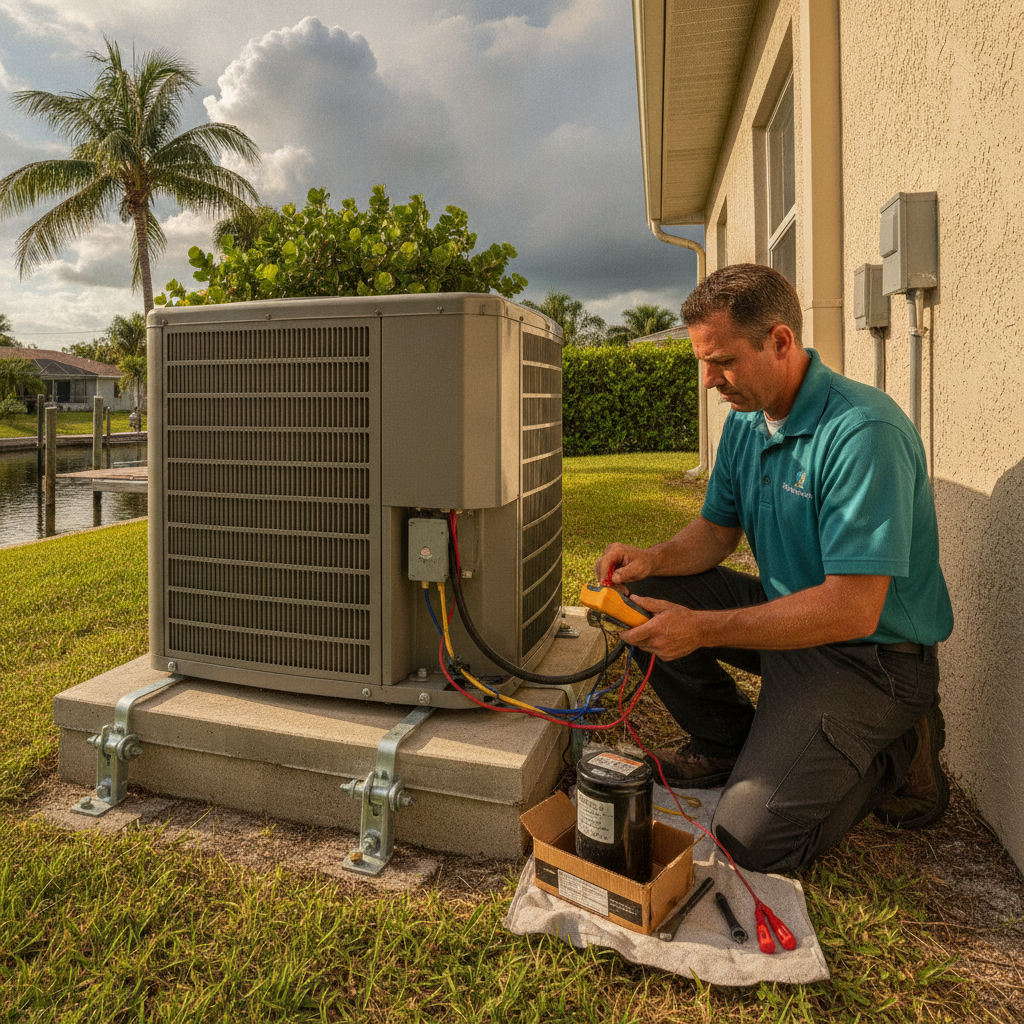
The outdoor unit clicks, then hums, and the fan just sits there. On a still August afternoon in Englewood that is often a capacitor that can no longer shove the compressor and fan motor into a start. After an $89 to $150 diagnostic, most AC repairs in this footprint, parts and labor, land between $150 and $650, and a capacitor swap usually belongs in that repair bucket, not a full system changeout.
The click, the hum, and a fan that will not spin
A capacitor is a small metal can in the outdoor electrical compartment. It stores a charge while the system sits idle, then dumps that charge when the thermostat calls for cooling. That jolt is what gets a heavy compressor and a salt-stiff fan spinning. Once they are moving, a run capacitor keeps the electrical field turning so the motor does not bog down and cook its windings.
Many condensers around Englewood, Venice, and Port Charlotte use a dual run capacitor: one can, two jobs. One side feeds the compressor. The other feeds the condenser fan. A separate start capacitor, when the unit has one, is only in the circuit for the first moment of spin. If either side of a dual can is weak, you get a half-alive machine. The fan turns and the compressor never loads, or the compressor groans and the fan never moves.
You hear it before the house feels it. The contactor pulls in. The cabinet buzzes. The blade may twitch and stall. Supply air drifts from cool to room temperature, then warm. A weakening capacitor also makes the motor pull extra current, which is why a breaker on a Port Charlotte ranch can start tripping on a still afternoon. The unit may shut off before the set point, then try again a few minutes later.
Heat is what finishes these parts. The can lives in a metal box on the sunny side of the house, inches from a coil that has been dumping attic heat all day. Put that box on a canal-front lot in Placida or on Manasota Key, and Gulf salt sits on the cabinet while the electrical compartment stays hot and damp. After Hurricane Ian’s September 2022 landfall near Charlotte Harbor, a lot of outdoor electrical gear that looked intact still ran poorly: a surge, a loose whip, a can that bulged and never held a charge the same way.
A Venice snowbird house closed from April to November stresses the same part differently. The first call for cooling in fall is a hard start after months of sitting in a hot cabinet. In North Port, a Wellen Park condenser is newer stock, but the outdoor heat load is the same. A replacement can that does not match the microfarad rating printed on the old label will fail for the same reason the last one did.
A swollen top, rust at the terminals, or an oily film on the side is a physical tell. The useful test is still a meter on the can against the rating on the label, plus a look at whether the compressor or fan is already drawing like it is in trouble. A humming unit is not always the capacitor. A seized fan motor or a compressor that is on its way out can wear the same sound as a system that will not turn on.
What a capacitor swap costs versus a missed diagnosis
A capacitor swap is a repair, not a changeout. In this footprint the published range for an AC repair diagnostic is $89 to $150. After that, most AC repairs, parts and labor, run $150 to $650. That is a market range for typical AC repair work here, not a quote for your house and not a promise the brand makes.
The part is small. The bill moves with everything around it. A dual can that feeds both the compressor and the fan is a different piece than two separate cans. A condenser shoved against a fence on a Rotonda West lot takes longer to open than a unit with clear sides. If the fan motor already seized and took the capacitor with it, you are no longer paying for a can alone. If the compressor has been humming against a weak start for days, the windings may already be damaged, and the conversation shifts from a repair to what a compressor failure costs or to a full changeout.
That is the expensive miss. A capacitor that cannot start the compressor leaves the motor pulling locked current while the house climbs through the afternoon. Leave it like that on a Dearborn Street cottage with original 1960s ductwork still dumping cool air into a hot attic, and you can cook the one part that is not cheap. A full system replacement, condenser and air handler on a single-family home, runs $5,500 to $12,000 installed in this market. A standard split sits in the $5,500 to $8,500 band. That is a different job, and it is the one you are trying not to buy because a $20-looking can went ignored in August.
| Path | What actually happens | What usually drives the bill |
|---|---|---|
| Capacitor swap | The contractor tests the can, matches the rating on the label, and replaces it | Cabinet access, a dual can versus separate parts, and a second failed motor |
| Broader AC repair | The same visit finds a fan motor, contactor, or another electrical part | Stacked parts, not a bigger capacitor |
| System changeout | Condenser and air handler both get replaced on a single-family home | Age, heat damage, and which county issues the mechanical permit |
After-hours and holiday dispatch is a different bucket. Emergency dispatch and diagnostic in this footprint runs $200 to $450, with holidays at the high end of that range. That is the after-hours diagnostic, not a capacitor price, and it does not change what the daytime repair range looks like.
If the diagnosis really does turn into a changeout, the address starts to matter in a way a capacitor swap never did. ZIP 34223 on the Sarasota County side of Englewood and ZIP 34224 on the Charlotte County side send the mechanical permit to different building departments. Boca Grande and Palm Island are reached through Charlotte County but they are not Charlotte County addresses; they sit in Lee County. None of that changes the physics of a bad can. It changes the paperwork if someone skipped the capacitor and jumped straight to AC installation.
HVAC maintenance is how a drifting can gets caught before the August failure. A tune-up visit here runs $89 to $150, less on an annual plan. The contractor can read capacitance against the label while the system is open, which is a quieter way to spend that money than waiting for the hum.
Why this is not a parts-store DIY on a live disconnect
The capacitor holds a charge after the thermostat is off and after the breaker is off. That stored energy is enough to shock you, and a screwdriver across the terminals is not a homeowner skill. The honest homeowner-side limits on this work are a filter change, a thermostat battery, a breaker reset, and a garden-hose rinse of the outdoor coil. The disconnect, the whip, and the can itself are not in that list.
Matching the part is the other trap. The replacement has to match the microfarad rating and the voltage rating printed on the old can, and the wires have to go back on the correct terminals: common, fan, and herm for the compressor. A can from the parts drawer that is “close enough” will overheat a motor or fail on the first hard start. A licensed HVAC contractor discharges the stored charge, labels the leads, seats a matching can, and then checks amperage on the compressor and fan so the new part is not covering for a motor that is already gone.
Warm air in a closed-up Venice house is easy to misread as a refrigerant problem. Adding charge will not spin a fan that has no start torque, and opening a sealed system is not homeowner work. EPA Section 608 certification is what governs who may maintain, service, repair, or dispose of equipment that could release refrigerant. The contractors we send are licensed and insured for the air-conditioning work. You can confirm a Florida air-conditioning contractor through the DBPR license search by name, city, or license type before anyone opens the panel.
The Atlantic hurricane season runs from June 1 to November 30, with most activity between mid-August and mid-October. That is the stretch when these outdoor cans run the hardest, when a Port Charlotte unit that took wind in 2022 is most likely to hum instead of start, and when a missed capacitor diagnosis turns into a compressor you did not budget for.
Common questions
How do I know if my AC run capacitor is bad?
The outdoor unit hums after the thermostat calls, and the condenser fan does not come up to speed, or the fan spins and the air still comes out warm because the compressor never loaded. A bulged or leaking can is a visible tell. The confirmation is a capacitance reading against the rating on the label, done by a licensed HVAC contractor, because a seized fan motor and a failing compressor can make the same noise.
Can I replace an AC capacitor myself?
The can holds a shock after the power is off, the replacement has to match the ratings on the old label, and a humming unit is often more than the capacitor. A wrong can, or a can that hides a locked compressor, is how a small electrical part turns into a burned motor. Leave the disconnect and the can to the licensed HVAC contractor we send.
How long do capacitors last in this climate?
There is no honest calendar number for a can that lives in a hot outdoor box on the Gulf. Heat inside the electrical compartment, long run hours from June through October, storm-related voltage hits, and salt on waterfront cabinets in Placida, Cape Haze, and Boca Grande are what wear them down. A maintenance visit is how a pro sees a can drifting out of spec before the first failed start of the season.
How long does it take to replace a capacitor on an AC unit?
The swap itself is a short electrical job once the diagnosis is done, the matching can is on hand, and the stored charge is discharged. The visit stretches when the fan motor failed with the capacitor, when the compressor is drawing like it is locked, or when the outdoor unit is boxed in by screening on a golf-course lot. The time worth protecting is the hours you do not run a humming compressor while you wait.
When to call us
When the outdoor unit hums and the fan will not spin, or the air goes warm on a still afternoon, that work belongs to a licensed HVAC contractor, not a parts-store swap on a live disconnect. We’ll match you with a licensed and insured pro who can test the can, check the motors it serves, and replace the capacitor if that is actually the failure. Call us at (941) 292-6250.