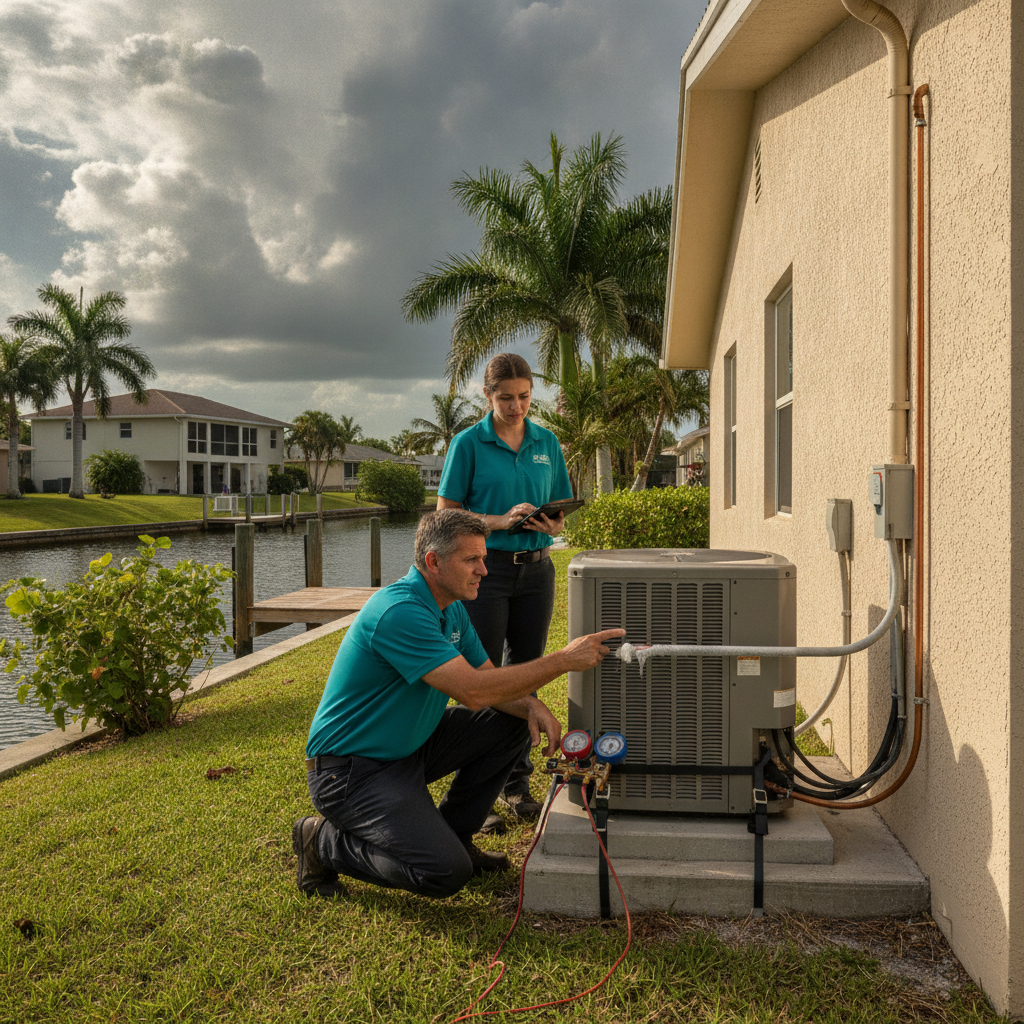
The fan is running. Air is moving. Your hand at the supply vent still feels like the hallway. That means the blower is doing its job while the cooling cycle isn’t. On this stretch of the Gulf coast, from a Dearborn Street cottage to a Wellen Park build, that split is the whole diagnosis. The air is warm because heat never left the house, not because the fan quit.
Warm air vs weak air
Strong, steady airflow that feels warm is not the same problem as a faint puff that never gets cold. Warm air with good volume means heat isn’t leaving the house. Weak air means the house isn’t getting enough of whatever the system is making.
An air conditioner doesn’t manufacture cold. It moves heat. Indoor air crosses a cold evaporator coil. Refrigerant in that coil picks up the heat. The compressor pumps that heat outside, and the condenser dumps it into the yard. The blower then pushes the stripped-down air back through the ducts. If the blower runs while that heat-moving loop is stopped, you get room air at the grille. If the loop is working but air can’t cross the coil, you get a weak stream, and the coil can ice over.
A clogged filter is the usual airflow story here. Gulf humidity loads a filter with dust and pollen, the coil starves, and the indoor unit starts making ice. Ice feels like cooling until it blocks the coil, and then the vents go lukewarm. A failing blower does the same thing from the other side: the wheel turns too slowly to pull air across the coil. On a 1960s cottage near Historic Dearborn Street, original ductwork can leak attic air into the supply, so even a working coil delivers a tepid mix by the time it reaches the bedroom.
Warm air with a healthy whoosh points somewhere else. The outdoor fan and compressor have to run or the indoor coil never gets cold. A tripped breaker, a dead capacitor, a failed contactor, or a compressor that won’t start all leave the indoor fan circulating uncooled air. Low refrigerant does it more quietly. The coil never gets as cold as it should, so the air at the vent is only a little cooler than the room, then not cooler at all.
| What you feel at the vent | What usually broke |
|---|---|
| Strong airflow, clearly warm | Cooling loop stopped: heat mode, outdoor unit off, compressor not pumping, or a refrigerant leak |
| Weak airflow, barely cool or room temp | Airflow problem: dirty filter, iced coil, tired blower, or leaky original ducts |
| Outdoor unit silent, indoor fan on | Power or starting parts at the condenser, not a low-air problem |
That table is the first fork. It keeps you from treating a heat pump in heat mode like a refrigerant job, and it keeps you from ignoring an iced coil because the fan still sounds busy. If the house isn’t cooling even when the grille feels a little cool, that broader stall is the pattern in why an Englewood AC stops cooling. Warm air at the grille is narrower: the system is moving air and not taking heat with it.
Heat-pump mode vs a failed compressor
Most replacement work in this metro now goes to a heat pump, because one outdoor unit handles the long cooling season and the occasional cool snap. That also means AC blowing warm air is sometimes the system doing exactly what the thermostat asked. Heat mode on a heat pump runs the same outdoor unit in reverse. The indoor coil gets warm on purpose. The air at the vent is supposed to feel like heat.
Check the thermostat before you assume a compressor died. Cool, not heat. Fan on Auto, not On. Set point below the room temperature. A snowbird house in Venice that sat closed from April to November often comes back with last season’s heat setting still in the controller, or with a dead thermostat battery that leaves the display looking fine while the call for cooling never goes out. A thermostat that won’t hold a cooling call can run the fan and nothing else.
A reversing valve that sticks is the mechanical version of the same mistake. The outdoor unit runs, the pipes are doing something, and the air inside is still warm because the refrigerant is flowing the wrong direction. That’s a licensed repair, not a setting.
A failed compressor is a different sound and a different backyard. The indoor blower runs. The outdoor fan may spin. The compressor itself is silent, or it hums and trips the breaker. Without that pump, refrigerant doesn’t circulate, the indoor coil stays near room temperature, and every vent blows warm. A bad run capacitor or a welded contactor can look identical from the hallway: indoor air moving, outdoor unit not actually pumping. Those parts are why a diagnostic visit exists. Most AC repairs after that diagnostic land in the $150 to $650 range for parts and labor. The diagnostic itself is $89 to $150. Those are market ranges for this footprint, not a quote. A compressor that’s gone can push the conversation toward a condenser and air handler changeout, which for a single-family home here sits in the $5,500 to $12,000 installed range, not a small part swap.
Don’t treat a silent outdoor unit as a DIY compressor job. The starting circuit is high voltage. Refrigerant work is a federal line: EPA Section 608 says the person who maintains, services, repairs, or disposes of equipment that could release refrigerant has to be certified. Adding charge through a hose isn’t a homeowner fix, and it won’t hold if the leak is still there.
On a canal-front lot in Placida, salt crust on the condenser fins can also fake a dead-compressor story. The outdoor fan runs, the compressor runs, and the unit still can’t dump heat because the coil is blanketed. The air inside goes lukewarm, then warm. That’s a coil and airflow problem at the outdoor unit, and Gulf salt does it faster than inland yards. A condenser that took wind damage when Hurricane Ian made landfall near Charlotte Harbor in September 2022 can still spin a fan and never pump heat the way it did.
What you can check without tools
You can settle the cheap, safe questions from the hallway and the backyard. None of this opens a refrigerant circuit or a high-voltage panel beyond a single breaker reset.
Look at the thermostat first. If it says heat, you found it. Switch it to cool, drop the set point a few degrees below the room, and set the fan to Auto. Fan On keeps the blower moving even when the compressor is off, which is how a lot of people get a steady stream of warm air with no cooling. Give it a few minutes. If cool air returns, you’re done.
Pull the filter. A packed filter in August in Rotonda West is a common reason the indoor coil ices. If it’s gray and felted, replace it. If you already see ice on the copper suction line or frost on the air handler cabinet, turn the system off at the thermostat and let it thaw. Running it while the coil is a block of ice just makes more ice. A frozen coil is an airflow or charge problem wearing a cold disguise. Once it’s thawed, a clean filter and a restart tell you whether airflow was the whole story. If ice comes back, stop. That’s either a still-blocked return or a refrigerant problem, and both belong to a licensed HVAC contractor.
Walk outside. The condenser should be running when the thermostat is calling for cool: fan spinning, a low mechanical sound from the compressor. If the backyard is quiet while the indoor fan is loud, look at the outdoor disconnect and the breaker that feeds the condenser. Reset a tripped breaker once. If it trips again, leave it off. That’s an electrical fault, not a nuisance trip. Clear leaves, mulch, and storm debris from around the cabinet. The Atlantic hurricane season runs from June 1 to November 30, and after a Gulf blow a Port Charlotte condenser can sit half-buried in yard waste and still try to run.
Don’t hose the electrical end of the unit. A gentle rinse of the fins, from the outside in, is the homeowner limit when salt and grass are caked on. Don’t bend the fins. Don’t spray the air handler. Don’t pull the service caps on the refrigerant valves.
If the house has no utility power, the AC can’t cool. Lights on inside with a dead outdoor unit is the split to notice: the air handler can still have a circuit while the condenser doesn’t. A generator that isn’t sized or wired for the outdoor unit produces the same warm indoor air. That’s a power path problem, not a low-refrigerant problem.
What a tech checks first
The licensed HVAC contractor we send starts with the same fork you just walked, then measures what you can’t see. They confirm the thermostat call, the indoor blower, and whether the outdoor unit is actually in the cooling circuit. They read the capacitor, the contactor, and the compressor current. They look at coil temperature and static pressure, not just whether air is moving.
If the charge is low, they look for the leak before anyone talks about adding refrigerant. A system that’s down on charge won’t stay fixed with a top-off. On older R-410A equipment, service is still legal. New residential systems face a different federal limit as of January 1, 2025, under the AIM Act Technology Transitions rule: new systems using a regulated refrigerant with a global warming potential of 700 or greater may still go in only when every specified component was made or imported before that date. That changes what gets installed on a replacement. It doesn’t make your existing system illegal to own or to repair.
If the indoor coil is dirty, or the outdoor coil is salt-packed, cleaning is often the repair. That work lives under HVAC maintenance, where a tune-up visit runs $89 to $150. A neglected coil in a closed-up Venice house, or a condenser that’s sat through two summers on Manasota Key, is a maintenance failure long before it’s a compressor failure.
If the compressor is dead, or the coil is eaten through, the conversation shifts to AC installation. A standard split system in this market is $5,500 to $8,500 installed. A higher-efficiency variable-speed system is $9,000 to $12,000. A heat pump, the usual recommendation here, is $6,000 to $14,000 installed. Those are market ranges, not a quote. A changeout is mechanical work, so it’s permitted work at any price. Englewood straddles the county line: ZIP 34223 goes to Sarasota County, ZIP 34224 to Charlotte County, and the contractor we send pulls the permit from the right building department. Boca Grande and Palm Island are reached through Charlotte County, but they aren’t Charlotte County addresses, so their permit path is different again.
Heat-pump repairs sit in the same $150 to $650 band as most AC repairs when the compressor is still good and the reversing valve, capacitor, or leak is the actual fault. You can confirm the contractor is licensed through Florida’s DBPR license search. The contractors we send are licensed and insured. Refrigerant work stays with someone who holds the federal certification for it.
Should I turn off the AC if it is blowing warm air?
Turn it off if you see ice on the lines or the indoor coil, if the outdoor breaker keeps tripping, or if you smell a hot electrical odor. Running a system that can’t dump heat cooks the compressor and grows ice on the evaporator. If the only issue is heat mode on the thermostat, switch it to cool and leave it running. If you aren’t sure which one you have, off is the safer pause until a licensed HVAC contractor looks at it.
Why is my AC blowing lukewarm air?
Lukewarm air is usually a coil that isn’t getting as cold as it should, not a blower that stopped. A dirty outdoor coil with salt crust, a filter that’s starting to choke the return, a heat pump whose reversing valve isn’t fully seated, or a slow refrigerant leak all land in that in-between range. On leaky original ducts in an Old Florida cottage, attic air mixes in and the bedroom grille never feels as cold as the air handler. Lukewarm is the early warning. Waiting until it goes fully warm is how a repair becomes a coil or a compressor.
How do I reset an AC that is not blowing cold air?
Reset the thermostat first: cool, Auto, set point below the room. Replace the batteries if the display is dim or dropping calls. Reset a tripped condenser breaker once. That’s the whole homeowner reset. There’s no magic button on the outdoor cabinet that recharges refrigerant or frees a stuck reversing valve. If the breaker trips a second time, or the air is still warm after a filter change and a correct thermostat setting, the next step is a diagnostic, not another reset.
Why is the indoor fan running if the power looks like it is on?
The indoor air handler and the outdoor condenser often sit on separate breakers. Lights in the house, and even a spinning blower, don’t prove the condenser has power. A storm, a surge, or a failed capacitor can kill the outdoor circuit while the indoor fan keeps circulating whatever air is in the ducts. That’s why the backyard check matters. If the condenser is silent during a cooling call, the cooling loop is off no matter how normal the hallway feels.
When to call us
Call when the air at the vent stays warm after the thermostat is on cool, the filter is clean, and the outdoor unit has been checked from the yard. Ice, a breaker that won’t hold, a silent condenser, or a heat pump that heats on a cooling call all need a licensed HVAC contractor, not another reset. We match you with a licensed and insured pro for the diagnostic and the repair. Call us at (941) 292-6250.