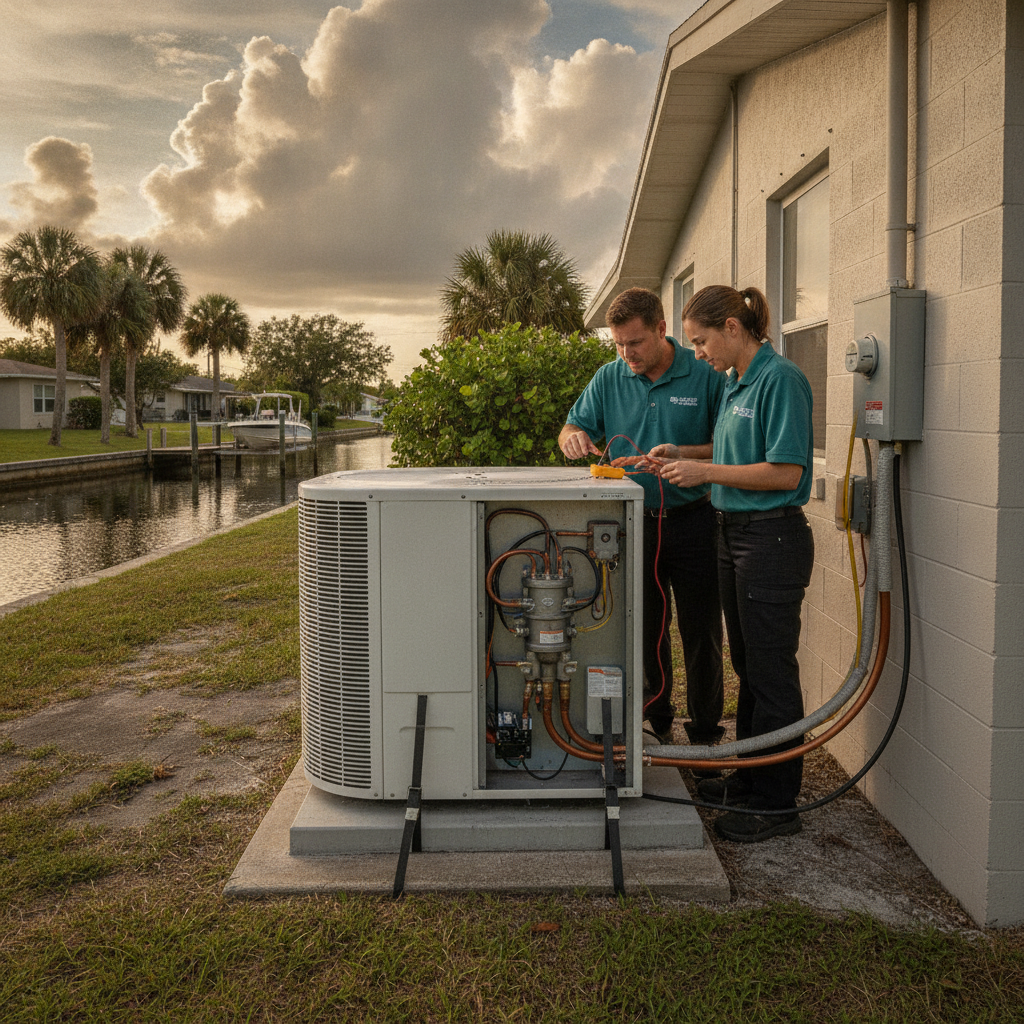
The first real cold front of the year is when a lot of Englewood heat pumps get found out. Cooling ran through the whole rainy season without a complaint. Then you set the thermostat to heat, the outdoor fan starts, and the air at the registers still feels like the hallway.
That split, cooling works and heating does not, is the classic reversing-valve and mode-control pattern on this coast. The rest of this page is what that feels like, how it differs from a normal defrost or from failed heat strips, and what a licensed HVAC contractor actually checks on the call.
Cooling works, heat does not
A heat pump that still cools in August and blows room-temperature air in January has not lost a furnace. It is a machine that moves heat in two directions, and one direction is stuck.
In cooling, the outdoor coil dumps heat and the indoor coil absorbs it. In heating, a reversing valve flips that path so the indoor coil is the warm side and the outdoor coil is the cold side. If the valve stays in the cool position, or the thermostat never sends the heat call, you get a system that looks busy and still leaves the house cold.
This is the week it shows up here. The National Weather Service Tampa Bay area office publishes the Punta Gorda and Sarasota-Bradenton climate records, and they tell the same local story every winter: long stretches where nobody asks the heat pump to heat, then a handful of nights when it has to. A snowbird house in Venice that sat closed from April to November, thermostat on a deep setback, meets that first front with a reversing valve that has not moved in months. A year-round ranch in Port Charlotte does the same thing after a summer of nothing but cool.
Feel the supply air, then feel the return. If both are about the same temperature while the outdoor unit runs on a heat call, the blower is moving air and the refrigerant circuit is not delivering heat. If the outdoor unit is silent on a heat call, the problem is upstream: thermostat, mode, breaker, or a control that never started the outdoor machine.
A short stretch of cooler air can be defrost, covered below. Hours of cool air with the outdoor fan spinning is not defrost. That is a failed heat mode.
Leaking original ductwork in a 1960s cottage near Historic Dearborn Street can make even a working heat pump feel weak, because the warm air never reaches the rooms. Weak heat in every room, with a warm supply at the air handler, is a duct problem. Cool supply at the air handler is a heat-mode problem. The AC repair diagnostic is how a licensed contractor sorts those two apart. If you already know the failure is on the heating path, heat pump repair is the matching service.
Reversing valve vs defrost vs strips
Three different parts can leave you cold, and they do not feel the same.
| What you notice | Likely part | Why it behaves that way |
|---|---|---|
| Cooling still works. Heat never arrives. | Reversing valve stuck in the cool path | The refrigerant never changes direction, so the indoor coil stays the cold side. |
| A short cool blast, frost on the outdoor coil, then the house recovers | Defrost doing its job | The system briefly warms the outdoor coil, then should return to heat. |
| Cool air that does not end, outdoor coil that stays glazed | Defrost control, sensor, fan, or airflow | The thaw never finishes, so the outdoor coil cannot pick heat back up. |
| Outdoor unit runs, the house still drops on the coldest night, emergency heat does nothing | Heat strips or the air-handler heat circuit | The backup elements never came on. |
The reversing valve is a refrigerant-path switch, usually on the outdoor unit, moved by a solenoid. When it sticks in the cooling direction, summer still works. Winter does not. Gulf salt air on a condenser in Placida, Cape Haze, Manasota Key, or Boca Grande is hard on that outdoor assembly: the coil, the cabinet, and the valve body all live in the same spray. Boca Grande and Palm Island are reached through Charlotte County and sit in Lee County, so the permit path is different if this call turns into a changeout. The symptom to remember is simple. Cooling is fine. Heating never arrives.
Defrost is the heat pump briefly flipping back toward cooling so it can warm the outdoor coil. On a damp January morning in Punta Gorda, a light frost on that coil is normal. The indoor vents can blow cooler air for a short run while that happens. Then the valve should flip back to heat and the house should recover. If the outdoor coil stays glazed, the fan cannot turn, or the indoor air stays cool for a long stretch, the defrost control is not finishing its job. Restricted airflow from a packed filter or a coil buried in leaves will also keep that coil wet and cold. Rinse debris off the outdoor cabinet with a garden hose. Change the filter. Leave the sealed refrigerant circuit alone.
Heat strips, the electric resistance elements in the air handler, are the backup. They carry the house when the pump cannot keep up, and they often run during defrost so you do not feel that cool blast. On this coast they work a few nights a year. If they are open, the air handler may blow, the outdoor unit may run, and the house still drops on the coldest night. A useful observation, not a repair: if you switch the thermostat to emergency heat and the air at the vents turns clearly hot, the strips work and the outdoor heating path is the failure. If emergency heat is also cool, the air handler side is in the picture, including the strips, the blower, and the heat call from the thermostat.
None of this is a reason to open the outdoor electrical disconnect or to add refrigerant. EPA Section 608 is the federal rule for who may service equipment that could release refrigerant. The licensed contractor we send holds that work.
What a tech checks
A licensed HVAC contractor starts with the call the thermostat is actually making, not with a guess at the valve.
They confirm the thermostat is in heat, not cool, and not an auto setting that never left cooling on a warm afternoon. They check batteries, wiring at the air handler, and whether the outdoor unit is receiving a heat call. A thermostat that will not switch modes can mimic a dead reversing valve for a full morning.
Then they watch the refrigerant circuit change direction. Line temperatures and gauge readings tell them whether the reversing valve moved. If it did not, they test the solenoid and the signal that drives it. If it did, they look at defrost: sensors, control board, outdoor fan, and whether the coil can actually thaw. Heat-strip circuits get a separate check at the air handler, because a failed strip leaves you hanging on the one night you needed it.
Airflow is on that same visit. A packed filter, a dirty indoor coil, and leaky attic ductwork in an older Englewood cottage all cut delivered heat. HVAC maintenance is how those get caught before the cold front. A maintenance visit is published at $89 to $150, less on an annual plan. Heat pump repairs after diagnosis typically land in the $150 to $650 range for parts and labor. Those are market ranges for this footprint, not a quote for your house.
If the outdoor unit is down to a compressor, a valve body, or a coil that salt air has already eaten, the conversation can shift to replacement. Heat pumps are the default system in this metro because one machine carries the long cooling season and the short heating season, which is the case we already make in why heat pumps are the default here. When repair is not the honest path, the contractors we send handle the changeout through AC installation. Installed heat pump work is published at $6,000 to $14,000 for this footprint.
A changeout is mechanical work. Florida’s $7,500 permit exemption does not cover mechanical work, so the pro we send pulls a mechanical permit at any price. On a Charlotte County address, that is the county’s residential mechanical permit for replacement of heating and air conditioning equipment. Englewood ZIP 34223 goes to Sarasota County. ZIP 34224 goes to Charlotte County. Same street grid, different building department.
Refrigerant work stays with a technician certified under EPA Section 608. A leak can starve heating mode and leave a coil glazed with frost. Nobody should add charge from a can.
Common questions about a heat pump that will not heat
Why is my heat pump blowing cold air when the heat is on?
Short bursts of cooler air during defrost are normal. The outdoor coil needs a thaw, so the system briefly runs the other direction and the indoor vents feel cooler until it flips back. Hours of cool air, with the outdoor fan spinning and no recovery, is a stuck reversing valve, a defrost control that never ends, or a thermostat that is not actually in heat. Emergency heat that turns the supply clearly hot points at the outdoor heating path. Emergency heat that stays cool points at the air handler, the strips, or the heat call itself.
How do you reset a heat pump?
Set the thermostat to off and wait a few minutes. Put it in heat, not auto, and raise the setpoint enough that it has to call. If the display is blank, replace the batteries. Check the indoor breaker and the filter. Those are the honest homeowner limits. If the system starts, runs, and the vents are still cool, stop. Do not pull the outdoor disconnect, and do not open the refrigerant circuit. Call for a licensed HVAC contractor.
What is the most common reason a heat pump stops heating?
This metro does not have a published failure ranking, and a page that invents one is guessing. The pattern on this coast is more useful than a ranking. Cooling runs for months. Heat is asked to work for one week. A reversing valve that has not moved since last January, a defrost board that never gets exercised, and heat strips that sit unused until the coldest night are the failures that match that calendar. Low refrigerant and a filthy outdoor coil can starve heat too, and salt air on a waterfront condenser in Placida or on the keys makes the outdoor side the harder-working half of the system.
People also ask about a twenty-degree rule. That is field slang for the gap between return air and supply air, not a code rating and not a number this page can pin as a spec. What a tech actually wants to see is the pattern: in heat, supply should feel clearly warmer than return. If both feel the same while the outdoor unit runs, the system is moving air and not heat.
When to call us
When cooling still works and the house will not warm on a heat call, the reversing valve, defrost controls, and heat strips are licensed HVAC work. Same if the outdoor coil stays glazed with frost, emergency heat does nothing, or you hear or smell something new at the air handler. Call us at (941) 292-6250. We’ll get a licensed and insured HVAC contractor out to you.